

Product piracy
Plagiarius 2023 negative prize awarded
On February 3, 2023, the Plagiarius campaign awarded the dreaded Plagiarius negative prize to manufacturers and retailers of particularly brazen counterfeits and fakes for the 47th time.
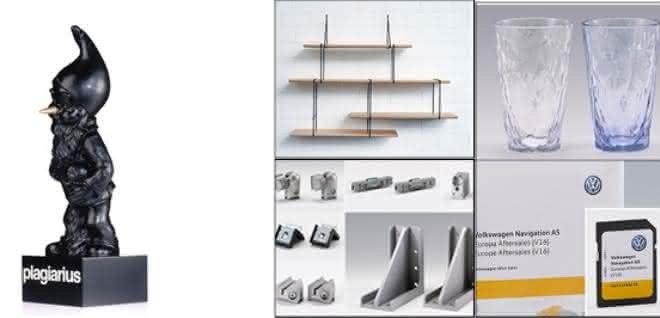
The 'Plagiarius' negative award was presented at a press conference at the Frankfurt consumer goods fair 'Ambiente'. The Plagiarius award says nothing about whether the counterfeit product is legally permitted or illegal. Rather, the aim of the Plagiarius campaign is to raise public awareness of the unscrupulous business methods of product and brand pirates and to sensitize industry, politics and consumers to the problem.
You can find all the award winners here in the picture gallery
Before the annually changing jury selects the winners, the alleged plagiarists are informed of their nomination and given the opportunity to comment. The jury's aim is not to brand legitimate competitor products, but rather to take a critical look at clumsy 1:1 imitations that deliberately look confusingly similar to the original product and show no creative or constructive contribution of their own. Fortunately, this year one of the imitators once again sought an agreement with the original manufacturer and withdrew the remaining stocks of counterfeit products from the market. The trophy of the Schmähpreis is a black dwarf with a golden nose. The latter symbolizes the immense profits that unimaginative imitators literally make at the expense of creative and innovative companies.
Global and digital distribution, professional and criminal structures behind it - product and brand piracy is a lucrative billion-dollar business, also for organized crime. Anyone who deliberately buys counterfeits supports the devastating structures: counterfeit products and fakes are often produced under inhumane working conditions and cause damage to innovative manufacturers and authorized retailers, sometimes threatening their very existence. The majority of cheap copies pose serious health, safety and environmental risks. This makes it all the more worrying that more and more influencers on TikTok & Co. are explicitly promoting counterfeit designer goods, trivializing the purchase of illegal products and positioning fakes as socially acceptable. In the interests of society as a whole, the importance of and respect for the intellectual property of others should be part of every curriculum.
The power of the consumer
According to the European Intellectual Property Office (EUIPO) and the European Commission, around 86 million counterfeit goods were seized in the EU alone in 2021, an increase of almost 31% compared to 2020. And these are just the proven seizures, i.e. the tip of the iceberg. The EUIPO and OECD put the international trade in counterfeit goods at an alarming 412 billion euros in 2019, which corresponds to 2.5% of global trade.
The greater the demand, the greater the success of the counterfeiters. (Purchasers) buyers therefore have the power, but also the social responsibility, to deprive counterfeiters of their business basis. And this is in their own best interests. Although counterfeit goods are available in all price and quality gradations, most are only deceptively similar to the original at first glance. The fact that an identical appearance does not automatically mean the same quality, performance and safety is proven by many products that customs and Interpol have already withdrawn from circulation: Contaminated perfumes and cosmetics, technical products with faulty electronics, faulty or contaminant-rich children's toys, incorrectly or not at all dosed medicines and much more. The VDMA, the German Engineering Federation, also confirms that counterfeit products often pose a risk to machine and plant operators or pose a risk to the safe operation of the plant.
Responsibility of the trade
Anyone wishing to sell products must ensure that they comply with the health, safety and environmental standards applicable in the sales territory and that the products are free from third-party rights relating to brands, designs, patents or copyrights. Even an extensive, frequently changing product range does not exempt those responsible for purchasing from these inspection obligations. Careful selection and evaluation of suppliers as well as regular quality and safety checks are essential. Discounters and large retail chains in particular often lure customers in 'Robin Hood' style with promises such as 'beautiful design, affordable for everyone'. There is nothing wrong with this, as long as it is an original design and the 'affordable' argument is not at the expense of creative designers and quality. A fair win-win situation would be, for example, a license agreement or a commission for the designer.
Generation Z
With astonishing naturalness, young consumers are demanding attractive new products at ever shorter intervals - available 24/7 and preferably for next to nothing. Originality, provenance and quality do not play the biggest role for everyone. More than one in three young Europeans (37%) between the ages of 15 and 24 have intentionally bought counterfeits, according to the 'Youth Barometer 2022 on Intellectual Property'. According to the EUIPO, this represents a more than doubling in the last three years. Counterfeit clothing, shoes, accessories and electronics are particularly popular. The main arguments are the low price and high availability. The EUIPO is concerned about the significant increase in social acceptance of counterfeiting and indifference to the problem. One reason for this is the increasing success of so-called 'dupe influencers'.
'Dupe influencers' show fake designer and luxury products in videos on Instagram, YouTube and TikTok and recommend them to their young, easily influenced followers. As supposed 'role models', they change their perception of counterfeits. They legitimize the sale of infringing items and trivialize the purchase of such items as cool and acceptable. With their behavior, they not only promote a culture of 'more appearance than reality', but above all a culture of disrespect for brands and the development work behind quality products.
In light of these developments, Aktion Plagiarius welcomes a current initiative by the EUIPO to make intellectual property more tangible for schoolchildren using easy-to-understand teaching materials. The aim is to educate young people to become responsible digital citizens who develop respect for their own ideas and the ideas of others. Intellectual property includes any intellectual achievement that presents itself in a unique new work - be it fashion, a product design, a technical solution, art or a cultural piece.
Digital trademark infringements require digital protection strategies
According to Europol, counterfeit products are increasingly being advertised and distributed via e-commerce platforms, social media and instant messaging services. And the forms of digital brand infringements are becoming increasingly diverse - from classic plagiarism, counterfeiting and copyright infringements to domain theft and brand abuse (e.g. fake AdWords) to complete identity theft and fake stores. A great deal of criminal energy is used to exploit the reputation and expertise of renowned manufacturers and weaken their brands and credibility.
For companies, this means that it is no longer enough to simply register industrial property rights in all relevant markets. Digital trademark infringements require digital protection strategies. These include a well-thought-out domain portfolio, AI-supported online monitoring to detect and remove infringing offers and the use of seals of approval for authorized online retailers.
In order to define uniform and binding rules for the internet, the EU adopted the Digital Services Act (DSA) in 2022. Among other things, this provides for consumers to be reliably protected from illegal content and counterfeit products and for brand owners to be better able to defend their intellectual property. Clear rules for law enforcement must now be laid down when transposing it into national law.


You might also be interested in
German industry under pressure
Industry association cancels growth forecast
The Federation of German Industries (BDI) believes that German industry remains under pressure and expects stagnation instead of growth. At the same time, the association is emphasizing the industry's innovative strength at the Hannover Messe.
 read more...
Why eleven federal states are calling for the use of low-emission steel in the automotive industry
Heads of federal states put pressure on Brussels: Eleven German federal states appeal to the EU to promote low-emission steel in the automotive industry more strongly. The German Steel Federation supports the initiative as an important lever for...
read more...Setting the course for Germany's technological future
The Federal Cabinet adopted the microelectronics strategy today. Germany wants to become a leader in microelectronics. The Federal Government's new strategy: bundling topics such as research, skilled workers and production in order to strengthen...
read more...European elections FSK 16
Good news: over the past 20 years, voter turnout in European elections in Germany has risen continuously - from 43.0% to just under 64.8% recently. I like the idea of allowing young people aged 16 and over to participate in politics in the form of...
read more...Democracy project
Many people are taking to the streets these days because they are fed up with right-wing hatred and populism. Industry is also aware of its social responsibility. "Transformation as the project of the century" is the title of a paper published...
read more...Artificial intelligence in Germany
Microsoft invests 3.2 billion euros in AI infrastructure
Microsoft has announced the largest investment in its 40-year history in Germany to accelerate the possibilities and benefits of artificial intelligence (AI) in the country.
read more...Plagiarius 2024 negative prize
On January 26, 2024, the Plagiarius campaign awarded its dreaded "Plagiarius" negative prize for the 48th time to manufacturers and retailers of particularly brazen counterfeits and fakes.
read more...100 years of Conrad Electronic
One hundred years of change
Conrad Electronic celebrated its centenary on June 21, 2023 with a gigantic event in the spirit of change. 400 high-ranking guests from business and politics as well as long-time Conrad companions were invited to the logistics center in...
read more...Loss of competitiveness?
The major associations BDI, VDMA and ZVEI are calling for more efforts to ensure that Germany remains competitive on an international level.
read more...