

Makers in Motion
Growth course under a new name
SKF Motion Technologies had been invited, but the stand at Motek was emblazoned with a different, as yet unknown name in the new leading color sun yellow: Ewellix. The linear technology division of the SKF Group, which was sold at the end of 2018, is now following its own course under a new name. To mark the renaming, handling spoke to Ewellix CEO Daniel Westberg at Motek about the background and future plans.
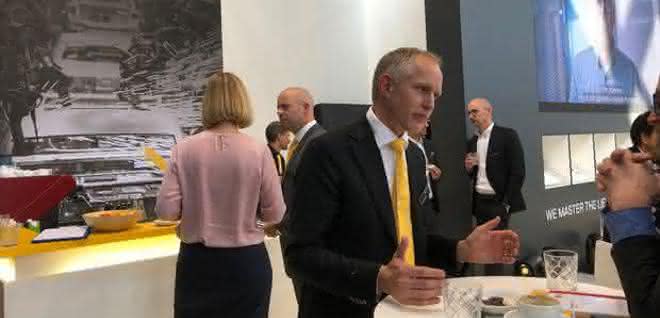
handling: Mr. Westberg, why Ewellix?
Daniel Westberg: Ewellix: Makers in Motion, which is the full name, expresses the values of our company: Commitment, Collaboration, Agility or in German: Engagement, Zusammenarbeit und Bewegigkeit. It was a lengthy process in which our employees were also heavily involved. A total of 80 names were involved. In the end, Ewellix came out on top. A name with which we also stand out in the competition.
handling: Since December 3, 2018, Ewellix has been owned by several investment funds managed by Triton Investments Advisers LLP. What are the effects of the separation from SKF and the new ownership structure?
Daniel Westberg: There are two questions. First of all. We can now focus much better on the tasks ahead and our three most important sectors: Medical Technology, Industry and Mobile. As an independent company, we can now respond even better to the needs of our customers. The new owner, Triton Partners, in turn, is very keen for us to grow significantly. We currently have 1400 employees. The aim is to increase this number. We are currently looking for engineers in particular so that we can continue to grow.
handling: But the signs are pointing to a crisis.
Daniel Westberg: You have to look closely at where the problems lie and what the causes are. In the case of automation, the reason is that China is weakening at the moment. But things are looking much better in other markets.
handling: What trends do you see that will counteract the crisis?
Daniel Westberg: For example, we are working on replacing fluid technology with electromechanical solutions. Electromechanics is clearly superior to hydraulics and pneumatics in most respects, regardless of whether you look at performance, environmental compatibility, complexity or cost.
handling: You are indeed showing new actuators at the stand. But the purchase price of an electromechanical system is still higher than that of a hydraulically operated system?
Daniel Westberg: That's a somewhat simplistic view. The decisive factor is the costs over the entire life cycle of a system and the additional costs are amortized very quickly. The new CASM and LEMC actuator series that we are showing here at Motek make this very clear once again: we have developed the CASM series, for example, for demanding applications in automated high-speed and large-scale production. These actuators can replace pneumatic cylinders in existing production systems. They have a modular design and are available in all standard sizes and can be operated with different motor types.
The new actuators in the LEMC series are designed for applications with higher loads and use a planetary roller screw instead of a ball screw. This gives the actuator a higher power density than conventional designs and makes it less sensitive to strong vibrations from the operating environment.
handling: Finally, let's talk about Germany's key industry, the automotive industry. What are you planning here in the area of handling and assembly?Daniel Westberg: The automotive industry is in a transition phase with the disappearance of the combustion engine. Flexibility and adaptability are now crucial: every plant today should be able to produce several models on a single production line - regardless of whether they are SUVs or electric vehicles. We also want to help speed up changeover times. Ewellix has developed flexible car transfer units (CTUs) to support users in this. Manufacturers have used these positioning systems to convert their assembly lines up to 85 percent faster than conventional solutions: They can be integrated into the production line and put into operation in less than two weeks. dsc


You might also be interested in
Plagiarius 2024 negative prize
On January 26, 2024, the Plagiarius campaign awarded its dreaded "Plagiarius" negative prize for the 48th time to manufacturers and retailers of particularly brazen counterfeits and fakes.
 read more...
Ivalua honors winners of the Generative AI...
AI-supported "add-ons" for buyers within 48 hours
Ivalua, provider of cloud-based spend management solutions, announced the winners and innovations of the first Generative AI Innovation Cup. The competition took place in December 2023. It was open to all Ivalua partners and employees - more than...
read more...Efaflex celebrates 50 years of high-speed...
The emphasis is on "fast"
Since day one, Efaflex has wanted to use new technologies as early as possible and drive progress in the industry. This year, the family business is celebrating its 50th anniversary under the motto "Fast Forward".
read more...Security of supply even during power outages
In the winter of 2022, Germany was worried about energy shortages. The drugstore retailer dm did not paint any horror scenarios, but nevertheless saw the possibility of controlled, temporary, regional power cuts (brownouts).
read more...Safety technology in mechanical engineering
Modules with new functions
Euchner's product highlights at EMO 2023 include the communication-capable solenoid interlocks.
read more...Transforming the paper industry towards climate neutrality
Together with partners from industry and research, Voith is developing a project for the optimization of energy and material flows in paper production. The aim of the research project is to develop a digital framework that enables effective process...
read more...Up to 95 percent less flue gas thanks to direct extraction
The requirements for occupational safety measures and safety technology are also constantly increasing in welding technology. The Technical Rules for Hazardous Substances (TRGS) stipulate that welding fumes and harmful substances must be extracted...
read more...Competitive advantages with large machines
Whether 3D-printed components for machines and systems, prototypes or aids for design: additive manufacturing is almost indispensable for modern companies in mechanical and plant engineering and automation if they want to play in the premier league.
read more...Transport technology from the modular system
Many transport tasks can be realized with the help of linear technology. Pre-configured solutions are available to simplify the interaction between the linear unit, motor, gearbox and controller. This minimizes the effort required for research and...
read more...