

Industrial robots
Sales increase by 29 percent worldwide
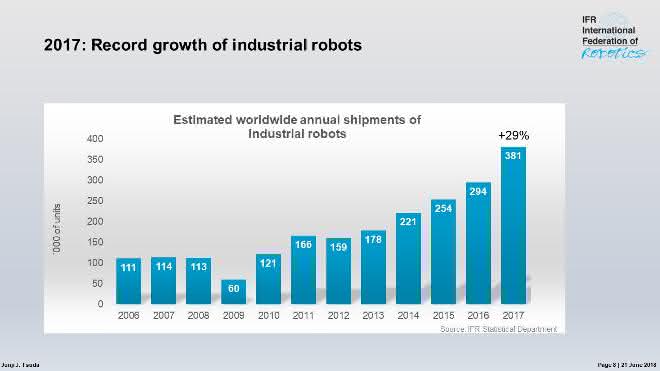
Global sales of industrial robots reached a new record of 380,550 units in 2017. This is an increase of 29% compared to the previous year (2016: 294,300 units). China recorded the highest growth in demand for industrial robots with an increase of 58%. In the USA, sales rose by 6% and in Germany by 8% compared to the previous year. These are the initial results of the Robot World Statistics 2018 published by the International Federation of Robotics (IFR).
Broken down by industry, the automotive industry continues to lead the global demand for industrial robots with the largest volume: around 125,200 units were sold in this segment in 2017 - a growth of 21%. The strongest growth sectors in 2017 were the metal industry (+54%), the electrical and electronics industry (+27%) and the food industry (+19%).
Strongest growth in Asia
In terms of sales volume, the strongest individual markets are in Asia: China installed a total of around 138,000 industrial robots in 2017, followed by South Korea with around 40,000 units and Japan with around 38,000 units. In America, the USA is the largest single market with around 33,000 industrial robots sold and in Europe it is Germany with around 22,000 units sold.
"The growth of industrial robots is continuing at an impressive pace worldwide," says Junji Tsuda, President of the International Federation of Robotics. "Key trends such as digitalization, simplification and human-robot collaboration will have a decisive impact on the future and continue to drive this rapid development."
Human-robot collaboration enables new production processes
In the course of digitalization, real production is becoming ever more closely networked with the virtual world of data, opening up completely new possibilities for analysis - including machine learning. Robots will acquire new skills through learning processes. At the same time, the industry is working on simplifying the handling of robots. In future, industrial robots will be easier and faster to program using intuitive processes.
This type of technology is not only interesting for established users, but also for small and medium-sized companies, for example, which can use it to introduce automation without the need for particularly experienced specialist personnel. This development also paves the way for the third major robotics trend: human-robot collaboration without safety fences offers new concepts for new flexible production processes. In the future, human-robot collaboration will support the flexible production of small quantities with high complexity.


You might also be interested in
Intelligent brownfield networking
Many industrial companies are struggling with established plant structures and proprietary interfaces. Stefan Klaus' presentation will show in a practical way how brownfield environments can be efficiently networked with open technologies and made...
 read more...
Factory-X in practice
How can set-up processes in highly variant production be automated efficiently? Markus Benndorff from soffico shows how Factory-X, industrial data rooms and modular architectures create new possibilities for flexible production concepts.
read more...Mechanical engineering | Case study
Cordless in brush production
The machine manufacturer Wöhler Bohemia is integrating wireless HMI panels from Keba into its brush production systems. The background to this is the need for flexibility, robotics integration and new market strategies.
read more...International product approvals as a strategic competitive advantage in the global market
Which certificates are valid worldwide? Christian Latte, Head of Technical Compliance and Approval Officer at Hummel AG, explains this in an interview. He provides insights into product approvals and explains why early approval strategies shorten...
read more...Foundry modernizes plant park with continuous wire belt shot blasting system
The Spanish foundry Funosa is modernizing its equipment fleet with an RDGE 1250 wire belt continuous shot blasting machine from Rösler. Focus: sand removal from heavy iron castings, energy efficiency, ease of maintenance and ESG strategy.
read more...How bridging steps, stairs and catwalks are changing processes in production and logistics
At Logimat 2026, Munk Günzburger Steigtechnik will be showcasing modular bridging steps, stairs, platform and walkway systems for production, warehousing and logistics. With online configurators, distances can be efficiently shortened, processes...
read more...Drilling cycles optimized
A new replaceable head drill from Walter can reduce machining time in series production thanks to its patented interface and screwless design.
read more...Production, metalworking, robots
Precise 5-axis machining
The new Kern Fortis HD five-axis machining center will provide manufacturing companies with high precision requirements with a new machine from 2026.
read more...Agentless remote access to industrial plants
TeamViewer is expanding its Tensor enterprise platform to include "Agentless Access", enabling secure remote access to industrial systems without the need for local software installation.
read more...