

Company and Corona
Small, specialized companies respond successfully
The coronavirus pandemic has affected German companies in very different ways. According to a Hays study, small, specialized companies in particular have been successful.
The coronavirus pandemic has affected German companies in very different ways. While six percent even rate their current economic situation as very positive, almost two-fifths speak of a rather negative situation. Seven percent are in a massive crisis, according to a survey of 750 decision-makers conducted by the market research institute Rheingold together with Hays AG. Industrial companies are particularly affected: For 54 percent, their situation is negative, while only 42 percent in the service sector see it the same way. On the one hand, it is much more difficult for manufacturing companies to comply with social distancing regulations on a day-to-day basis. IT service providers, on the other hand, were often able to send their employees to work from home without any problems. Secondly, the automotive sector, as a leading industry, was already undergoing a major upheaval before coronavirus, which is now leading to even greater uncertainty. Due to the high complexity of their supply chains, mechanical engineering companies cannot adapt so quickly. Instead, they are taking advantage of the current lower capacity utilization to optimize processes and quality.
Developing action plans together

This was also the case at Glaub Automation & Engineering GmbH in Salzgitter. Starting in March, all 66 employees developed action plans in teams over the course of two months in the "risk assessment" workshop together with an external coach. The main focus was on how they could make their day-to-day work less stressful in future. For example, the quality manager's office is now in a more central location so that everyone involved can communicate more directly with each other. "It was important to us that we implement the feasible suggestions quickly," says Managing Director Andrea Glaub, who runs the family business together with her sister Claudia and her husband Niko. Continuations of the workshop are planned: On the one hand, the aim is to check whether the measures implemented are actually an improvement. On the other hand, the process will continue. "We are interested in good working conditions and that the employees are involved in this development," says the person responsible for marketing, sales and quality management.
Like 47 percent of German companies, the automation specialist has applied for short-time working for its workforce. Some areas are still going well, says the 43-year-old business administration graduate, such as switch cabinet construction in electrical production or IT development, even if employees are not yet allowed to visit all the plants. However, the general crisis is having an impact on construction and mechanical production. "There is a lack of orders and when we have orders, we sometimes lack material," she notes. The Hays study makes it clear that a third of the manufacturing industry is experiencing this: supply chains and sales markets have collapsed for them. However, Andrea Glaub believes that her company is fundamentally well positioned thanks to increasing automation and digitalization: "We want to break even by the end of the year."
Further qualify employees
Companies are thinking ahead and relying on their own skills. "It is very likely that companies will lay off employees in the coming months," she suspects. This will primarily affect low-skilled staff. A team has therefore drawn up a training concept over the past few months: The further training in three modules, each with 121 hours, is in place. Firstly, it is intended for production assistants who have had nothing to do with robotics and automation so far. They will then be taught the basic concepts and receive initial practical training. "We will implement this with one or two training providers," says the Managing Director happily. She also wants to offer other companies further training for their specialists in robotics in the future and respond specifically to their needs. "If that works, we will be developing an additional business area with further training."
New ways in sales

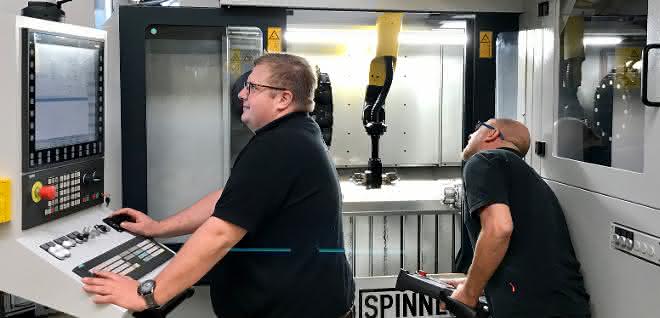
"We will achieve a very good result this year," predicts Dominik Jauch. This is because Spinner Automation is still working through a large order backlog, including a fully automated machine with a batch size of one. The Swabian company has therefore not had to resort to short-time working for its 60 employees. However, the 41-year-old managing director and engineer finds the current order situation difficult: "I'm not worried about the company, but it's unclear whether we can keep all of our employees." He believes that the small and flexible company fits in well with the times. Because business cycles are getting shorter, customers are no longer thinking in terms of large, long-lasting machines. The investment risk is too high for them. "We can provide digitalized and automated solutions that precisely meet customer needs," says Jauch confidently.
That's why Spinner Automation is breaking new ground in sales, sitting down with potential customers in a workshop: On the one hand, they understand the customer's problem better; on the other hand, the automation specialist can suggest solutions that the customer has not thought of, based on the experience of 50 projects a year. Discussions with designers, programmers and fitters lead to further results. According to the study, specialists such as Glaub or Spinner are obviously becoming more interesting for German industry again. Hays CEO Dirk Hahn summarizes: "What the crisis has taught many companies is to achieve more security and minimize dependencies." Almost two thirds of the managers surveyed want to strengthen the production of central products or services in their own company. Furthermore, 62% of those surveyed want to return to local proximity to important suppliers, whether in Salzgitter, Markgröningen or another corner of Germany.


You might also be interested in
Humanoid robotics from Germany
Igus launches service robots for everyday industrial use
Humanoid robotics: With the Iggy Rob Home, igus presents a service robot for industry and everyday life. What's behind it.
 read more...
New sales and service unit in Gurugram
Yamaha Motor expands robotics business in India
Yamaha Motor is opening a new Robotics Business Support Division in India to strengthen sales and service in the growing robotics market. The unit will support SMT systems and industrial robots, among other things, and will be complemented by a...
read more...Robotics and autonomous order picking
Locus Robotics acquires Nexera Robotics and expands autonomous warehouse logistics
Locus Robotics takes over Nexera Robotics and may have taken a decisive step towards truly universal warehouse automation. A new gripping technology should now make possible what was previously considered difficult to automate.
read more...Factory planning without compressed air...
How vacuum becomes mobile
Modular factories, mobile robotics and rising energy prices are fundamentally changing automation. One solution: into the future without compressed air. Electric vacuum systems reduce costs, save energy and support flexible manufacturing and...
read more...A robot for all occasions
Industrial robots take on many tasks. Even milling with accuracies in the sub-millimeter range is now possible.
read more...Why stator and rotor laminations are becoming a performance factor
Why the future of robotics depends not only on software, but also on high-precision stator and rotor laminations inside the motor.
read more...Infineon Startup Challenge 2026
Focus on humanoid robotics
Infineon brings together young deep-tech companies worldwide to drive innovation in humanoid robotics. The focus is on hardware and system solutions from sensor technology to motor control. Applications are still possible until May 27, 2026.
read more...Synergy in the special machine
Highly automated production line for scaffolding standpipes sets standards in efficiency and process reliability
How is one of the most modern scaffolding tube production lines in Europe created? At MJ-Gerüst, a fully networked high-tech line produces six finished standpipes every 60 seconds. With automation, robotics and precision technology from Schunk. How...
read more...Quality controls in production
Robots check car floor pans fully automatically
How can complex components in automotive production be inspected fully automatically and in real time with the help of machine vision and robotics? The case study shows how floor pans are measured and inspected fully automatically.
read more...