

Festo board member Dr. Frank Melzer
New head of the steering committee of the Industry 4.0 platform
Festo board member Dr. Frank Melzer takes over as head of the steering committee of the Industry 4.0 platform for the digitalization of the economy in Germany. He replaces SAP board member Bernd Leukert. The handover took place on December 4, 2018 at the Digital Summit in Nuremberg.
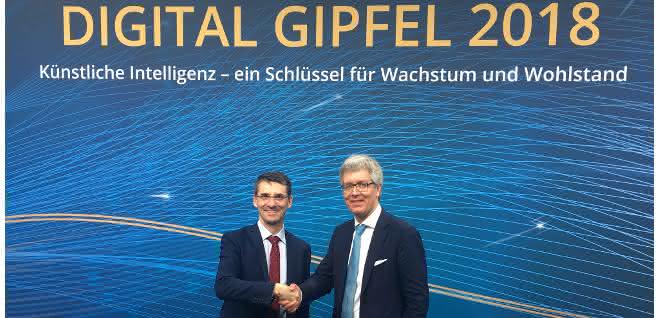
Dr. Frank Melzer has been a member of the Management Board of Festo AG & Co. KG since 1 October 2017. Dr. Melzer, who holds a doctorate in mechanical engineering, is responsible for Product and Technology Management, which includes the Digital Business and Corporate Research and Innovation divisions.
"I am looking forward to taking over the chairmanship and would like to thank Mr. Leukert for his successful work over the past two years. He has led the steering committee with dedication and made a significant contribution to the success of the platform, particularly through the promotion and implementation of innovative test centers for companies," said Dr. Frank Melzer. "During my term of office, I would like to focus on technology development. In particular, the further development of decentralized, autonomous systems and artificial intelligence, which provide us with excellent tools for optimizing industrial production processes in the future. Another focus will be the qualification and further training of skilled workers. After all, digitalization is driving skills change in our society faster than any industrial change before."
Festo has been involved in the research advisory board and several working groups since the Industry 4.0 platform was founded. The experts are primarily involved in the topics of reference architectures, standards, security of networked systems and qualification.
Administration shell for Industry 4.0
Among others, Dr Michael Hoffmeister, Executive Expert in the Digital Business division at Festo, was significantly involved in the concept of the administration shell in the "Reference architectures, standards and standardization" working group of the Industry 4.0 platform. The paper "Details of the Administration Shell" was published at the SPS IPC Drives trade fair in Nuremberg at the end of November. The Administration Shell is so important for Industry 4.0 because it abstracts the devices and other assets and enables their data and other functionalities to be accessed in a standardized and controlled manner. An asset can be a single sensor or an entire production line. The asset administration shell describes the asset using submodels that complement each other. Each sub-model represents a specific aspect, such as documentation or technical data.
The Industry 4.0 platform
The Industry 4.0 platform is the central network in Germany for advancing the digital transformation in production. More than 300 players from over 150 organizations are actively involved in the platform, working shoulder to shoulder with politics, business, science, trade unions and associations. As one of the largest international and national networks, the platform supports German companies - especially SMEs - in implementing Industry 4.0, in particular by making existing examples of Industry 4.0 practice known to companies and disseminating them. It also provides important impetus with concrete recommendations for action and refers to support services and test environments. The platform's numerous international collaborations underline its strong role in the international discussions surrounding the topic of Industry 4.0.
Digital summit
Once a year, the Digital Summit of the Federal Ministry for Economic Affairs and Energy (BMWi) is dedicated to ideas, tasks and concepts to strengthen Germany as a location for digital transformation. The theme of this year's summit on December 3 and 4 in Nuremberg was "Artificial intelligence - a key to growth and prosperity". Representatives from politics, business, science and academia discussed the challenges and opportunities of digitalization. Until 2017, the Digital Summit was still called the National IT Summit. The new title reflects the fact that digitalization affects both providers and users, from Industry 4.0 to the cultural and creative industries.


You might also be interested in
More than 900 exhibitors already registered
Around six months before the start of the trade fair, more than 900 companies have registered for SPS 2026 in Nuremberg. The trade fair focuses on industrial AI, cyber security and digital transformation.
 read more...
Virtual PLCs in practice: How vPLCs make production systems more flexible and scalable
The increasing networking of IT and OT is fundamentally changing industrial automation. The IT/OT Integration Summit shows how modern technologies can make production environments more efficient, flexible and future-proof. The event will focus on...
read more...Sales growth in a turbulent market environment
Thanks to innovations and a focus on strategic industrial markets, Sick was able to moderately increase its sales in the 2025 financial year. In a turbulent market environment, the company was able to maintain its position and gain market share with...
read more...Siemens presents new AI agent
Siemens is launching 'Eigen Engineering Agent', an AI for automation technology. The solution is integrated into the TIA Portal, has been tested with over 100 companies and is designed to significantly accelerate engineering processes.
read more...Schaeffler keeps sales almost stable
Schaeffler generated revenue of EUR 23.5 billion in 2025 and increased EBIT before special items to EUR 936 million. At 266 million euros, free cash flow was significantly above the prior year and forecast. Net income remained negative due to high...
read more...Advancing artificial intelligence together
Helukabel is stepping up its activities in the field of artificial intelligence and is now a member of the IPAI. The innovation and collaboration platform for companies, research facilities, institutions and administration has set itself the goal of...
read more...New impetus for ifm sales
Two new positions were filled at ifm at the start of 2026: Markus Wolf becomes Managing Director Sales Germany, Sven Quant takes over the position of Central Managing Director in the Process Sensors division within the ifm Group.
read more...Digital twin meets product passport
Future-proof end-to-end solution at SPS 2025
At SPS, conplement and R. STAHL will present how the digital twin works end-to-end along the entire value chain: from creation and provision to productive use.
read more...Changes in the management of Endress+Hauser
Endress+Hauser strengthens its management team: Mirko Lehmann, Katja Windt and Helena Svensson take on central management roles. What is changing in technology, production and personnel.
read more...