

Better tools for digital engineering
Tools and services based on the digital twin
While production is already becoming increasingly digitalized, the digital transformation of design and development is still in its infancy. Although the digital twin is now a reality, there is still a lack of an end-to-end tool chain. Lenze is working flat out to adapt and expand its tools and services in order to close this gap. The machine automation expert relies on close cooperation with OEMs.
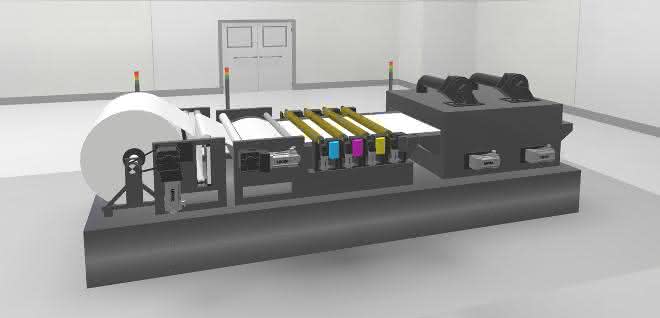
The digitalized development process enables more precise testing in an early project phase, offers support in programming the application software and paves the way for virtual commissioning. This opens up huge opportunities for OEMs: shorter development cycles with lower personnel costs and faster time-to-market because customer requirements are met from the very first draft and the defined specifications are reliably adhered to.
From isolated solutions to a tool chain
The digital twin provides the basis for such progress. This is where information about components, machines and systems is stored and passed on without breakage or even loss - through the various stages of the development process, ongoing operation and maintenance measures right up to the end of the life cycle. However, there are still too many isolated solutions in the development process that are not able to exchange data with each other at a reasonable cost. Without a consistent flow of information, however, the positive effects of digital engineering cannot be achieved. It is therefore necessary to develop a consistent tool chain based on a standardized digital twin, at least within a closed manufacturing world. Lenze has decided to take this path and get its customers on board at an early stage. The company sees digital engineering as one of the most important innovation drivers for the industry, which will determine the topics of the future.
Further and new developments
The starting point for development at Lenze is the familiar tools, such as the Lenze FAST application software toolbox. In addition, there are new applications that are developed specifically with digital engineering in mind. The "InA" concept provides the starting point. This allows an OEM to configure and parameterize an application from mechatronic machine modules and generate the software automatically. With the help of VR or Hololens glasses, a virtual machine can be displayed as an augmented reality object in 3D, which shows simple processes in the simulation. In this way, potential errors or problems are detected at an early stage of the project and can be remedied with less effort than if they only become apparent after implementation.
The FAST Application Software Toolbox, which makes it easy to develop a modular machine control system, is being expanded into a software framework that can handle the digital twin and also forms the basis for automatic code generation. This is supplemented by tools for automated code testing, which further relieves the development department. Similar to the popular "Drive Solution Designer" tool, a new application is being created that not only covers motion control, but also the complete automation of machines.
Other tools can be used to simulate machines or systems at different levels, which place different demands on computing time and capacity: the physics of mechanics, drive technology and motion applications through to automation systems and complete manufacturing processes - in other words, not only the basic properties, but also the customer-specific design with many specific details. With sufficient computing power, virtual commissioning can already be carried out in this way.
All the necessary data can be found in the digital twin. This also provides valuable information for new OEM services and business models. With its standardized data models and formats, the data in the asset administration shell also simplifies the use of cloud applications, for example for machine learning applications and the use of big data analyses, such as those required in the IIoT. pb


You might also be interested in
ESTIA aims to strengthen Europe's cloud
New tech alliance for EU sovereignty
Twelve companies, including Dassault Systèmes, are founding the European Sovereign Tech Industry Alliance (ESTIA). The initiative aims to strengthen Europe's technological independence and define requirements for sovereign cloud services. The start...
 read more...
Deutsche Telekom and Nvidia launch one of Europe's largest AI factories
With the Industrial AI Cloud in Munich, Deutsche Telekom and NVIDIA are creating one of the largest AI factories in Europe. Companies can train AI models, carry out simulations and access 10,000 GPUs.
read more...Leveraging data potential with AI and streaming
Huge data treasures are still lying dormant in many manufacturing companies. And yet it is high time that these treasures were unlocked. There is often a lack of resources and capacity to make data usable in real time. Streaming production data can...
read more...More awareness of noise
Dematic offers solutions that are tailored to different cloud environments and reduce environmental impact through reduced material consumption and improved energy efficiency.
read more...Generative AI in the automation environment
The mechanical engineering and automation industry is undergoing profound change. This transformation is being driven by more volatile global trade, geopolitical crises and increasing market pressure, which demands greater agility, technological...
read more...Rigid data structures have had their day
The traditional data center is no longer the center of data. A hybrid cloud storage approach enables manufacturing companies to both meet the current requirements of data-intensive processes and future-proof their infrastructure.
read more...Software as a service in three stages
CIM Database Cloud is a new out-of-the-box solution from Contact for end-to-end digital product development.
read more...How production can benefit from AI
Together with AI technology, IIoT networking makes it possible to better control machine parameters and optimize quality with predictive quality. Downtimes and set-up times can also be further minimized. Cloud platforms also make these technologies...
read more...More expertise for digital engineering
Altair, a computational science and artificial intelligence (AI) company, has acquired OmniV, a technology from Michigan, USA-based software company XLDyn.
read more...