

Space mission
Swiss drives on the way to the sun
The Solar Orbiter space probe is due to be launched in February and will provide new insights into the sun. Swiss research and industry played an important role in the construction of the space probe. This includes drives from Maxon.
The European Space Agency (ESA) wants to explore the sun more closely. To this end, it is sending the Solar Orbiter space probe, which is equipped with ten instruments. Scientists hope that the multi-year mission will provide new insights into solar winds and the complex dynamics responsible for solar flares. Solar Orbiter will fly closer to the sun than its nearest planet Mercury - to around 45 million kilometers. It will be over 500 °C hot on the side facing the sun. A heat shield protects the valuable instruments on board and only allows a view of the sun during measurements.
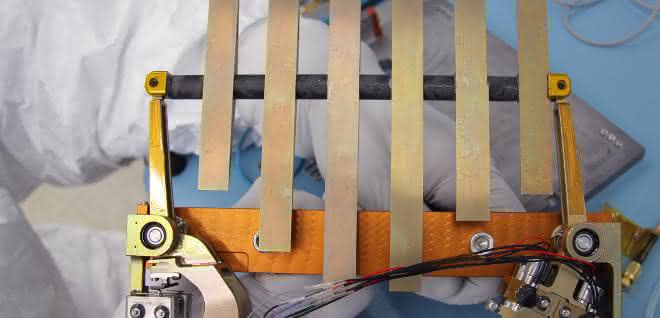
This also applies to the X-ray telescope (STIX), which is intended to examine solar flares more closely and may make it possible to predict large flares. It was developed at the School of Engineering at the University of Applied Sciences Northwestern Switzerland (FHNW) in collaboration with several Swiss industrial partners such as Almatech. Drives from Maxon are also used in the X-ray telescope. Two specially modified DC motors with diameters of 13 mm move an aluminum damping net, which is pushed in front of the 30 STIX detectors as required. The microdrives are placed in parallel and can be operated together or individually, ensuring smooth operation over the entire planned mission of five years. The design is based on micromotors that will soon be used in ESA's ExoMars rover. Low weight, energy efficiency and vibration resistance played a particularly important role in the selection of the drives.
After the planned launch at the beginning of February, Solar Orbiter will be on its way for almost two years before it can start taking measurements. The mission is scheduled to end in 2025.
From the sun to Mars
While Solar Orbiter is about to be launched, preparations are underway for the next two major Mars projects, which are due to start in summer 2020: NASA's Mars2020 rover and ESA's ExoMars rover. Both missions are intended to provide new knowledge about the Red Planet and, for example, answer the question of whether life once existed there. Mars2020 is also equipped with a small helicopter, which should prove that flights on Mars are possible despite the very thin atmosphere.
Maxon drives fulfill mission-critical tasks in both projects: For example, for the wheel drives, handling the soil samples or controlling the Mars helicopter.


You might also be interested in
Motors, gearboxes and encoders: Faulhaber expands Ø 16 mm portfolio
Faulhaber is expanding its portfolio with new DC motors from the SXR and GXR family, a 16 mm planetary gearbox and the IEX3 magnetic encoder for compact drive solutions.
 read more...
New drive solutions for industrial automation and robotics
Faulhaber presents drive solutions with the new GXR and SXR motor family, which offer high efficiency and flexibility in combination with powerful gearboxes and encoders. These optimized components open up new possibilities for applications in...
read more...Marco Altherr becomes new Chief Financial Officer
The Supervisory Board of Ziehl-Abegg has appointed Marco Altherr as the company's new Chief Financial Officer (CFO). Altherr will take up his post in May 2025.
read more...Hydrogen storage in metal hydride
With its focus on storage systems for green hydrogen in solid form (metal hydride), GKN Hydrogen presents itself as a pioneer in safety and efficiency for the industry. GKN Hydrogen offers safe storage systems for green hydrogen and focuses on two...
read more...INDUSTRIAL Production Products of the year...
2nd place, Robotics category: EGS Automation
The SUMO automation systems from EGS Automation - economical standard solutions for automating a wide range of processes in plastics and metalworking - took second place in the robotics category in the competition for Product of the Year 2024.
read more...More productivity with Drive Intelligence
The trends in automation are productivity, sustainability and connectivity. Baumüller is launching new products on the market that address these trends, including new tools for smart energy monitoring, condition monitoring in the drive and new...
read more...Intelligence in Motion
At SPS, Koco Motion will be showcasing its expertise in customized drive solutions based on DC and BLDC motors, stepper motors, servo motors, linear drives and controllers.
read more...Nomination Products of the Year 2024
EGS Automation: SUMO automation systems
The SUMO automation systems from EGS Automation, economical standard solutions for automating a wide range of processes in plastics and metalworking, have been nominated in the Robotics category in the competition for Product of the Year 2024.
read more...Transport technology from the modular system
Many transport tasks can be realized with the help of linear technology. Pre-configured solutions are available to simplify the interaction between the linear unit, motor, gearbox and controller. This minimizes the effort required for research and...
read more...