

Drive technology
Energy supply with fuel cells FC
The FC (FC Fuel Cell) as one of the most efficient electrical energy generators from primary energy sources (see http://www.gruenbuch-energieeffizienz.de) promises to revolutionize the energy industry together with wind, water and sun. This economical energy conversion is associated with high expectations regarding the reduction of greenhouse gas emissions and the conservation of limited energy resources.
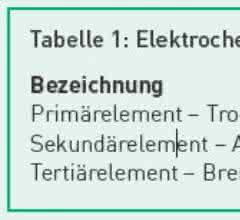
The FC - known since 1839 by the Englishman Sir William Robert Grove (1811-1896) - is one of the electrochemical energy sources (Table 1). In contrast to a battery, it supplies uninterrupted power without recharging, provided it is continuously supplied with chemical "fuel". Their useful life is unlimited. Due to their high achievable output, energy efficiency (no Carnot process) and environmental friendliness, FCs play a key role in supplying stationary and mobile consumers with electrical energy. Decentralized, environmentally friendly provision of electricity and heat from a single system (CHP) and electromobility are becoming economically viable.
Functional principle
Energy generation with the FC as a reversal of electrolysis converts gaseous or gasifiable fuels in cold combustion directly into direct current. Instead of water beingbroken down into its gaseous components hydrogen H2and oxygen O2, the FC processes both substances into water. In the process, electrical energy is extracted from the fuels (e.g. H2and O2) with the simultaneous exothermic release of heat. In the redox process, H2 is oxidizedto water H2Oor cold-burned.
2 H2(gas) + O2(gas) = 2 H2O(liquid/vapor)
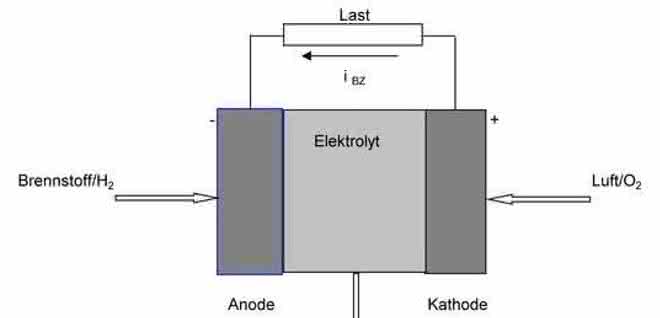
To avoid normal combustion or an oxyhydrogen reaction, H2and O2 mustnot come into direct contact with each other. For this reason, the porous electrodes are separated from each other by an electrolyte (e.g. potassium or sodium alkali). H2 isoxidized at the anode and positive H2 ions are formed. The cathode ensures O2 reduction, negative O2 ions are formed. Both processes require catalysts (metals of the platinum-iron group) with which the gas-permeable electrodes are coated. The different polarity between them leads to the DC voltage DC. It can be used as soon as both poles are connected by a circuit.
The cell/open-circuit voltage U0≈ 1.2 V decreases under load (shunt characteristic). A voltage between approx. 0.6 and 0.7 V has proven to be the optimum operating point for the individual cell. However, in order to achieve higher voltages and outputs, cells are connected in series and parallel. The resulting stack (up to > 800 cells) is stored in a container.
Theoretically, the FC releases the amount of electrical energy that was required for the electrolysis process andstored in the H2. This provides a store of electrical energy with considerable capacity. O2manages without buffering, as the majority of FCs work with air.
FC vs. conventional energy generation
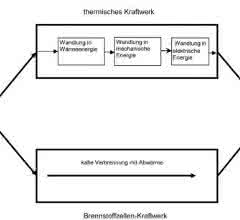
In FC, the conventional, lossy multiple energy conversion is eliminated. Therefore, efficiencies η > 65 % can be achieved (for comparison: steam power plants ≤ 50 %, CCGT plants > 60 %. Gas turbines and diesel-gas engines approx. 35 %). In addition, conventional generators are bound to minimum output values in the MW range.
Another advantage is the use of their waste heat (utilization rate of primary energy up to 90 %). In addition, the thermodynamic efficiency is highest at low operating temperatures and remains roughly constant in the partial load range.
Fuels and FC types
In addition to the energy sources H2and O2, which allow the highest efficiency in their purest form, methanol, natural gas, coal, biogas and, as an oxidant, air are also suitable. The process always requires different catalysts depending on the FC type.
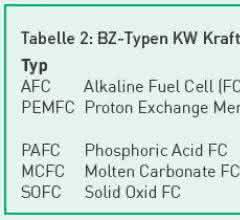
In addition to the electrolyte used, the various types differ in terms of operating temperature and fuel. There are three operating temperature ranges: low (60-90 °C AFC, PEMFC), medium (160-220 °C PAFC), high (600-1000 °C MCFC, SOFC) (Table 2).
Realizations
The maturity of FCs now allows commercially interesting projects (Table 2). They are still mainly used for testing and demonstration purposes. The core is the provision of the energy storage medium hydrogen H2. As it is not freely available in nature, it has to be produced. H2 surpluses from industry can be used, as can the electrical energy available during off-peak periods.
Economic and ecological outlook
FC technology promotes decentralized energy generation with smaller units close to the consumer. The elimination of energy transportation from large power plants also results in economic benefits. At the same time, FC favors e-mobility and the development of the necessary infrastructure, which is currently in deficit. It also supports the trend towards DC. Its use leads to a significant reduction in carbon dioxide emissions. Thanks to CHP and higher efficiency, the overall ecological balance is more favorable. FCs are superior to all conventional generators in terms of their environmental impact. Their emissions achieve significantly lower (reference) values compared to established technologies (reference value 100 %): NOx7 %, COx20 %, CHx0 %. Only FCsusing ultra-pure H2 are zero-emission systems. That is why an important part of the future is H2.
Combined heat and power generation CHP
Simultaneous generation of electricity and heat in one system. A compact small system is called a combined heat and power unit (CHP).
DC technology
Renewable generators (wind, solar with battery storage, etc.) are increasing, as are DC consumers. The conventional AC grid structure forces multiple, lossy conversion of the electricity. This reduces the overall efficiency of the energy supply to less than 60 %. In contrast, a complete DC grid (without capacitive losses, with HVDC) would alternatively achieve approx. 90 %.


You might also be interested in
Plagiarius 2024 negative prize
On January 26, 2024, the Plagiarius campaign awarded its dreaded "Plagiarius" negative prize for the 48th time to manufacturers and retailers of particularly brazen counterfeits and fakes.
 read more...
Ivalua honors winners of the Generative AI...
AI-supported "add-ons" for buyers within 48 hours
Ivalua, provider of cloud-based spend management solutions, announced the winners and innovations of the first Generative AI Innovation Cup. The competition took place in December 2023. It was open to all Ivalua partners and employees - more than...
read more...Efaflex celebrates 50 years of high-speed...
The emphasis is on "fast"
Since day one, Efaflex has wanted to use new technologies as early as possible and drive progress in the industry. This year, the family business is celebrating its 50th anniversary under the motto "Fast Forward".
read more...Security of supply even during power outages
In the winter of 2022, Germany was worried about energy shortages. The drugstore retailer dm did not paint any horror scenarios, but nevertheless saw the possibility of controlled, temporary, regional power cuts (brownouts).
read more...Safety technology in mechanical engineering
Modules with new functions
Euchner's product highlights at EMO 2023 include the communication-capable solenoid interlocks.
read more...Transforming the paper industry towards climate neutrality
Together with partners from industry and research, Voith is developing a project for the optimization of energy and material flows in paper production. The aim of the research project is to develop a digital framework that enables effective process...
read more...Up to 95 percent less flue gas thanks to direct extraction
The requirements for occupational safety measures and safety technology are also constantly increasing in welding technology. The Technical Rules for Hazardous Substances (TRGS) stipulate that welding fumes and harmful substances must be extracted...
read more...Competitive advantages with large machines
Whether 3D-printed components for machines and systems, prototypes or aids for design: additive manufacturing is almost indispensable for modern companies in mechanical and plant engineering and automation if they want to play in the premier league.
read more...Transport technology from the modular system
Many transport tasks can be realized with the help of linear technology. Pre-configured solutions are available to simplify the interaction between the linear unit, motor, gearbox and controller. This minimizes the effort required for research and...
read more...