

Automotive industry
End-of-line test system at BMW in Dingolfing
Kuka realizes a fully automated test system for end-of-line testing of the current eDrive generation.
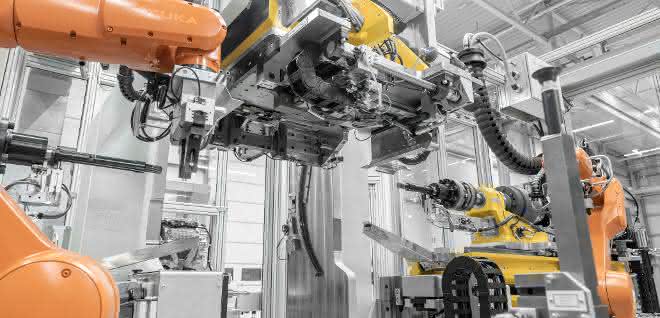
The latest generation of electrified drives is produced at the Dingolfing site, the BMW Group competence center for e-drive production. Kuka implemented a fully automated test system here for testing up to eight different drive variants.
Electrified mobility
The Kuka team of experts, based at the Bremen site, invested around two years in the design, construction and finally the successful commissioning of the eDrive test system. "With Kuka's automation expertise, we help our customers to achieve very high volume and variant flexibility," says Stefan Horner, Project Manager at Kuka Assembly & Test in Bremen. "The special feature of this station is the ability to test a very high number of variants with an automation wheel of one hundred percent."
Highest precision - maximum flexibility
The system is divided into two independent test areas. In the first area, the test specimen is tested for its basic function, without adapted output shafts, and for its electrical safety.
The second test area consists of performance tests, all of which are carried out with adapted load machines. Here, the use of a swivel unit and the very rigid, adjustable traversing units for adapting the test specimens with the load machines ensure maximum variant diversity. The swivel unit is used to hold and position the test specimens in the specified test position. High torques can be applied here using a driveline. This highly flexible test system enables a wide range of different types to be tested on one system. "In addition to its mechanical flexibility, the test stand also offers a very wide range of electrical capabilities for testing a wide variety of electric drives," says Johannes Schwanbeck, BMW Planning for Electric Drive Systems. "This means that several eDrive variants can be tested on one system with an extremely high performance and test voltage."
The different output shafts are changed independently using two Kuka KR10 robots. Furthermore, they take over the delivery of the NVH (structure-borne noise) sensors, Kuka for each test specimen, as well as the removal of the radial shaft seal ring caps at a preliminary station. This ensures optimum utilization of the robots.
Own measurement technology software
The customer-specific requirements for the various eDrive variants are validated with the help of Kuka's own measurement technology software, which ensures the recording and validation of the measurement signals during the test runs. "The increasing demands on test depth can be better implemented with a customizable test sequence using Kuka's automation software," says Johannes Schwanbeck.


You might also be interested in
AI automation specialist reorganizes...
Generation change at Insiders Technologies
After almost 30 years at the helm, Werner Weiss is handing over the management of Insiders Technologies. Andree Albrecht takes over the management after a transition phase.
 read more...
Intelligent brownfield networking
Many industrial companies are struggling with established plant structures and proprietary interfaces. Stefan Klaus' presentation will show in a practical way how brownfield environments can be efficiently networked with open technologies and made...
read more...Factory-X in practice
How can set-up processes in highly variant production be automated efficiently? Markus Benndorff from soffico shows how Factory-X, industrial data rooms and modular architectures create new possibilities for flexible production concepts.
read more...Quality controls in production
Robots check car floor pans fully automatically
How can complex components in automotive production be inspected fully automatically and in real time with the help of machine vision and robotics? The case study shows how floor pans are measured and inspected fully automatically.
read more...Measurement software with integrated calibration wizard
The WinControl measurement software from Ahlborn is designed for the acquisition and processing of measurement data with Almemo measuring devices and offers functions for complex calibration tasks. A graphical user interface and context-sensitive...
read more...New platform facilitates chip design
Siemens opens access to EDA software in Europe
Siemens is cooperating with the Chips JU within the framework of EuroCDP and is facilitating access to modern EDA software for chip design, development and innovation for European companies. The aim is to strengthen start-ups, SMEs and research...
read more...AI and virtual twins for the industry
Dassault Systèmes confirms annual forecast after solid start to 2026
The French software group Dassault Systèmes has made a solid start to 2026 and is continuing to focus on artificial intelligence, cloud applications and virtual twins as growth drivers in its industrial business.
read more...Use data consistently and uniformly
New connectors and an app solution for the IIoT framework from PLCnext Technology make it easier to collect data from controllers, sensors and field devices - especially in existing systems.
read more...How companies can prevent cyberattacks
Instead of using traditional malware, attackers use legitimate programs and system tools within their victims' IT environments. Malicious behavior can hardly be distinguished from normal user behavior. For companies, this means that security...
read more...