

Electric motors and frequency inverters
Drive for more climate protection
Climate protection is on everyone's lips worldwide, and Germany is also aiming to reduce greenhouse gas emissions by at least 55 percent by 2030 compared to 1990 levels, with targets of up to 95 percent by 2050.
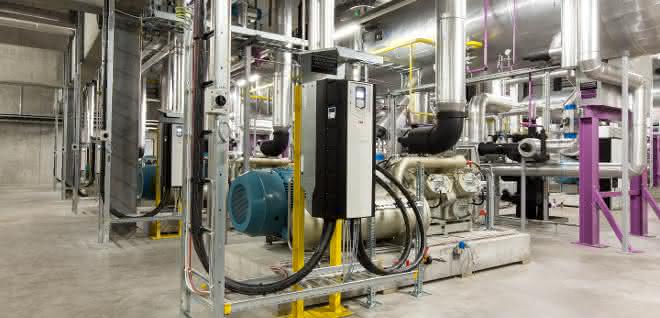
In addition to the use of renewable energies and the expansion of electromobility, energy efficiency plays a key role here. According to the ZVEI, around 47 percent of total electricity consumption is attributable to industry, 70 percent of which is accounted for by electric drives. The use of speed control with frequency converters and energy-efficient motors can save 19 percent of energy every year. In economic terms, electricity consumption is also the biggest cost driver over the entire life cycle of a motor: it accounts for around 96 percent of total costs. The purchase price, on the other hand, is only around 2.5 percent.
The motor sector alone therefore has enormous potential. After all, there are around eight billion electric motors in use in the EU: from small motors for operating cooling fans in computers to very large motors for heavy industry.
New Ecodesign Regulation
On July 1 of this year, the EU Commission's Directive EU 2019/1781 will set new requirements for electric motors and frequency inverters, replacing the Ecodesign Regulation 640/2009. From then on, efficiency class IE3 will be mandatory for 3-phase electric motors with a rated output of between 0.75 and 1,000 kW, and from July 1, 2023 they will even have to be IE4 for rated outputs between 75 and 200 kW. For frequency converters, efficiency class IE2 is mandatory from July 1, 2021.
The regulation is also the first regulation for which the documentation is digital. In future, the additional conformity information can also be made accessible via a QR code in addition to on paper. And: Frequency inverters installed in a control cabinet do not have to be looked at again if they are already compliant. This is an important point for machine manufacturers, as they no longer have to apply the new regulation to their control cabinet.
Small motors under 750 W make up 90 percent of the electric motor stock, but only account for 9 percent of total electricity consumption. 68 percent of this is accounted for by motors with a rated output of between 0.75 and 375 kW. In terms of volume, large motors with outputs above 375 kW make up the smallest share, but still account for 23 percent of energy consumption. Around 420 million electric motors are covered by the new regulation. Once it comes into force, annual savings are expected to increase to 110 TWh by 2030, which is equivalent to the electricity consumption of the Netherlands, for example. This means that 40 million tons ofCO2 emissions will be avoided every year. A considerable contribution to climate protection!
"This perspective may seem optimistic at first glance - but the technologies to make it a reality already exist," explains Dr. Volker Lindenau, Head of the Drive Technology business unit at ABB Germany. "We are even going one step further and our synchronous reluctance motors already meet the criteria of the ultra-premium energy efficiency class IE5. They reduce energy losses by up to 50 percent and enable significantly lower energy consumption than asynchronous motors in efficiency class IE2."
The use of efficient electric motors and frequency inverters is one of the most important levers for greater energy efficiency in industry. Further potential savings can be achieved by addressing two common problems: the oversizing of products and the retention of surplus system reserves. Intelligent tools such as the ABB Optimizer or the EnergySave Calculator help to find the right motor or inverter and show the savings in energy consumption and costs.
Last but not least, digitalization does not stop at increasing efficiency: intelligent, networked solutions can be used to collect data from which valuable information about the condition and performance of the motor can be obtained and which offer users the opportunity to identify inefficiencies in their system, reduce operational risks and identify opportunities for energy savings. With the ABB Ability Smart Sensor, for example, ABB has various sensors for drive components in its portfolio that transform electric motors or pumps into intelligent devices that report maintenance requirements, among other things. The sensors are part of the ABB Ability Condition Monitoring service for the drivetrain, with which the technology company supports customers in analyzing their equipment.
Energy efficiency is a driver for more climate protection and concerns everyone. Only if all stakeholders - industry, science, associations, politics and investors - work together and pull in the same direction can the full potential be realized.


You might also be interested in
Atlas Copco takes over long-standing sales partner
Atlas Copco has taken over Heide-Pumpen. The specialist for mobile pumps has been working closely with Atlas Copco in sales and service for a long time, especially for surface pumps for construction site dewatering and wastewater detour or in the...
 read more...
Lutz Pumpen at the Achema 2024
New mobile drum pump with battery drive
The new B3 Battery from Lutz Pumpen promises mobile and safe working with aggressive liquids without having to compromise on pumping performance compared to wired versions. The battery-powered drum pump will be on display at Achema, the world's...
read more...Maintenance and Pumps&Valves in February
Final preparations are underway in Dortmund: On February 21, 2024, maintenance will start as the leading trade fair for industrial maintenance and with it Pumps&Valves as the trade fair for industrial pumps, fittings and valves.
read more...Liquid separator keeps pumps dry
Vacuum clamping minimizes distortion and enables five sides to be machined in one clamping operation. The use of cooling lubricants poses a challenge: If they get into the vacuum generator, they can cause serious damage.
read more...Spring clutches for construction machinery
Spring clutches from Torsion Control Products (TCP) are ideal for use in construction machinery where modern diesel engines are used.
read more...Protection against cooling lubricant
Liquid separator from Schmalz keeps pumps dry
Anyone clamping with a vacuum during CNC machining must protect the pump from cooling lubricant. The NLS liquid separator from Schmalz separates the cooling lubricant and returns it to the running process - without interrupting the vacuum.
read more...Which clutch for what?
Mechanical engineering and its applications are multifaceted. Every application is special and requires a perfect machine design. Individual components in the system must also be optimally designed.
read more...Energy efficiency needs electrical engineering and IT
The energy crisis makes one thing clear: it is not enough to simply screw a photovoltaic system onto your roof or purchase green electricity. Industry is faced with the challenge of reducing consumption in order to counter the rise in energy prices,...
read more...Solutions for a networked and climate-neutral industry
At the world's leading trade fair for industry, around 4,000 companies from the mechanical engineering, electrical and digital industries as well as the energy sector will be showcasing solutions for the production and energy supply of the future.
read more...