

Technical education at schools
Didactics modules in vocational training
The Ehrhart-Schott-Schule in Schwetzingen, with its diverse, primarily technical educational program, uses SEW-Eurodrive's learning field-oriented didactics to prepare the next generation of technicians for the future through integrated learning in STEM subjects.
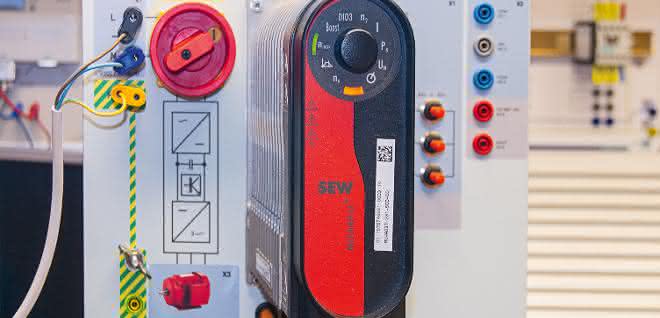
"All theory is gray, dear friend" - this is how one of Johann Wolfgang von Goethe's famous quotes begins. In contrast, it is the practical contact and the proverbial "grasping" that triggers young people's enthusiasm for technology.
The STEM subjects - science, technology, engineering and mathematics - are probably the most important innovation sector in Germany, not least in view of increasing digitalization. As early as 2012, cross-sector value creation was estimated at 250 billion euros - and the trend has been rising ever since.1
Surveys of companies and industry analyses also show that STEM employment and innovative strength are closely interlinked.2 At the same time, there has been a major shortage of skilled workers in these subjects for years - despite excellent career prospects. The qualification of young STEM talent is therefore of great importance for Germany's innovative strength.
Regardless of the type of school or university, integrated learning promises success. It includes both the teaching of theoretical, technical fundamentals and practice-oriented learning using standardized modules, for example electrical drive and control technology, as well as application-related models. SEW-Eurodrive offers ready-made, learning field-oriented and didactically well-designed learning modules with equipment suitable for training. They are designed for use in technical training and further education, for example in vocational, technical and technical colleges as well as technical high schools. These STEM school types are united under one roof at the Ehrhart Schott School (ESS) in Schwetzingen near Heidelberg, for example.
Providing interdisciplinary and integrated training
The school offers a wide range of initial and further vocational training in the fields of wood technology, metal technology, automotive technology, mechatronics and personal care. Within these vocational fields, students can choose between different types of school. Each type of school leads to a different qualification or a special qualification - from secondary school leaving certificate to A-levels. In addition, the ESS offers master craftsman courses and technical college training to become a state-certified technician, which is on a par with a bachelor's degree internationally.
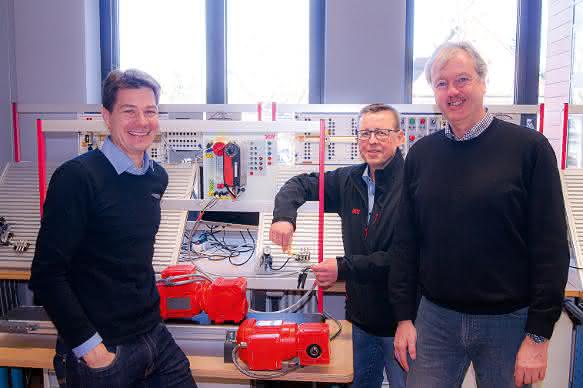
"Around 950 pupils attend the various types of school at ESS," explains Headmaster Thomas Edinger. "Our teaching staff consists of 75 teachers who attach great importance to interdisciplinary education in their teaching activities and also encourage students to think outside the box when teaching technical skills." This approach, with which the ESS aims to impart both vocational and study skills, is confirmed by the intensive use of the ESS's technical facilities.
Under the official name "Mechatronic Center Rhine-Neckar", the school operates several workshops, various laboratories for control engineering and product development, as well as four CAD rooms and around 400 student PCs throughout the school, a carpentry workshop, an engine laboratory and even an automotive workshop. "Many of these facilities primarily benefit our technical college, which offers courses in mechanical engineering and automation technology. Because we are an integrated school association under one roof, the training facilities are also available to other types of schools and training courses," explains Thomas Edinger and confirms: "The technical equipment is used intensively."
State-of-the-art equipment
The Rhein-Neckar district is responsible for the facilities at Ehrhart-Schott-Schule. It keeps the infrastructure up to date and equips the premises to meet the demands of modern education. It is supported by a number of companies from the Rhine-Neckar metropolitan region, which underlines the close links between industry and the region. "We have been working successfully with SEW-Eurodrive for more than twelve years," reports Dipl.-Ing. (FH) Markus Bürger, Director of Studies at the ESS and Production Technology Advisor at the Karlsruhe Regional Council. "During this time, an intensive and trusting partnership has developed from which both sides benefit."
In fact, the drive and automation manufacturer from Bruchsal is much more than "just" a supplier of laboratory equipment and teaching materials. The company has built up a broad didactics portfolio that covers all aspects of vocational training and qualification. "Technologically, it represents the state of the art," says Markus Bürger. "This is the best way to prepare students for their future careers, for example in project planning, design and maintenance of drive and control technology."
Blended learning
Under the slogan "Learn - Understand - Inspire", SEW-Eurodrive has developed a didactic concept that is more than just a training, teaching or learning aid. Gear unit and electromechanical modules, models and application samples are offered - accompanied by classic, but also electronic-interactive training documents that impart theoretical knowledge and prepare for practical application with exercises and calculation tasks as well as the corresponding solution instructions. The product developers for these didactic concepts from SEW-Eurodrive have understood the requirements of training - this is not about the parameterization and operation of a drive component. Instead, the technology behind the hardware is explained to the trainees in a step-by-step description.
The didactics portfolio has a modular structure. Divided into a total of seven main topics, it offers a high degree of flexibility for professional qualification and at the same time meets the different requirements that various training organizations place on SEW-Eurodrive. Regardless of the individual didactic configuration, the concept is always based on two pillars: the presentation of theory and the transfer of practical knowledge - both together referred to as blended learning.
This integrative approach is consistently implemented at ESS. It begins with the training of teachers, to which SEW-Eurodrive regularly invites them to Bruchsal. Teaching the basics of drive and control technology is supplemented by practical work with the company's electric drive and control technology. This is based on SEW-Eurodrive's current product range and is specially adapted for the didactics portfolio to meet the needs of teachers and learners and for use at individual or group workstations.
Teachers are also involved in the further development of the individual ESS didactic concept, in which they can make the appropriate selection for their subject area from the available gear technology modules, functional section models, application assemblies and multifunctional systems. "At ESS, we work with didactic kits of spur and bevel gearboxes and their functional models, among other things. These include Movi4R-U single-phase frequency inverters and Movidrive B three-phase drive inverters, as well as didactic assemblies of CMP three-phase asynchronous motors and DRS three-phase synchronous motors," summarizes senior lecturer Dipl.-Ing Jürgen Mertens from the Mechatronics department. "In addition, we also use various modified drives from SEW Eurodrive, which we use in our self-developed application models."
Practical experience of drive technology
During practical training, students from different types of schools use the technical equipment in the individual laboratories. Groups of up to ten students are common, with two of them usually sharing a workstation. "The frequency inverter, for example, is mainly used by students from the automation technology department," explains Jürgen Mertens. "In the 'commissioning of drives' practical course, for example, they learn how to mechanically connect a geared motor and commission it electrically. They learn how to integrate and operate the frequency inverter - and thus understand the interaction with the motor. Today's drive systems cannot be subdivided into electronics, electromechanics and mechanics. In terms of qualification, however, this also means that all those working with such a system must not shy away from thinking outside the box. They calculate the current and power consumption and parameterize the inverter so that the drive can start a conveyor belt smoothly, for example."
Building on this, the advanced training is correspondingly more demanding. Among other things, SEW servomotors and linear systems are used here and these are also integrated into communication with an automation system, for example. At the same time, the frequency inverter, for example, is used to teach interdisciplinary skills. At the Ehrhart Schott School, mechanical engineering technicians are also introduced to topics such as electrics and control technology. "They have to calculate currents, learn about different control options and are also made aware of drives and safety technology," explains Jürgen Mertens. "This basic understanding of electrical engineering will help them in their future careers."
Future-proof training
Standing still means going backwards - this statement also applies to technical training and qualification, especially in the age of digitalization, Industry 4.0 and the Industrial Internet of Things. SEW-Eurodrive's didactic offering has a modular structure so that both theoretical and practical modules can be updated and supplemented at any time. "On the one hand, this applies to the training documents, which we receive from SEW-Eurodrive as a printed class set in addition to the electronic version," says Markus Bürger, "but also to drive and control technology, which is constantly being updated with new technologies and requirements, such as energy efficiency. And, of course, the constant further development is also reflected in the ongoing teacher training with SEW-Eurodrive, because it is only through the interplay of theory and practice that sound training with a view to future professional life and work reality is possible."
Gregor Wohlfart, Sales Engineer Field Service Didactics, SEW-Eurodrive GmbH & Co KG, Bruchsal
1[C. Anger, W. Geis, A. Plünnecke; Cologne Institute for Economic Research (IW): MINT - Spring Report 2012, p. 3]
2[www.iwkoeln.de/studien/gutachten/beitrag/christina-anger-oliver-koppel-axel-pluennecke-mint-fruehjahrsreport-2017-339805.html]


You might also be interested in
Motors, gearboxes and encoders: Faulhaber expands Ø 16 mm portfolio
Faulhaber is expanding its portfolio with new DC motors from the SXR and GXR family, a 16 mm planetary gearbox and the IEX3 magnetic encoder for compact drive solutions.
 read more...
New drive solutions for industrial automation and robotics
Faulhaber presents drive solutions with the new GXR and SXR motor family, which offer high efficiency and flexibility in combination with powerful gearboxes and encoders. These optimized components open up new possibilities for applications in...
read more...Marco Altherr becomes new Chief Financial Officer
The Supervisory Board of Ziehl-Abegg has appointed Marco Altherr as the company's new Chief Financial Officer (CFO). Altherr will take up his post in May 2025.
read more...Hydrogen storage in metal hydride
With its focus on storage systems for green hydrogen in solid form (metal hydride), GKN Hydrogen presents itself as a pioneer in safety and efficiency for the industry. GKN Hydrogen offers safe storage systems for green hydrogen and focuses on two...
read more...INDUSTRIAL Production Products of the year...
2nd place, Robotics category: EGS Automation
The SUMO automation systems from EGS Automation - economical standard solutions for automating a wide range of processes in plastics and metalworking - took second place in the robotics category in the competition for Product of the Year 2024.
read more...More productivity with Drive Intelligence
The trends in automation are productivity, sustainability and connectivity. Baumüller is launching new products on the market that address these trends, including new tools for smart energy monitoring, condition monitoring in the drive and new...
read more...Intelligence in Motion
At SPS, Koco Motion will be showcasing its expertise in customized drive solutions based on DC and BLDC motors, stepper motors, servo motors, linear drives and controllers.
read more...Nomination Products of the Year 2024
EGS Automation: SUMO automation systems
The SUMO automation systems from EGS Automation, economical standard solutions for automating a wide range of processes in plastics and metalworking, have been nominated in the Robotics category in the competition for Product of the Year 2024.
read more...Transport technology from the modular system
Many transport tasks can be realized with the help of linear technology. Pre-configured solutions are available to simplify the interaction between the linear unit, motor, gearbox and controller. This minimizes the effort required for research and...
read more...