

Orbital welding
Welding thin-walled pipes safely
Orbital welding is a fully mechanical gas-shielded welding process in which the electrode and arc are guided completely around round workpieces. The advantages: high process reliability and reproducibility, short production times, consistently high weld seam quality, easy operation of the process and documentation.
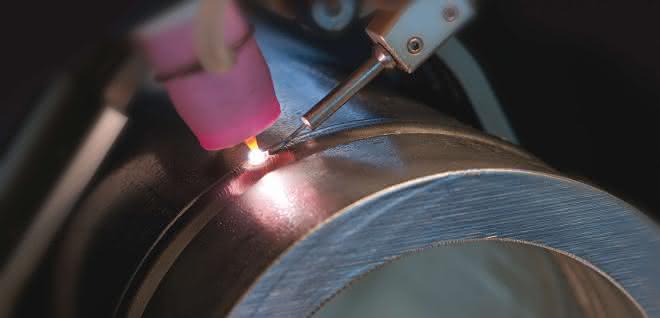
Orbital welding really comes into its own in industries where thin-walled pipes are welded to a consistently high quality. These include semiconductor production, food technology, aerospace, pharmaceuticals and chemicals as well as heat exchanger construction - in other words, wherever aggressive and corrosive media or high process pressures require leak-free piping and high hygiene standards.
The demand for orbital welding systems is constantly increasing due to the high level of quality awareness and the shortage of skilled workers. Increasing documentation requirements also play their part, as this process meets international requirements thanks to intelligent welding power sources and defined processes.
Orbital welding head types for thin-walled pipes
An orbital welding system such as the one from Orbitalum consists of a power source with control unit and cooling unit, the welding head with hosepack for the supply of control signals, shielding gas, cooling medium and welding current. A distinction is made between closed and open welding head types. Closed heads and the tungsten inert gas welding process (TIG) are used for thin-walled pipes made of stainless steel or titanium, for example, with diameters of up to around 170 mm and wall thicknesses of 0.3 to approx. 3.5 mm. The welding process takes place under constant conditions in the orbital welding head, which completely surrounds the pipe. Under a permanent shielding gas atmosphere, a TIG electrode is guided around the pipe in a defined manner via the welding head rotor. The pipes to be welded are butt-welded together (without gaps or offsets) using an arc. This requires good seam preparation: pipes cut at right angles, a consistently flat chamfer and a metallically clean and burr-free surface can be achieved using orbital, pipe cutting and chamfering machines.
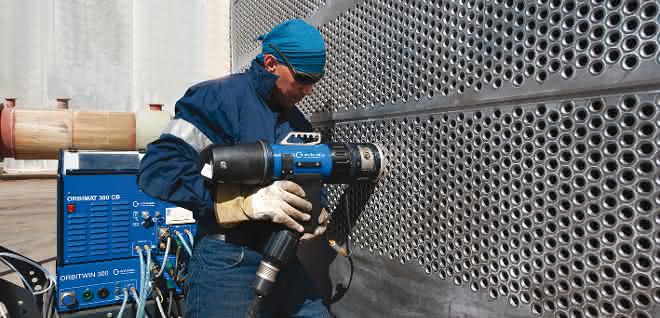
The dimensions of the welding heads have become increasingly compact over the course of development, meaning that welding can now also be carried out in confined installation spaces. Closed welding heads are currently available for pipe diameters from 3 to 170 mm.
Open orbital welding guns are often used for larger wall thicknesses and pipe diameters up to 270 mm. In contrast to closed systems, the open arc makes it possible to feed additional material into the weld pool in the form of cold wire. Multi-layer welds with thicker wall thicknesses are also possible in this way.
Intelligence in the welding process

The handling of the welding process using the example of the closed welding heads is simple: The head is opened and the two pipes to be welded are inserted without a gap. The pipe joint is aligned with the electrode. After closing the head and starting the process, the liquid-cooled head is reliably flooded with argon gas. After arc ignition, the electrode moves cleanly around the workpiece. Tarnishing is prevented by the permanent shielding gas cover. Welding takes place automatically, without offset or gaps and with consistently high quality.
Intelligent welding power sources ensure operating safety during the process: by entering workpiece-dependent parameters such as material, diameter and wall thickness, the power source automatically determines the appropriate currents, pulse times, welding speeds and, in the case of open welding guns, the required wire quantity for the application.
The connected head type is automatically detected so that the operator only has to call up the corresponding welding program and start the process before welding begins.
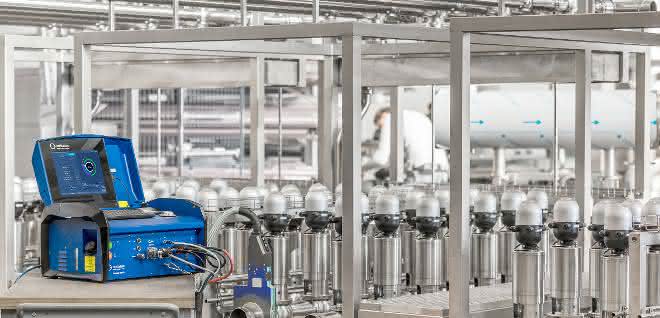
With modern welding power sources, seamless data recording and backup in the user's LAN is also possible. The Orbimat 180 SW, for example, can be connected to the network via the integrated LAN interface: Communication with various systems is possible via the IoT/Industry 4.0-compatible MQTT protocol. The entire welding process can thus be tracked directly, as operators, work planners and QA experts have access to projects and data at all times. All welding data and programs for each individual weld can be called up and documented in full, analyzed and adopted or optimized for future welds. This makes it easier to plan production processes.
In addition, all data can be saved in the internal system memory or on an external USB data carrier. In addition to data such as pipe diameter, material quality and wall thickness, the customer can define further parameters - for example the operator name, workpiece batch numbers and the position number of the weld seam as well as the pipe isometric number.
Walter Lutz, freelance technical journalist / ag


You might also be interested in
Intelligent brownfield networking
Many industrial companies are struggling with established plant structures and proprietary interfaces. Stefan Klaus' presentation will show in a practical way how brownfield environments can be efficiently networked with open technologies and made...
 read more...
Factory-X in practice
How can set-up processes in highly variant production be automated efficiently? Markus Benndorff from soffico shows how Factory-X, industrial data rooms and modular architectures create new possibilities for flexible production concepts.
read more...Mechanical engineering | Case study
Cordless in brush production
The machine manufacturer Wöhler Bohemia is integrating wireless HMI panels from Keba into its brush production systems. The background to this is the need for flexibility, robotics integration and new market strategies.
read more...International product approvals as a strategic competitive advantage in the global market
Which certificates are valid worldwide? Christian Latte, Head of Technical Compliance and Approval Officer at Hummel AG, explains this in an interview. He provides insights into product approvals and explains why early approval strategies shorten...
read more...Foundry modernizes plant park with continuous wire belt shot blasting system
The Spanish foundry Funosa is modernizing its equipment fleet with an RDGE 1250 wire belt continuous shot blasting machine from Rösler. Focus: sand removal from heavy iron castings, energy efficiency, ease of maintenance and ESG strategy.
read more...How bridging steps, stairs and catwalks are changing processes in production and logistics
At Logimat 2026, Munk Günzburger Steigtechnik will be showcasing modular bridging steps, stairs, platform and walkway systems for production, warehousing and logistics. With online configurators, distances can be efficiently shortened, processes...
read more...Drilling cycles optimized
A new replaceable head drill from Walter can reduce machining time in series production thanks to its patented interface and screwless design.
read more...Production, metalworking, robots
Precise 5-axis machining
The new Kern Fortis HD five-axis machining center will provide manufacturing companies with high precision requirements with a new machine from 2026.
read more...Agentless remote access to industrial plants
TeamViewer is expanding its Tensor enterprise platform to include "Agentless Access", enabling secure remote access to industrial systems without the need for local software installation.
read more...