

Micro waterjet cutting
Waterjet cutting - feasibility and limits
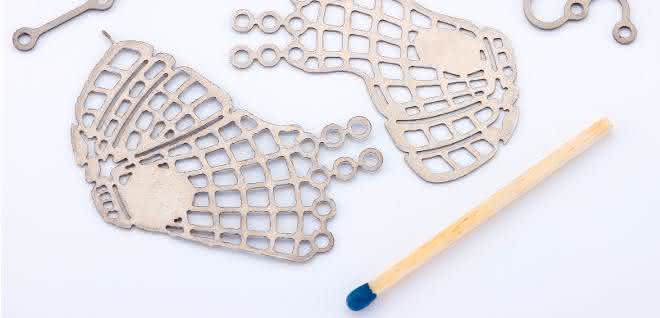
According to Walter Maurer, owner of Waterjet in Aarwangen, Switzerland, the starting signal for the development of a new generation of high-precision systems for waterjet cutting was a crisis that began in 2001. Until then, the medium-sized company had been a waterjet cutting service provider for a large number of clients: Industrial and craft businesses, research institutions or even artists and architects. When the multi-year crisis that began in 2001 caused sales to plummet by up to 30 percent, a new strategy was needed. Rather than hunkering down, cutting costs or even considering downsizing the company, Waterjet decided instead to take the bull by the horns and invest all its reserves in a development project. The aim was to develop its own line of innovative waterjet cutting systems that would be 10 times more accurate than the technology previously available on the market. For too long, Maurer had been annoyed that particularly lucrative inquiries could not be executed because the required accuracy could not be achieved with the existing systems. In future, the new systems would be used to serve demanding and lucrative markets such as the watchmaking industry and medical technology.
Smaller, lighter and more precise
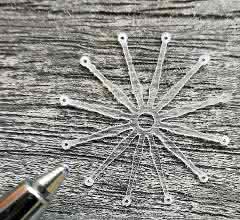
"There is a long-term trend in the industry towards solutions that are smaller and lighter and require less material and resources than before," explains Maurer. Naturally, this also increases the precision requirements for machining. This applies to almost all machining processes and therefore also to waterjet cutting, which is preferably used for sensitive materials such as stainless steels, titanium, ceramics, plastics, glass, stone or wood. The previous systems, which mostly work with nozzle diameters of 0.8 mm, were primarily developed with the highest possible cutting performance in mind. The parts produced with these systems therefore generally only achieve dimensional tolerances in the order of ±0.1 mm. Waterjet began in this zero hour with a CNC-controlled axis mechanism whose path measuring system had a resolution of ±6 µm, and then experimented with finer nozzle diameters of 0.5 to 0.17 mm.
A complex process chain
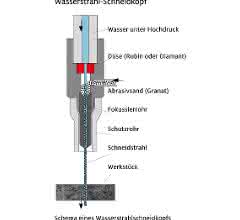
"We quickly realized that it was far from enough to simply trim the dimensions of the jet downwards and the path accuracy of the machine upwards," reveals Maurer. Waterjet cutting is a complex process in which fluid dynamics, mechanics, mineralogy and pneumatic and mechanical conveying technology interact in many different ways. The decisive factor here is the flow behavior of the jet after it passes through the outlet nozzle, when it picks up the cutting material particles in the mixing chamber and then in the focusing tube and accelerates them towards the workpiece. The size of the mineral particles and their shape play an important role. The more angular and sharp-edged they are, the more effectively they cut. Another criterion is their distribution in the jet: high cutting performance is best achieved when the particles are accelerated in the center of the water jet. If, on the other hand, they tend to be entrained around the circumference of the jet, they will better reflect the diameter of the focusing tube on the workpiece. Although this slightly reduces the cutting performance, it increases the edge sharpness and also reduces the roughness of the cutting surface.
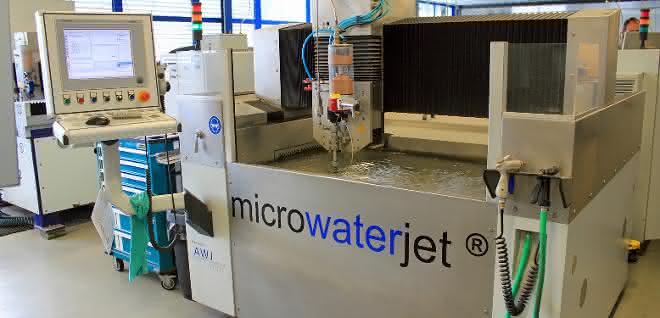
"We have invested a lot of time, money and effort in researching these relationships together with university partners," says Maurer. The current fourth generation (F4) of the in-house developed waterjet cutting machines is based on a machine frame whose axes achieve a positioning accuracy of ±0.5 µm. The jet head, which has also been revised several times, can achieve a radial accuracy of the jet diameter of up to ±1.5 µm at a diameter of 0.2 mm, depending on the boundary conditions, so that the nominal final accuracy can be up to ±2 µm. Depending on the material and cutting width, cutting surface roughnesses down toRa 0 .5 µm can be achieved. This means that the self-imposed target of exceeding the accuracy of conventional system technology by a factor of 10 has been achieved. The control system also plays an important role, with functions developed in-house such as a correction of roundness deviations of the beam and a control option for the blasting medium throughput.

"With our machines, micro waterjet cutting with accuracies of up to 10 µm and slit widths down to 0.2 mm can be safely mastered," says Walter Maurer. However, due to the numerous parameters and boundary conditions, running in new processes requires personnel with experience, care and conscientiousness. This is why Waterjet attaches great importance to providing comprehensive support services for its customers, regardless of whether it is simply a matter of cutting services or the purchase of machines. The spectrum of cutting orders ranges from research prototypes and small series to large series. If the customer wishes to set up their own production, the required system is supplied either as a stand-alone machine or, on request, with the necessary automation. Depending on the agreement, we can also cover the running-in of the production process up to series production. The decisive factor here is that the customer is supported in every situation with all the know-how accumulated in-house. All tasks are taken care of, from advice on new product developments to the provision of reserve capacity in the event of breakdowns or bottlenecks. Continuous in-house research ensures that this service is always at the cutting edge of technology.
Technologies for further miniaturization
"We are often asked by customers whether or when there will be a further step in the miniaturization of waterjet cutting," adds Maurer. Of course, the company is continuing its research in this direction and has already developed the corresponding components. However, the hurdles are high, as considerably finer abrasive material is required for this. The biggest handicap is the significantly lower removal rate, as the smaller abrasive particles can transfer less kinetic energy. This reminds him a little of the situation with the miniaturization of laser processing. Femtosecond lasers can be used for much finer processing than the systems commonly used in industry today, but here too the ablation rates are so low that the market for corresponding applications is extremely limited. Whether and when there will be a market breakthrough for ultra-micro waterjet cutting technology cannot yet be estimated.
Klaus Vollrath, freelance journalist / ag


You might also be interested in
Further simplify assembly processes
In addition to the proven racks with a length of one meter, Wittenstein alpha now offers optional two-meter racks for linear systems. They are particularly suitable for use in short axes, for example, in order to simplify assembly even further.
 read more...
Hiwin manufactures its own shaft gearboxes
Have you ever waited several months for an urgently needed corrugated gearbox? Hiwin has too. That's why the Offenburg-based drive specialist has decided to produce its own space and weight-saving reduction talent.
read more...Human-robot interaction at the trade fair
Sumitomo Drive Technologies is presenting its drive solutions for automation and robotics at Automatica 2023 together with the Lafert Group. The company will be showcasing two different applications of the Tuaka drive system for robot applications...
read more...Partial automation with robots
At Automatica, Promess will be showcasing its modular individual workstations and how these can be partially automated with robot support. The servo press manufacturer will also be providing information about the latest features of its Revolution X...
read more...A new benchmark for collaborative robots
At this year's Automatica, Denso Robotics will be showcasing its innovations in the field of robotics. The collaborative Cobotta Pro product family will be the focus of the presentations. Visitors to the trade fair can see all variants in various...
read more...Clamping system for a new milling machine
Investments in machinery often lead to further purchases - as is the case at Joma-Maschinenbau, whose modern production facility has recently been supplemented by a 5-axis milling machine.
read more...Schunk wants to simplify processes in automated production
The declared aim of automation specialist Schunk is to make its customers' processes comprehensible, simple and efficient. Data transparency plays an important role in this. It enables reliable processes and provides the basis for resource-saving...
read more...Festo and Hahn Automation develop battery tester for greater safety
The success and reputation of electric vehicle manufacturers depend on the safe and flawless functioning of batteries. Hahn Automation has therefore developed a battery tester that performs a fully automated 100% test of mobile energy storage...
read more...SPN Schwaben Präzision presents gearbox solutions for automation and industrial robotics
Short cycle times, robust technology, wear-free surfaces and compact designs have always been relevant for automation and robotics solutions. This year's Automatica trend topics include "Sustainable production" and "Digitalization and AI". SPN aims...
read more...