

Welding 4.0 practical guide
Industry 4.0 in a medium-sized welding company
The current Welding 4.0 trend is still a dream of the future for many medium-sized welding companies. However, corresponding welding management systems such as ewm Xnet 2.0 can be introduced with little investment and administration effort - even in small to medium-sized welding companies with around ten to 40 employees. This practical guide illustrates the significant competitive advantages of Welding 4.0 and the technical requirements that SMEs need to fulfill.
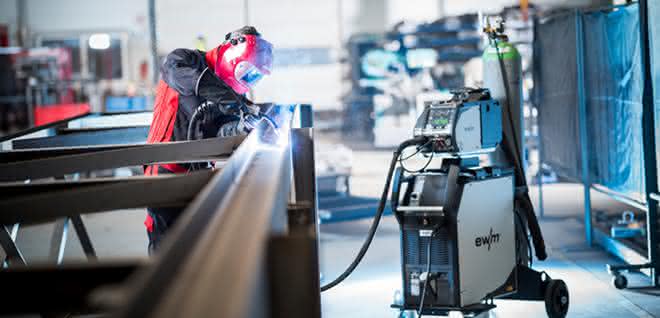
Based on Industry 4.0, Welding 4.0 outlines the digital networking and visual representation of a welding company's value creation process. The aim is to maximize efficiency and quality in planning, production, quality management, welding supervision and administration. To this end, welding management systems network any number of MIG/MAG and TIG welding machines in a company and allow them to communicate - even in real time - with the PCs in the planning, administration and welding supervision offices via LAN/WLAN or USB stick. This results in numerous evaluation possibilities and options for optimizing specific production processes that were previously almost impossible to implement.
The extent to which a company can benefit from Welding 4.0 depends in particular on its certification and product diversity: EN 1090 in the 1st or a higher design class, standard or customized workpieces? Professional Welding 4.0 welding management systems such as ewm Xnet 2.0 have a modular structure and can be individually adapted to the actual requirements on site.
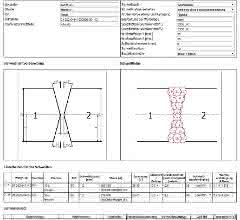
Cost estimates for welded constructions are still often calculated on the basis of perceived empirical values. Whether stairs, canopies or steel halls - "pi times thumb" usually works approximately. Ewm Xnet 2.0, on the other hand, provides all calculation-relevant data for exact quotations. Among other things, the system records the effective arc time and the demand for electricity, gas and filler materials. This information is based on the company's previous projects, in which the welding management software determined the values and stored them centrally.
A few mouse clicks on the system's platform-independent, browser-based interface are all it takes to call up the calculation. Even simple questions are answered, for example: What does it cost to produce one meter of weld seam in a specific welding process already documented in the company? This documentation and evaluation function of ewm Xnet 2.0 (Module 1) is already worthwhile for companies that are certified in the 1st execution class of EN 1090 and manufacture a large number of different welding products.
Precise specifications for the welder - for every seam on every component
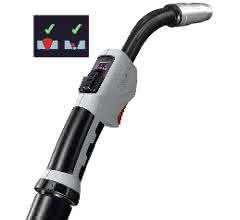
Welding 4.0 becomes even more interesting for companies with certification in the 2nd or higher execution class of EN 1090. This is because where qualified welding procedures and processes as well as welding procedure specifications (WPS) are mandatory, the planning and documentation effort for the company increases enormously. WPS, for example, can be created and managed on the PC using the graphic editor of the WPQ-X Manager in ewm Xnet 2.0 (Module 2) by means of sketches and transmitted directly to the welding machine of the welder responsible. Before starting work, the welder identifies himself via his personal hardware key, the Xbutton, on the welding machine. If his qualification stored in the welder database corresponds to the required welding task, he can start work in accordance with the WPS. The welding management software permanently documents both the actual welding parameters and the welder's qualification. In this way, the company fulfills its documentation obligation. Welding 4.0 even makes it possible to determine and qualify each individual step of welding production in advance and document it in real time during production. This is what the component management of ewm Xnet 2.0 (Module 3) does: Component drawings are imported here directly from CAD or newly created. In the next step, the welding supervisor defines the welding sequence plan and assigns a WPS to each individual weld seam. Thanks to the program's many useful functions, work preparation is very quick. The welder then scans a barcode printed out by the office and the connected welding machine automatically receives all relevant data about the component and welding tasks via ewm Xnet 2.0. If specified, the welding machine even sets the welding process parameters for the respective seam according to the order. The welder then only needs to confirm the respective completion after each bead or layer by pressing the up/down button on the torch. The component management module of ewm Xnet 2.0 is particularly interesting for companies that manufacture a wide variety of products. The concrete advantages for a medium-sized company: significantly less preparatory work for the welding supervisor, minimized set-up time for the welder, assured quality thanks to defined parameter specifications and detailed traceability of each bead/layer thanks to automatic digital documentation. Component management also opens up maximum evaluation options for post-calculation and controlling: as each individual weld seam produced is assigned to a component or order, detailed, order-related insights are possible at any time: for example, how much time, gas, electricity and wire were used for a single railing section or for a specific beam with connecting plates?
Simple data transfer - up-to-date online and offline
With ewm Xnet 2.0, the welding machines can exchange data with a central server online via LAN/WLAN or offline via USB stick. If you opt for LAN networking, the welding machines are connected to the company network via a stationary network cable. With the WLAN option, the connection is wireless via radio. Online networking with LAN/WLAN offers major advantages over data transfer via USB stick: From the office, the current operating status of all connected welding machines can be clearly displayed in real time as a list or site plan. For example, the welding supervisor can see at any time which device is currently welding which component, which parameters are set in detail and how far the work has progressed.
Any error messages from the welding equipment are also displayed immediately in the office, for example in the event of a wire feed malfunction. This allows prompt intervention, if necessary, to prevent welding faults that may go unnoticed over a longer period of time as a result of a malfunction or to minimize the costs of rectifying faults that have already occurred. The allocation of work can also be adjusted in real time to increase efficiency, for example if a welder is working faster than planned.
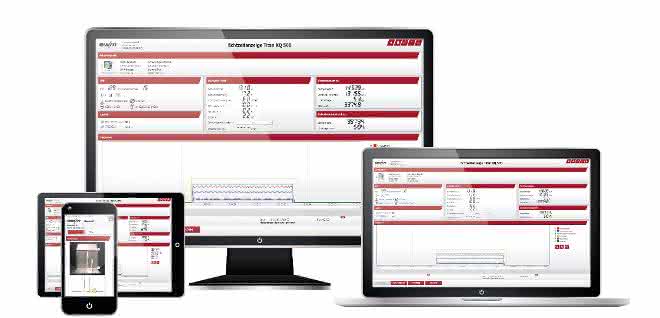
Data transfer between the welding machine and ewm Xnet 2.0 is also possible offline via USB stick. This option is particularly economical for companies with up to three networked welding stations. The USB stick only needs to be connected in the office to transfer the information from the welding machine. After three simple mouse clicks, the welding management system synchronizes automatically and the USB stick can be returned to its place on the welding machine.
Better management through continuous optimization
The continuous monitoring of the welding management software quickly builds up a valuable, company-specific database. With its help, the welding company can continuously optimize its work processes. For example, the ratio of arc time to working time for each welder registered via Xbutton can be read from the documentation of the completed orders. If, in a fictitious extreme case, the ratio is ten percent welding time to 90 percent non-productive time, this may raise unexpected questions. You can then get to the bottom of them: What does the welder do in the non-productive time? One possible answer: grinding material to a bright metal finish in preparation for welding or removing welding spatter from workpieces.
Efficiency can be optimized in both cases: In future, the grinding work will be carried out by a more cost-effective assistant and the spatter problem can be eliminated by changing the welding process, for example by using a pulsed arc. If the insights into the actual work processes opened up by ewm Xnet 2.0 are used consistently to increase efficiency, the economic success of the company can be increased. The company thus improves its competitiveness and employees benefit from greater job security.
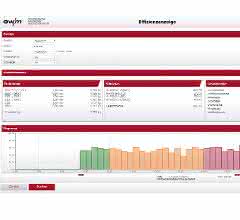
The Welding 4.0 welding management software ewm Xnet 2.0 networks digital MIG/MAG and TIG welding machines from EWM manufactured from 2002 onwards. Machines already in operation can therefore be easily integrated into the digital system. All that is required is an external gateway from EWM, which is connected to the 7-pin interface of the welding machine and ensures communication between the welding machine and ewm Xnet 2.0. With new welding machines from EWM, the gateway is already integrated as an option in the Expert 2.0 control unit ex works, for example in the new Titan XQ puls MIG/MAG multiprocess welding machine.
If a welding company decides to use the Welding 4.0 welding management software ewm Xnet 2.0, the program is simply installed on the server: It can be used via a browser and is therefore platform-independent with all connected PCs, tablets and smartphones. A one-off software license is required for each welding machine at a fixed price. The number of employees using the software is unlimited. Regular updates of EWM are free of charge. The ewm Xnet 2.0 system has a modular structure and can be expanded as required from module 1 to module 3 at any time by purchasing an additional module. Implementation can be carried out either by the welding company's IT administrators or by EWM and its sales partners.
Boyan Ivanov, welding engineer at EWM AG / ag


You might also be interested in
Plagiarius 2024 negative prize
On January 26, 2024, the Plagiarius campaign awarded its dreaded "Plagiarius" negative prize for the 48th time to manufacturers and retailers of particularly brazen counterfeits and fakes.
 read more...
Ivalua honors winners of the Generative AI...
AI-supported "add-ons" for buyers within 48 hours
Ivalua, provider of cloud-based spend management solutions, announced the winners and innovations of the first Generative AI Innovation Cup. The competition took place in December 2023. It was open to all Ivalua partners and employees - more than...
read more...Efaflex celebrates 50 years of high-speed...
The emphasis is on "fast"
Since day one, Efaflex has wanted to use new technologies as early as possible and drive progress in the industry. This year, the family business is celebrating its 50th anniversary under the motto "Fast Forward".
read more...Security of supply even during power outages
In the winter of 2022, Germany was worried about energy shortages. The drugstore retailer dm did not paint any horror scenarios, but nevertheless saw the possibility of controlled, temporary, regional power cuts (brownouts).
read more...Safety technology in mechanical engineering
Modules with new functions
Euchner's product highlights at EMO 2023 include the communication-capable solenoid interlocks.
read more...Transforming the paper industry towards climate neutrality
Together with partners from industry and research, Voith is developing a project for the optimization of energy and material flows in paper production. The aim of the research project is to develop a digital framework that enables effective process...
read more...Up to 95 percent less flue gas thanks to direct extraction
The requirements for occupational safety measures and safety technology are also constantly increasing in welding technology. The Technical Rules for Hazardous Substances (TRGS) stipulate that welding fumes and harmful substances must be extracted...
read more...Competitive advantages with large machines
Whether 3D-printed components for machines and systems, prototypes or aids for design: additive manufacturing is almost indispensable for modern companies in mechanical and plant engineering and automation if they want to play in the premier league.
read more...Transport technology from the modular system
Many transport tasks can be realized with the help of linear technology. Pre-configured solutions are available to simplify the interaction between the linear unit, motor, gearbox and controller. This minimizes the effort required for research and...
read more...