

Hanover Fair
Revolutionary control cabinets and wireless transport systems
Beckhoff was present in Hanover with a large presence and numerous innovations, and the figures continue to be good.
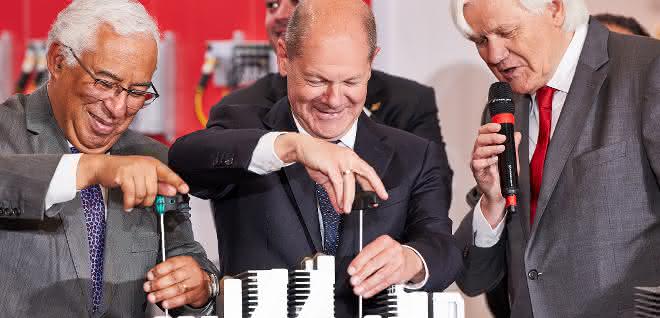
Company boss Hans Beckhoff had a lot to do at the Hanover Fair, even welcoming the German Chancellor and the Portuguese Prime Minister to his stand and having both of them work effectively in front of the cameras. Beckhoff's most important trade fair innovation was also in the spotlight: the fundamentally redesigned MX.
New switch cabinet concept
This is a flexible, space-optimized and intelligent system solution that is designed to completely replace the conventional control cabinet, thus opening up completely new possibilities for system automation. As a modular control cabinet replacement that can also be distributed decentrally on the machine if required, the MX system saves on engineering, assembly, installation and maintenance costs. This should enable highly efficient processes for manufacturers and operators of machines and systems, starting with the planning, assembly and installation of the MX system through to the maintenance of a machine equipped with the MX system.
The basic idea of the MX system is to standardize the electrical and mechanical interfaces for all electronic and electromechanical components. The result of implementing this idea is two interfaces:
- The data interface integrates each functional unit into an EtherCAT network and simultaneously supplies it with 24 V DC and, if necessary, 48 V DC.
- A second interface has been defined as standard for the low-voltage range. This is used to distribute the mains voltage of up to 530 V AC and a DC voltage of max. 848 V for the drive network.
High degree of standardization
This standardization allows the entire functionality of the control cabinet to be mapped as a backplane system. Similar to the interfaces, there are two different backplanes, which have the described interfaces in the form of plug connectors as essential features. The backplanes are installed in a robust aluminum housing. The combination of backplane and housing is known as a baseplate.
There is also a wide range of function modules from the IPC, bus coupler, I/O, motion, relay and system areas. These are simply plugged and screwed onto the baseplate. The combination of baseplate and function modules results in a space-optimized IP67-protected unit that can be mounted directly on the machine.
The aim is to significantly streamline and standardize control cabinets once again and, above all, to drastically simplify assembly and installation.
Contactless power supply
With the new No Cable Technology (NCT) for the intelligent XTS transport system, Beckhoff is ensuring greater machine flexibility. This is made possible by a contactless power supply and synchronous real-time data communication, with which the individual XTS movers can be expanded into mobile handling and processing stations.
The XTS modular system has been expanded for NCT to include a special motor module and electronics that can be mounted on the mover. The hardware required for the transmission technology is fully integrated into the motor module so that the existing functionalities and compact design are retained. No additional connections or supply lines are required. The control of the hardware on the mover is fully implemented in TwinCAT.
All familiar TwinCAT functionalities are available for simple project implementation.
For the first time, NCT enables the machining and quality control of products on the mover during the running process. Sufficient performance and fast communication with the TwinCAT controller enable the simple connection of sensors and actuators. Data communication is real-time capable and can synchronize system-wide events with μs precision in conjunction with EtherCAT.


You might also be interested in
Electronic modules for professionals
RS Components has expanded its RS-Pro range with the introduction of 4,000 new products. The expansion of the product range focuses on industrial automation applications.
 read more...
It started with a timer for X-ray machines
In 2023, the automation expert Omron can look back on 90 years of innovative company history, in which many technological boundaries have been crossed and milestones set.
read more...Pilz cracks the 400 million euro mark
Pilz breaks the 400 million euro sales mark for the first time. The company has succeeded in "making the best of such unfavorable and unpredictable economic conditions". For the coming years, the company has announced plans to expand its range in...
read more...More space in the switch cabinet
The new generation of compact Varioface interface modules is the link between the remote I/O systems and the field level. An innovative design ensures fast and error-free wiring and saves space in the control cabinet.
read more...Miniature PCB high-power relay
DC relay for mobility applications
Three new PCB relays from Omron Electronic Components Europe are aimed at automotive and mobility applications where space is at a premium and performance is critical. The new Omron G8K, G8G and G8PM relays support the control of high-power DC...
read more...Partnership with Conrad Electronic
Omron expands its European sales network
Omron Electronic Components Europe today announced the signing of a pan-European distribution agreement with Conrad Electronic, the German-based technical sourcing platform operating in 17 European countries.
read more...Simply digitize processes
Despite a high degree of automation and digitalization, many companies still have unconnected work areas or processes that do not provide centrally accessible information.
read more...Phoenix Contact and TE Connectivity
Partnership to acquire miniature relay technology and production
The Phoenix Contact Group has signed a long-term partnership agreement with TE Connectivity. The collaboration provides for the takeover of the technology for the NSR elementary relay.
read more...The art of the engineer
With a new safety switching device, an Austrian automation company will be able to cover up to 80 percent of its applications in future. This is due to the flexibility and individual configurability of the device, which can be combined with other...
read more...