
Crane automation
Crane solutions for the networked steelworks
Automation solutions for crane systems in steelworks help to make material transportation more efficient and at the same time facilitate logistics throughout the plant. The networked systems also contribute to increased safety in the harsh working environment. By Ronald Meyns
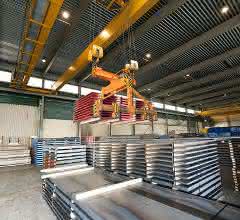
Aspects such as productivity and safety are particularly important in metal processing and steelworks. The harsh environment and repetitive nature that prevail in this industry often take their toll on man and machine. A crane automation solution that meets the requirements for safety and conveyor technology is a good first step.
Finding a suitable crane automation solution is no easy task and involves a considerable amount of time and money. However, users and decision-makers must always be aware of the benefits of the improvements in terms of safety, reliability and productivity and that the expense is more than justified. In addition, occupational safety is a top priority in heavy industries such as the metal sector. By working with technology partners on a crane automation solution, a modern, networked steelworks can be realized.
Rockwell Automation 's automation solutions for crane and lifting applications are based on an integrated system comprising ControlLogix PLCs and PowerFlex frequency inverters. Each crane solution must be developed by experts based on the respective application areas and adapted to the field of application based on experience from successful projects. The solutions are scalable for semi- or fully automated cranes, are extensively tested, validated and equipped with advanced features such as sway damping, synchronization control and user-friendly operator controls.
Crane automation supports storage and retrieval systems
An inefficient and disorganized storage area not only wastes time and money, but also impairs safety and productivity. Well-designed material handling processes can be a great help for decision-makers. For example, the storage area may be filled with unidentified, misplaced, damaged or surplus products. To ensure efficient production operations, many factories use an automated storage and retrieval system (ASRS).
Optimizing the product warehouse is often a challenge for users at first, but the benefits outweigh the risks. Crane automation plays an important role in the storage of steel products. Modern crane automation solutions consist of hardware and software that work together to ensure plant-wide transparency of the ASRS. If this transparency is provided in real time, the location of each individual product can be tracked at all times.
Timely information and planning are particularly important for steelworks with high throughput. Crane solutions that monitor several production lines and can be operated around the clock with virtually no manual intervention should be used here. With an integrated control system and precise programming, accurate crane positioning is possible so that coils can be stored directly on transport trolleys or in high-density storage areas. While every steel mill's requirements are different, with the right supplier, scalable crane automation solutions can ensure a more efficient and productive production environment.
Architecture of a networked steelworks
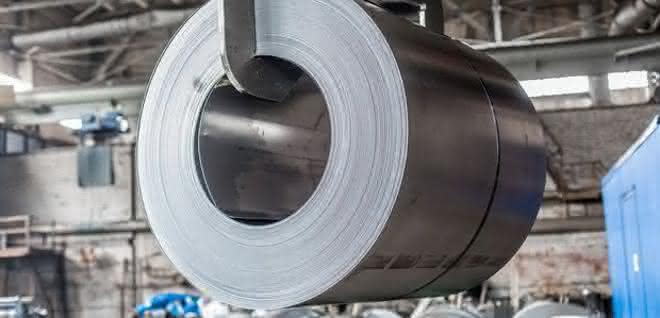
A networked steel mill is the result of combining information technology (IT) and automation (OT) in a common network infrastructure. The infrastructure enables seamless connectivity and the smooth exchange of information across the entire steel mill operation. Integrated solutions for the steel and metals industry ensure complete transparency from the shop floor to the enterprise level.
At the heart of this solution is the process control system, which can be scaled according to requirements. It executes process control, sequence control, power monitoring, drive control and safety applications within the same control visualization environment to provide a unified system approach for the entire plant.
Solutions for an end-to-end networked steel plant start with data management and manufacturing intelligence - at every level. Simulation software can mimic a business process from process and equipment optimization to manufacturing execution systems before it is executed.
Such solutions can extend across an entire steelworks. It is not necessary to completely overhaul existing systems. Experts first analyze the existing infrastructure and determine the appropriate upgrades and retrofits. Once the foundations have been laid, the benefits of a "connected enterprise" arise from the availability and evaluation of company-wide data. Thanks to real-time visualization of the plant, intelligent decisions can be made that impact overall business success.
Increasing productivity and safety can be a major concern in a steel mill. In addition, there is often a desire to maximize machine and operator performance, connect separate systems and comply with safety regulations. Overall, an automated storage and retrieval system can achieve improvements on a number of levels. The transportation, tracking and dispatch of products can be better monitored. It is also possible to optimize the overview of current stock levels and material transports within a company. User interfaces tailored to the respective customer requirements and compatibility with existing systems round off the benefits of using a Connected Enterprise in the steelworks.
Ronald Meyns, Sales Manager at Rockwell Automation


You might also be interested in
Robotics and autonomous order picking
Locus Robotics acquires Nexera Robotics and expands autonomous warehouse logistics
Locus Robotics takes over Nexera Robotics and may have taken a decisive step towards truly universal warehouse automation. A new gripping technology should now make possible what was previously considered difficult to automate.
 read more...
How bridging steps, stairs and catwalks are changing processes in production and logistics
At Logimat 2026, Munk Günzburger Steigtechnik will be showcasing modular bridging steps, stairs, platform and walkway systems for production, warehousing and logistics. With online configurators, distances can be efficiently shortened, processes...
read more...Highly automated warehouse for...
SSI Schaefer implements highly automated warehouse for CERP in France
SSI Schaefer and CERP are building a highly automated logistics center for pharmaceutical logistics in Wissous with shuttle storage, A-Frame, robotics and WAMAS software.
read more...Start of construction for new production hall
Mayr Antriebstechnik invests in its home base and internationally
Mayr Antriebstechnik strengthens location and international logistics: Construction of a new hall in Mauerstetten - parallel expansion of the plant in Poland as a logistics hub.
read more...Conveyor systems that adapt
Modern conveyor systems must reliably transport different product sizes, shapes and materials. The new modular product system from Kipp offers flexible, modular solutions for this: Adjustable side guides ensure precise alignment and gentle...
read more...Focus on sustainability and AI at the trade fair
With more than 120,000 square meters of exhibition space, LogiMAT 2025 will once again occupy all ten halls of the Stuttgart exhibition grounds. From March 11 to 13, global players, medium-sized companies and start-ups will provide an overview of...
read more...Workstation system for shipping and logistics
With Sintro Packing, Karl is launching a workstation system that is designed to meet the specific requirements of shipping and logistics. It is characterized by modular adaptability and ergonomic efficiency.
read more...Deutsche Messe announces Robotics Award
On the occasion of Hannover Messe 2025, Deutsche Messe is once again presenting the Robotics Award after a break of several years. Prizes will be awarded for robot-supported automation and logistics solutions. Companies and institutions from Germany...
read more...Micro motors as the driving force behind intralogistics
Suitable transport structures in intralogistics are a prerequisite in all industries in order to withstand competitive pressure in the future. The basis for this is comprehensive automation, which would be inconceivable without an armada of powerful...
read more...