

Workplace design
Reduce mental stress in the workplace
Workplace design. Employers have a duty to optimize working conditions and the environment. This applies to workplaces in the office, but also to work areas in industrial production. For example, measures should be taken to prevent chronic pain caused by mental stress.
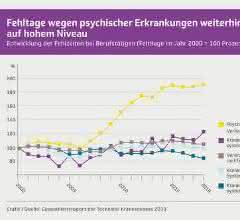
Working as efficiently and productively as possible is only possible if all the conditions are right. However, employees are often exposed to physical and mental stress in the workplace and are less productive as a result. According to the Ministry of Labor, the number of sick days due to mental health problems has more than doubled since 2007. According to the latest study by Techniker Krankenkasse, illnesses due to mental disorders were even the number one reason for sick leave in 2018.
The pressure on employees is increasing due to staff cuts and process changes. More and more tasks often have to be completed in less and less time. If employees are permanently exposed to high levels of stress, this inevitably has negative effects. Disturbed attention, tiredness and lack of concentration are followed by burnout or depression as well as alcohol abuse or dependency. Increased muscle tension leads to tension and chronic pain. As a result, employees are less productive or are absent altogether. A high sickness rate has a direct impact on a company's productivity. It should therefore be the aim of every employer to take measures to reduce mental stress and to design the working environment in such a way that error rates fall and employees can work efficiently.
What can employers do to provide employees with an optimal working environment? In addition to changing work organization and processes or redesigning work areas, improving the working environment is a crucial aspect.
Lighting
Poor lighting conditions at the workplace with too little, too strong or dazzling lighting, flickering light, excessive shadows and too much contrast have a negative impact on employees' work and ability to concentrate. Fatigue sets in and the error rate increases. On the other hand, well thought-out lighting increases work performance. "The illuminance should be based on the visual task," explains Marius Geibel, expert in workplace systems and product manager at Item, the specialist in modular systems for industrial applications. "Homogeneous light with soft shadows is ideal."
Ergonomics
A perfectly designed assembly workstation supports employees in their work. "A holistic approach is important in order to understand the interplay between physical and mental aspects," says Marius Geibel. "Modular systems, for example, enable individual adaptation to different requirements and production processes." If workstations are height-adjustable and ergonomically optimized, unnecessary and permanently stressful movements are avoided.
Intuitive processing of tasks
In industrial production, the ideal provision of materials and tools is of great importance. Clear visual aids, such as containers in different colors or a continuous labeling system, support the intuitive processing of tasks. This prevents materials from being mixed up from the outset. Direct information for employees via screens also contributes to the optimization of processes in manual production.
Optimization of production processes
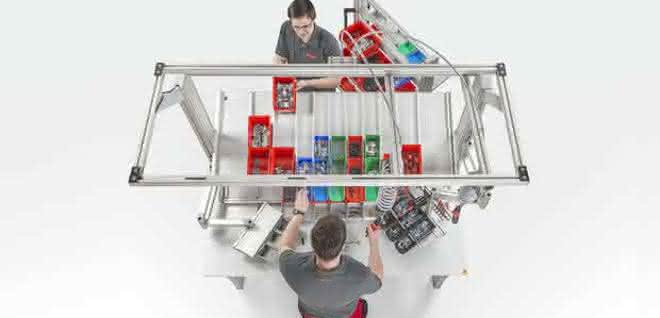
The combination of work processes can lead to an increase in efficiency while at the same time reducing the workload of employees. For example, Item's 4E Fifo-Shooter combines a height-adjustable work table with a Fifo shelf, allowing for quick changeovers when producing variants. "We rely on the lean philosophy to optimize work processes," reports Marius Geibel. "Low-cost (intelligent) automation on the item 4E Fifo-Shooter results in customized material feed and faster removal of empty containers."
Order and structure
The 5S method is a suitable principle for organizing the workplace. The approach is based on the lean philosophy and includes the five individual steps of sorting, systematizing, cleaning, standardizing and practicing self-discipline. Once implemented, employees feel more comfortable in a clean, tidy and safe environment and are happier and more productive. The structured working environment also reduces the induction period for new employees.
Job satisfaction has a positive influence on work performance, reduces fluctuation and absenteeism in the company and promotes the mental health of employees. "You shouldn't underestimate the amount of time an employee spends at the workplace," summarizes Marius Geibel. "Companies should therefore focus on ergonomically optimized and individually configurable working environments." Individual and process-related requirements must be defined in close cooperation with the individual employees in order to find the ideal solution for each employee. as


You might also be interested in
Handling and storage solution from Viastore
Hardware and software for the fully automated warehouse
As part of the restructuring of its plant in Curitiba, Brazil, household appliance manufacturer Electrolux has switched to a fully automated warehouse. The literal verticalization of stocks increased productivity, reduced costs and standardized the...
 read more...
Drives for autonomous mobile robots
Fast delivery thanks to powerful drives
Knapp's Open Shuttles, autonomous mobile robots (AMR), enable the automation of in-house transportation without having to adapt the existing infrastructure. The installed drive solutions from Dunkermotoren and gearbox manufacturer Framo Morat enable...
read more...Radio networks for the flow of information
How do you integrate moving components and load carriers into the internal information flow? A radio-supported automatic material retrieval system (AMS) is available for this task, which also precisely records the stocks of goods in the (material)...
read more...Flexibility in the warehouse
Autonomous mobile robots make it possible to automate in-house transportation without having to adapt the existing infrastructure. The built-in drive solutions allow even bulky and heavy loads to be transported safely.
read more...Measure, report, optimize
Trouble-free system control is the basis for efficient production - and this in turn requires seamless, precise monitoring of important parameters.
read more...Modular storage concept
Gebhardt will be presenting the new Gebhardt Upstream at its LogiMat trade fair stand. The proven software solutions, warehouse technology solutions and conveyor technologies such as Galileo IoT, StoreWare and SpeedSorter can also be seen there.
read more...Four automation tips for SMEs
Cobots and mobile robots support automation projects in SMEs. What to look out for when taking the first steps.
read more...Scara robots change the profitability of automation
The introduction of low-cost robots to supplement human capabilities can increase the speed and quality of production. Yamaha uses the example of automated quality control of injection molded parts to show how this can be achieved.
read more...Energy supply, motors and drives
Customized drive technology for intralogistics
ABM Greiffenberger will be presenting complete drive solutions at LogiMAT (April 25 to 27). The system provider adapts these to specific applications and customers - always in close and cooperative partnership with the customer.
read more...