

Congress Modern assembly
Great potential for innovation in assembly
The event brought together assembly experts from various industries in Stuttgart on 8 and 9 October to learn more about the topics of "Digitalization across the board" and "Where are the people in modern assembly?".
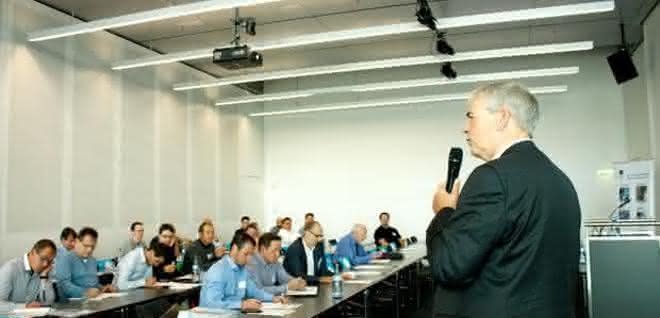
More than forty specialists with responsibility for assembly in their companies took a day or two off from the hustle and bustle of Motek in Stuttgart to attend the Modern Assembly Congress. As the organizer, the handling editorial team had invited twelve speakers from the worlds of science and business to shed light on two main topics.
In most manufacturing processes, assembly is the station where the greatest added value is achieved. It is also an area that is still heavily characterized by manual work. This leaves room for technical innovations that allow partial or even complete automation of assembly processes. On the other hand, the worker still plays the decisive role in practice today: everything depends on the documented quality of their work.
Digitalization without fear
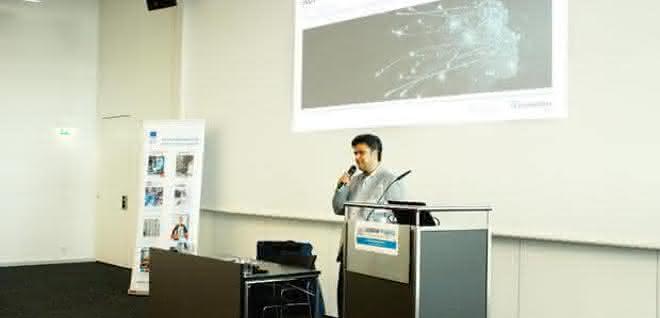
On the first day, under the motto "Digitalization all along the line", the focus was on the opportunities that digitalization and automation offer for assembly. In his keynote speech at the start of the event, Sven Schuler from the Fraunhofer Institute for Industrial Engineering (IAO) highlighted the importance of artificial intelligence (AI) for use in companies and explained the upcoming trends that those responsible for production and assembly will have to prepare for in the future. However, he also showed how simple AI can be in some cases and that there is no need to be afraid of thresholds.
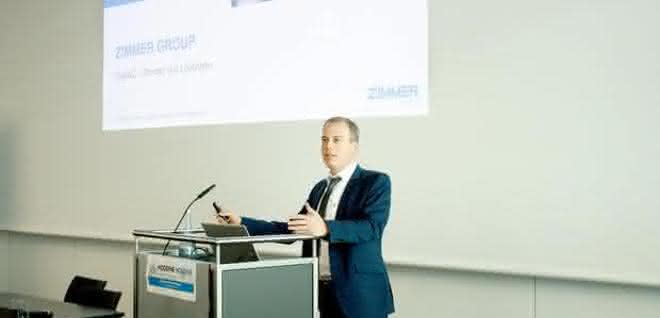
Andreas Rüdenauer from R3DT and Timur Ucan from Siemens showed what modern system design and implementation can look like. R3DT uses virtual reality glasses to not only visualize assembly workstations long before practical implementation, but also to test for conceptual errors and work processes that are unergonomic for the worker. Siemens offers a far-reaching technology that uses a "digital twin" to test systems in advance to ensure that they function correctly. Marcel Nagel from Schunk explained how the digital twin can be used as part of a comprehensive digital engineering process. Kai Köhler presented DigitalZ, the Zimmer Group's Industry 4.0 solution. Dr Thorsten Sögding from Auvesy addressed an often overlooked aspect of digitalization: secure digital data storage, which on the one hand keeps unauthorized persons safely at a distance and at the same time provides authorized persons with reliable access to the right information when it is needed.
Humans as an advantage
The high level of interest in the topic of human-robot cooperation was demonstrated on the second day of the event. Dr. Georg Plasberg from Sick explained how the correct assessment of risks and potential damage can create a safer working environment for workers that is also more productive. Michael Schlaich from Schmalz showed current developments that safely relieve the strain on employees during handling. Michael Weinmann from Pilz presented an internal research project in which the integration of a cobot relieved workers of an unpopular, repetitive task and at the same time improved the quality of the result. Manuel Rösinger from Bott derived easy-to-understand solutions from his daily work practice in order to avoid typical problems in manual assembly by using the latest technologies and to improve the working environment for the workers. Plamen Kiradjiev, Global CTO Industry 4.0 at IBM, gave a very wide-ranging overview of how complex data mining technologies help ordinary assembly workers to easily find the right information in a jumble of sources.
The congress will take place again next year as part of Motek, on October 6 and 7, 2020 with the topics: "Cobots & Co. - technologies for the collaborative assembly station and their use" and "Quantity 1 and variants - practical solutions for the assembly of individual products." dsc


You might also be interested in
Hamburg Regional Court issues preliminary injunction against Elite Robots Germany
In the copyright dispute between Teradyne Robotics and Elite Robots Germany, the Hamburg Regional Court has issued an interim injunction. The distribution of the software and products concerned is prohibited, and there is also a comprehensive...
 read more...
Schunk founds tech spin-off for humanoid robot hands
Schunk is bundling its activities in humanoid robotics by founding its own spin-off at the beginning of January. The aim of the new company is to develop modular humanoid robot hands for industrial applications.
read more...Partnership for humanoid robotics
Schaeffler and Neura Robotics jointly develop humanoids
Schaeffler and Neura Robotics will work together in the future to develop and supply key components for humanoid robots. The systems will also be integrated into Schaeffler's global production network.
read more...Yaskawa at the Automatica 2025
AI meets robotics
At this year's Automatica, everything at Yaskawa revolves around AI-based robotics solutions for the smart factory and beyond. As a trade fair highlight, the manufacturer is presenting its new Motoman Next product concept.
read more...Kassow Robots at the Automatica
7-axle vehicle in action
At Automatica, Kassow Robots will be presenting a wide range of industrial applications for production and logistics tasks that provide new impetus for efficiency and flexibility in industrial automation.
read more...Robotics and automation in six exhibition halls
From June 24 to 27, 2025, Automatica, the trade fair for intelligent automation and robotics, will bring industry and research together in six exhibition halls. Preparations are in full swing.
read more...Interview with Jörg Rommelfanger
Robotics in 25 years
The annual IFR report shows that the number of industrial robots is steadily increasing worldwide. They have already played an important role in ABB's portfolio for decades. In an interview with INDUSTRIAL Production, Jörg Rommelfanger, Head of...
read more...Reliable end effector for cobots
Collaborative robots are now widely used for a wide range of handling tasks. SMC offers three versions of the RMH pneumatic gripper for this purpose; it is compatible with cobots from a total of twelve companies.
read more...7-axis cobots with controller in robot base
With the Edge Edition, Kassow Robots has launched the world's first 7-axis cobots with a controller integrated into the robot base.
read more...