

Communication in the world of work
Digital twin for knowledge transfer
The coronavirus pandemic requires new ways of working together. The Fraunhofer Institutes for Industrial Engineering IAO and for Manufacturing Engineering and Automation IPA have solutions for communication in the working world of the future.
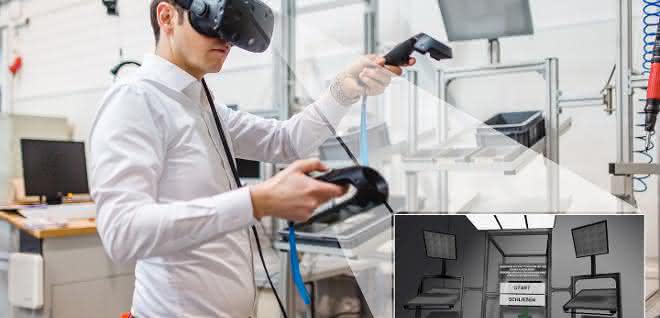
It is impossible to imagine production without the digital twin, which is a key component of Industry 4.0. It maps the entire production process and enables direct intervention in production at any time. It is the digital representation of a real object in the digital world. Researchers from Fraunhofer IAO and Fraunhofer IPA are now using the digital twin for the first time in the field of knowledge transfer: Until now, interested parties have been able to find out about new research work and solutions in the Future Work Lab on the Stuttgart campus and have new methods explained to them on site. In the FutureWork360 project, a laser scanner is used to create a digital twin of the laboratory environments, which are then transferred to the digital world and made available online. Technology partner Hemminger Ingenieurgesellschaft is implementing the visualization.
Virtual access to research and innovation
"The 360-degree scanner captures our laboratories spatially and makes them accessible via an online platform, regardless of time and place," says Yeama Bangali, scientist at the IAO and project manager. Via www.futurework360.de, visitors can now go on virtual tours of the laboratories and explore them for themselves. The tours available include additive manufacturing, assistance systems, digital planning and networked production systems.
Bangali and her team have been offering guided tours since the end of March. Live Q&A sessions are possible in online meeting rooms. Texts, videos and images illustrate the research content. Virtual reality, for example, makes it possible to experience various forms of human-machine collaboration. "If a company is interested in a specific exhibit, we invite them to an online web session. The digital exchange in the virtual labs is well received, as we have already seen in webinars with French companies from the Plastipolis plastics processing industry and research association," says the researcher.
New forms of work benefit climate change
The FutureWork360 project, funded by the German Federal Ministry of Education and Research (BMBF), aims to research what virtual forms of collaboration could look like in the future. "Our approach is proving its worth in times of crisis and beyond. An open day, an Open Lab Day for example, is also possible digitally with our online platform. We also enable climate-friendly, hassle-free working in an international context. There are no flights and therefore no travel costs," Bangali emphasizes. The researcher and her colleagues are currently working on new collaboration tools and optimizing the digital twin of the Future Work Labs. as


You might also be interested in
Intelligent brownfield networking
Many industrial companies are struggling with established plant structures and proprietary interfaces. Stefan Klaus' presentation will show in a practical way how brownfield environments can be efficiently networked with open technologies and made...
 read more...
Factory-X in practice
How can set-up processes in highly variant production be automated efficiently? Markus Benndorff from soffico shows how Factory-X, industrial data rooms and modular architectures create new possibilities for flexible production concepts.
read more...Mechanical engineering | Case study
Cordless in brush production
The machine manufacturer Wöhler Bohemia is integrating wireless HMI panels from Keba into its brush production systems. The background to this is the need for flexibility, robotics integration and new market strategies.
read more...International product approvals as a strategic competitive advantage in the global market
Which certificates are valid worldwide? Christian Latte, Head of Technical Compliance and Approval Officer at Hummel AG, explains this in an interview. He provides insights into product approvals and explains why early approval strategies shorten...
read more...Foundry modernizes plant park with continuous wire belt shot blasting system
The Spanish foundry Funosa is modernizing its equipment fleet with an RDGE 1250 wire belt continuous shot blasting machine from Rösler. Focus: sand removal from heavy iron castings, energy efficiency, ease of maintenance and ESG strategy.
read more...How bridging steps, stairs and catwalks are changing processes in production and logistics
At Logimat 2026, Munk Günzburger Steigtechnik will be showcasing modular bridging steps, stairs, platform and walkway systems for production, warehousing and logistics. With online configurators, distances can be efficiently shortened, processes...
read more...Drilling cycles optimized
A new replaceable head drill from Walter can reduce machining time in series production thanks to its patented interface and screwless design.
read more...Production, metalworking, robots
Precise 5-axis machining
The new Kern Fortis HD five-axis machining center will provide manufacturing companies with high precision requirements with a new machine from 2026.
read more...Agentless remote access to industrial plants
TeamViewer is expanding its Tensor enterprise platform to include "Agentless Access", enabling secure remote access to industrial systems without the need for local software installation.
read more...