

Assistance systems
Support for manual assembly
Digital assistance system. The industry is increasingly demanding inspection technologies that seamlessly record the correct condition of manually manufactured supplier products. With the One-Piece-Flow-Assistance-System (OAS), Treston provides a digital assistance system that guides and supports employees during manual assembly, documents all steps and reduces the workload for staff.
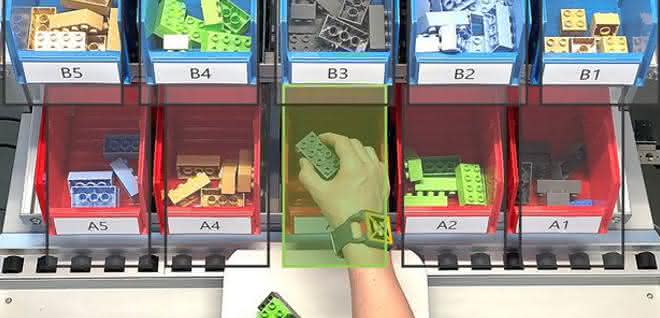
The aim of the OAS is to support employees in carrying out manual assembly activities in terms of efficiency, process reliability and error prevention. The system is equipped with an image processing unit. 2D markers, which employees wear on their wrists like a watch, recognize gripping movements and compare them with predefined target processes. This transforms the system into an intelligent inspection technology that reduces production costs by minimizing errors, complaints and expensive re-production. The OAS was developed in collaboration with the Fraunhofer Institute for Factory Operation and Automation (IFF) in Magdeburg.
Clearly structured processes
The OAS further streamlines assembly and creates a clearly structured work process with step-by-step instructions. This also benefits the employee. The strain on their concentration is greatly reduced. In future, all other Treston workbench solutions - such as Concept, LMT, WB, Towerline or TP - will also be able to be optionally extended with the OAS and benefit from the stable, secure process. Depending on the intended use, the solution adapts to different assembly applications because the operator can define individual work processes themselves.
Depth image sensors localize gripping movements
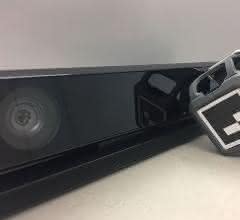
An OAS system consists of an assembly monitoring unit (AMU), two 2D markers, each measuring 4.5 x 4.5 centimetres and weighing 30 grams, a touchscreen and a computer. The AMU is mounted vertically above the workstation on the Moduline superstructure, for example. From there, a depth image sensor built into the AMU analyzes and monitors the hand and gripping movements of the employee taking place beneath it. This monitoring is made possible by the continuous, image-based identification and localization of 2D markers, which the employee wears on their wrists like a watch. It is possible to grip with the right, left or both hands.
Step-by-step to the finished product
The work steps at the two workstations are predefined and stored in a database. When the employee starts the assembly process at a workstation via the touchscreen, the individual work instructions for each work step are displayed there. As soon as the OAS identifies a work step as "ok", it completes the work step and calls up the next work step with the associated work instructions. If the work step is declared "not ok" - due to a gripping error, for example - the system prompts the employee to correct the error and repeat the work step. The system is also equipped with a documentation function that creates a photo after each completed work step and enables sustainable and consistent quality management.
In order to carry out these process steps, the OAS must perform a continuous hand-based analysis. It compares the actual hand movements per work step with the predefined target hand movements. In this way, the OAS can draw intelligent conclusions and make decisions as to whether the work step is "ok" or "not ok". In the future, the OAS will have further levels of analysis. An area-based and an object-based analysis are planned, which in turn will trigger certain functions as soon as the 2D marker enters certain pre-defined work zones. In this way, further documentation and measurement functions are to be initiated and specific requirements of other industries are to be developed.
Electrical assembly, shipping and logistics
OAS is suitable for continuous use in non-automated, manual assembly processes that are characterized by small order volumes and frequent product changes. It is a good fit for applications in the electrical industry, for packing processes in shipping and logistics and for manual assembly in toolmaking and mechanical engineering. Installation, application-specific adaptation and process programming of the system are simple and can be carried out without training; commissioning takes just a few hours. pb


You might also be interested in
Robotics and autonomous order picking
Locus Robotics acquires Nexera Robotics and expands autonomous warehouse logistics
Locus Robotics takes over Nexera Robotics and may have taken a decisive step towards truly universal warehouse automation. A new gripping technology should now make possible what was previously considered difficult to automate.
 read more...
How bridging steps, stairs and catwalks are changing processes in production and logistics
At Logimat 2026, Munk Günzburger Steigtechnik will be showcasing modular bridging steps, stairs, platform and walkway systems for production, warehousing and logistics. With online configurators, distances can be efficiently shortened, processes...
read more...Highly automated warehouse for...
SSI Schaefer implements highly automated warehouse for CERP in France
SSI Schaefer and CERP are building a highly automated logistics center for pharmaceutical logistics in Wissous with shuttle storage, A-Frame, robotics and WAMAS software.
read more...Start of construction for new production hall
Mayr Antriebstechnik invests in its home base and internationally
Mayr Antriebstechnik strengthens location and international logistics: Construction of a new hall in Mauerstetten - parallel expansion of the plant in Poland as a logistics hub.
read more...Conveyor systems that adapt
Modern conveyor systems must reliably transport different product sizes, shapes and materials. The new modular product system from Kipp offers flexible, modular solutions for this: Adjustable side guides ensure precise alignment and gentle...
read more...Focus on sustainability and AI at the trade fair
With more than 120,000 square meters of exhibition space, LogiMAT 2025 will once again occupy all ten halls of the Stuttgart exhibition grounds. From March 11 to 13, global players, medium-sized companies and start-ups will provide an overview of...
read more...Workstation system for shipping and logistics
With Sintro Packing, Karl is launching a workstation system that is designed to meet the specific requirements of shipping and logistics. It is characterized by modular adaptability and ergonomic efficiency.
read more...Deutsche Messe announces Robotics Award
On the occasion of Hannover Messe 2025, Deutsche Messe is once again presenting the Robotics Award after a break of several years. Prizes will be awarded for robot-supported automation and logistics solutions. Companies and institutions from Germany...
read more...Micro motors as the driving force behind intralogistics
Suitable transport structures in intralogistics are a prerequisite in all industries in order to withstand competitive pressure in the future. The basis for this is comprehensive automation, which would be inconceivable without an armada of powerful...
read more...