
3D printer
Kratzer optimizes its fixture construction with Stratasys
Thanks to the installation of a Stratasys Fortus 450mc 3D printer, Kratzer was able to reduce the production time of its fixtures on the production line from a few days to a few hours, achieving time savings of up to 90 percent compared to conventional methods.
The Kratzer company specializes in the production of customer-specific and needs-based turned, milled, honed and ground parts. It is currently looking back on the most successful year in the company's history. Turnover increased to almost 60 million euros in 2017. The new building with more than 5,000 square meters of additional production space is expected to be completed in July 2018. Once the new production halls are completed, the latest machine technologies will be installed in the next few years at a cost of more than 20 million euros.
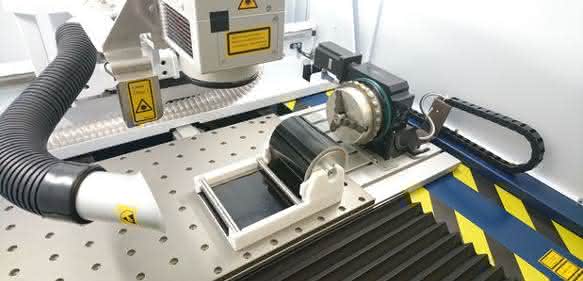
The family-owned company from Offenburg uses its fixtures as part of the process to manufacture highly complex production parts, ranging from implants for the dental market to brake housings for the automotive and aerospace industries. With so many different industries and areas of application, it is vital that production lines can be designed ready to function in the shortest possible time. The integration of Stratasys' additive manufacturing techniques has enabled Kratzer to produce complex, customized assembly line fixtures quickly and with complete design flexibility, replacing milled fixtures in Kratzer's laser and measuring machines. "We have traditionally manufactured components that naturally wear and crack over time," explains Christian Maier, Head of Fixture Design and Training at Kratzer. "We used to have to wait for the team to make a replacement fixture, which delayed the production process by several days. Now we have a file for this and can produce the fixture in just a few hours. This speeds up our production process considerably."
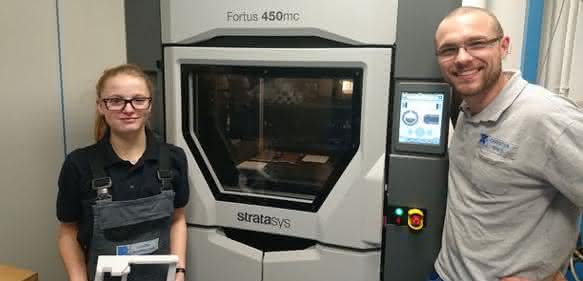
With the Stratasys Fortus 450mc 3D printer, the user is able to produce durable fixtures with highly complex geometry without compromising on quality. Most parts are printed in polycarbonate and ABS, but ULTEM material has also proven valuable for certain production requirements. Especially for components that require resistance to extreme temperatures or chemical solutions.
The ability to customize fixtures for specific components with the 3D printer is of great importance to the company and offers increased flexibility as they can process and complete customer orders faster. "Since installing our new 3D printer, our fixtures are ready for use the very next day, which results in time savings of up to 90 percent," says Maier.
Stratasys Fortus 450 mc in the video:
The laser devices in Kratzer G's production line are just one area in which the company benefits from additively manufactured devices. "Our customers often require components that need to be provided with a serial number, logo or labeling, which is done by our laser machines," says Maier. "Before we had our 3D printer, we had to place each component separately in the laser machine or mill custom jigs for each job to accommodate multiple parts. This was of course extremely tedious and time-consuming, but now with additive manufacturing we can produce jigs for 30 components at a time, which saves us an incredible amount of time and work." The 3D printer has not only made the work processes in the production line more efficient, but has also increased the level of training in the company. For Maier, the Stratasys 3D printer has had an even more profound effect: "This technology has created a completely new, additive approach that enables additive approaches to the entire design process," he concludes. "Examples such as Kratzer show the enormous impact that additive manufacturing can have on the efficiency of the entire production process," says Andy Middleton, President at Stratasys EMEA. "The significant time and cost savings as well as the additional flexibility and design freedom offer companies the opportunity to increase their competitiveness and enable their engineers to adopt an additive mindset." ee
Technical data of the 3D printer
Installation space: 406 × 355 × 406 mm
Material feed: Capacity for two material and two support material containers
Layer thickness: 0.330 mm, 0.254 mm, 0.178 mm, 0.127 mm
Support structure: Mainly soluble; for PC-ISO and ULTEM to be removed mechanically; for PC soluble or to be removed mechanically
Size/weight of the system: 129.5 × 90.2 × 198.4 cm / 680 kg, without packaging: 601 kg
System compatibility: Microsoft Windows 8.1 and Windows 8 (Pro, Enterprise), Microsoft Windows 7 (Pro, Enterprise, Ultimate), Microsoft Windows Vista (Business, Enterprise, Ultimate), Microsoft Windows Server 2008, Microsoft Windows Server 2003
Network communication: 10/100 base T connection; Ethernet protocol


You might also be interested in
Practical training in drive technology
ABB Motion University: Learn, try, apply
The ABB Motion University in Mannheim has presented its training program for drive technology. The courses are designed to be practice-oriented so that participants can apply the knowledge they have acquired directly in the implementation, operation...
 read more...
More space for more possibilities
Introduce, train, specialize: This triad forms the basis for the new training center of the Bruchsal-based drive and automation specialist SEW-Eurodrive. DriveEducation has now been officially opened with renowned guests from education, politics,...
read more...Rethinking communication in schools
Whether privately or professionally - digital communication is becoming an increasingly important part of our everyday lives. However, things are often different at schools, at least as far as the flow of information is concerned.
read more...BASF sponsors new Master's program
The Rhineland-Palatinate University of Technology Kaiserslautern-Landau (RPTU) is launching a Master's degree in Digital Process Engineering in the winter semester 2025/26. BASF is supporting the program with scholarships.
read more...More efficient training in the industry
Teamviewer introduces an immersive spatial computing solution for efficient training and onboarding processes in industry. As one of the world's leading providers of solutions for the digital workplace, including augmented reality (AR) in industry,...
read more...Next generation of robotics experts
Students deepen their automation expertise at Igus
Students from Nuremberg Institute of Technology Georg Simon Ohm visited the Igus plant in Cologne to deepen their knowledge of automation technology. Last July, they had already traveled to Bordeaux as Team Autonohm to take part in the 26th RoboCup...
read more...The first day is done
Excitement and anticipation were in the air when 38 junior employees started their careers at automation specialist Lenze on August 1. The new Lenzians are starting their careers in ten commercial and technical apprenticeships and degree courses -...
read more...Everything on one platform
Functional and powerful tools are essential for professional work on the construction site, in the workshop or when carrying out repairs.
read more...Groundbreaking ceremony for new production...
SW focuses on green energy
Schwäbische Werkzeugmaschinen has officially broken ground for the construction of a new production hall at the company headquarters in Schramberg-Waldmössingen. A photovoltaic system on the roof of the hall will provide green energy. SW is also...
read more...