

3D printing materials
Materials for demanding tasks
At Formnext, Lehvoss will be showcasing 3D printing materials for demanding tasks. For example, Luvocom 3F PEI 50236 GY, which meets the EN45545-2 standard, which is particularly popular in the railroad industry. The material, based on polyetherimide (PEI), already fulfills the EN45545-2 R1 HL3 certification for 3D-printed samples that are only 2 mm thick. According to the company, the test specimens made from Luvocom 3F PEI 50236 GY achieved unprecedented test values, positioning the material as one of the best in its class for web applications. This enables the use of 3D-printed parts in sensitive applications in rail vehicles. The material is gray in color. This eliminates the need for a base coat of paint on components and improves weather resistance and UV resistance.
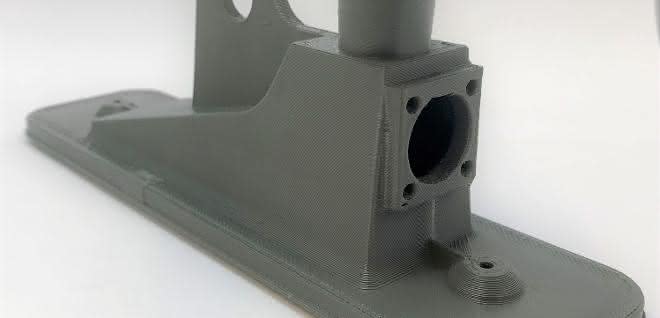
The production of mechanically resilient, temperature- and chemical-resistant molds for laminated components made of GFRP and CFRP plastics using 3D printing processes is becoming increasingly popular. The tools produced in this way for laminating prototypes, batch size 1 or small series represent a technically high-quality and economical alternative to conventional mold making, as complex and time-consuming roughing processes are replaced by near-net-shape 3D printing and the directly downstream fine finishing process. Lehvoss will be presenting a wide range of customized 3D printing materials for this area. These also enable the use of sophisticated resin systems, such as polyester or epoxy resin, which are used for sophisticated carbon fiber laminates. In particular, the resin systems differ in their chemical reactivity and the required consolidation temperatures and pressures.
Formnext: Hall 12.1, Stand G109


You might also be interested in
High-speed transportation and positioning
In the networked factory, everything has to mesh seamlessly and quickly. This also applies to the transportation and positioning of products and materials. The linear motion system ctrlX FlowHS achieves this through flexibility and high speed with...
 read more...
Displacement measuring systems
Economic positioning
The integrated position measuring system IMS from Bosch Rexroth is now also available as IMS-compact for absolute measurement. The non-contact solution with magnetic measuring principle enables robust and economical position detection for linear...
read more...CU-Flex copper processing center
Process copper in three stations
Boschert also presented the revised CU-Flex copper processing center with its three stations for punching, bending and shearing in Hanover. This allows users to completely manufacture copper parts in just one work process.
read more...Economic positioning
The integrated position measuring system IMS from Bosch Rexroth is now also available as IMS-compact for absolute measurement. The non-contact solution with magnetic measuring principle enables robust and economical position detection for linear...
read more...Mastering logistics transparently and flexibly
In order to master the current and future challenges facing the logistics industry, logistics planners and service providers, system integrators and automation specialists must design their systems to be smart and future-proof.
read more...31 percent more sales, 10 percent more employees
Despite geopolitical and economic challenges, the Lapp Group once again closed the past 2021/2022 financial year (October 1 to September 30) successfully.
read more...Timmer at the Intec for the first time
At Intec, Timmer is presenting two compact and powerful vacuum tube lifters, the lightLift and the quickLift.
read more...Voith continues on course for sustainable growth
The Voith Group developed satisfactorily in the 2021/22 fiscal year (ending September 30) in a challenging environment and is in robust shape both operationally and financially.
read more...Punching with precision
Wink Stanzwerkzeuge from Neuenhaus has automated its punching sheet production. The company has teamed up with proven project partners for the linear technology and automation.
read more...