

3D printer
More pressure for the race
As Formula 1 production times and budgets have been cut for 2022, the McLaren racing team is using several 3D printers to win the race off the track. 3D printing reduces production times for some model parts to just three days, speeding up vehicle development.

Formula 1 racing team McLaren Racing is responding to tighter time and budget constraints on vehicle production by manufacturing tens of thousands of parts using large next-generation 3D printers, the Neo800 Series stereolithography printers from Stratasys.
The company produces up to 9,000 parts per year for front and rear wings as well as large parts of the side and upper bodywork.
The racing team reports great progress in optimizing the aerodynamics of the vehicle in wind tunnel tests thanks to the high accuracy of the parts printed on the five Neo800 systems. Beyond the quality aspect, the production time for the parts has also been drastically reduced, with the team now able to produce certain large parts, such as scaled upper body panels, in just three days.
Production is also more cost-effective. With the sport facing uncertain times and no revenue due to Covid, the FIA had decided to reduce the budget cap for the first year of operation in 2021 from 175 million to 145 million US dollars, then to 140 million for 2022 and 135 million US dollars for 2023. By using its in-house printers, McLaren can manufacture all aerodynamic parts at its site in Woking, UK, saving on supplier costs and the associated quality assurance. The team can also 3D print assembly jigs and templates, as well as small molds that were previously milled from metal blocks. The speed of the Neo800 stereolithography process not only saves a lot of time, but also expensive metal.
"Stereolithography technology and materials have evolved and so has the way we use them," says Tim Chapman, Head of Additive Manufacturing at McLaren Racing. "We no longer just produce prototypes, but now produce many full-size components and tooling." One of the main applications where McLaren sees the most benefit from its next-generation Neo800 printers is wind tunnel testing. The team uses 60% of the full-scale models to optimize the aerodynamic package and achieve more downforce, which provides more aerodynamic grip, and to balance the aerodynamic loads on the front and rear of the car.
Progress in the wind tunnel
"Wind tunnel testing is still the gold standard when it comes to assessing how all surfaces work together, either as an assembly or as a complete car," Chapman explains. "Our Neo Series 3D printers have helped us dramatically reduce lead times for our aerodynamic wind tunnel components and projects." The team prints parts using Somos PerForm Reflect resin, which was developed specifically for wind tunnel models. The result is robust, rigid parts with a 30% reduction in post-processing time.
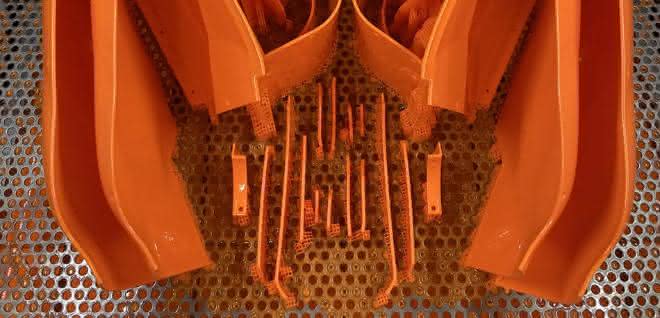
Chapman continues, "We are finding that the high precision components from our Neo printers require minimal manual finishing, which allows for much faster throughput in the wind tunnel. In addition to the speed advantage, we can now produce wind tunnel parts with the highest accuracy, detail and best surface finish. This has allowed our team to improve testing and develop new ideas to improve performance. I cannot emphasize enough how important these advantages are in Formula 1, where the deadlines for delivery of cars for the next race are extremely tight and where the smallest design adjustment can make the difference between winning and losing or helping to gain better positions on the grid."
The large installation space of 800×800×600 mm of the Neo800 enables the production of large individual parts or a large number of smaller parts. Even complicated details can be produced with very high repeatability and reliability. One example of this is McLaren's racing cars, which are equipped with 50 to 60 housings in which the air pressure is measured on various surfaces. The small pressure gauges in these housings are extremely complex. They record detailed data during tests and races so that engineers can continuously monitor and optimize aerodynamic performance.
Andy Langfeld, President EMEA at Stratasys, says: "The transformative value of 3D printing comes from the ability to quickly customize and tailor parts for specific applications. In this case, McLaren was able to dramatically reduce product development time with full cost control by combining Stratasys' next-generation stereolithography technology with Somos materials and extensive racing experience."
Formnext: Hall 12.1, Stand D121


You might also be interested in
Housing and inserts for plenty of power
Lapp presented the expansion of its Epic Power series at SPS 2023: four new M23 circular connector inserts and three new M23 housings. The special feature: all housings can be combined with any of the four inserts.
 read more...
News and product updates from Smartgas
Portable gas analyzers for outdoor use
Smartgas is starting the second half of the year with a series of updates to existing products and a number of new products. Portable analyzers expand the range of applications, while new accessories such as protective housings and heating modules...
read more...Everything accurate in switch cabinet construction
To ensure smooth work processes, tools for processing enclosures and housings must function flawlessly and reliably. Häwa rounds off its punching range with the Multi-Press 500.
read more...Shafts and conversion parts
The Rodriguez range includes ball bushings including matching housings, shaft brackets, crossbars and supports.
read more...Cooling and temperature control units
Hygienic packaging sells safely
In few industries are the requirements for hygiene in the production process as strict as in the food sector - the health of consumers has top priority. This results in enormous challenges for all machines and components involved, especially in...
read more...Simple tool change in seconds
With the CMS, Schunk is launching a user-friendly, manual change system for quick component replacement. In addition to its simple and convenient operation, the CMS also stands out with its extensive range of optional modules and complementary end...
read more...Motion controller for small drives
Medium power range covered
Faulhaber has another housing-less and compact motion controller in its range, which is particularly suitable for integration in device construction and medical technology applications.
read more...Welding solutions in the name of resource efficiency
At the Welding & Cutting trade fair in Essen (September 11-15), Fronius will be focusing on the major drivers in welding technology. Quality requirements are increasing in all industries, but the required welding specialists are scarce. In...
read more...Safe solutions for cable installations
From thick power cables to thin sensor lines, cables and lines must be routed safely through systems and machines. A challenge that should not be underestimated, explains Jörg Sokat, Head of Product Management at Pflitsch.
read more...