

Image processing
Vision system detects irregularly shaped objects
Yamaha Motor has developed the new RCXiVY2+ vision system, which has a new "blob detection" feature that enables picking, presence detection and high-speed counting of multiple workpieces for irregularly shaped objects.
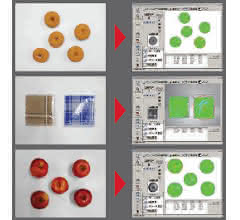
The model is the successor to the existing iVY2 system and, in addition to new functions, also offers a high-performance camera and improved processing performance, which enables a reduction in detection time of up to 45 percent.
A feature of the vision system is its integration with robotic systems through the integration of a vision board, an illumination board and a tracking board into the RCX3 series multi-axis robot controller.This integration enables unified management of robot control, image processing, illumination control and data processing for conveyor belt tracking by the robot program alone, significantly reducing system setup time.With the addition of "blob detection", the system can now handle products such as food and clothing - which have a greater variation in shape and size compared to industrial products - thus expanding its range of applications.
New features of the RCXiVY2+
The word "blob" evokes the idea of an amorphous lump or mass.Blob detection functions take grayscale images (including light and shadow variations) captured by cameras, apply certain threshold criteria and convert them into black and white images through binary encoding.This detection method can then recognize the presence or absence, number or size of blobs.
The RCXiVY2+'s blob detection can detect workpieces two to ten times faster than with the edge detection capabilities of previous models.This upgrade means the new model can perform tasks such as picking, presence detection and high-speed counting of multiple workpieces with irregularly shaped objects such as food and clothing.The combination of RCXiVY2+ and Scara robots is ideal for high-speed tracking of conveyor belts.
The search speed has been improved by eight to 45 percent thanks to a more powerful CPU, while the number of pixels and the frame rate have also been improved through the use of a high-performance camera.
The market for industrial robots continues to grow. In addition to the automotive, electrical and electronics industries, the use of industrial robots has also increased in recent years in areas such as the food, clothing and cosmetics industries. In response, Yamaha Motor has developed vision systems that are optimized for the detection of irregularly shaped objects, which are characteristic of industries such as food, pharmaceuticals, clothing and cosmetics. as


You might also be interested in
Alternative to optical positioning methods
Solutions for workplace and intralogistics systems
With the SensorBoard for detecting the position and orientation of components, RK Rose+Krieger is integrating a technology commonly used in television studios into its modular system for customized system solutions.
 read more...
Schubert System Elektronik at the embedded...
Industrial computer technology "Made in Germany"
This year, Schubert System Elektronik (SSE) will once again be exhibiting at embedded world in Nuremberg. From March 14 to 16, 2023, SSE will be presenting innovative, industrial computer technology "Made in Germany" for various sectors and...
read more...The tiger among processors
Since the move towards the Industrial Internet of Things (IIoT) and Industry 4.0 has picked up speed, processor boards and modules must be able to process exponentially growing amounts of data.
read more...IFR publishes "World Robotics R&D Programs"
Countries around the world are investing in robotics to promote the further development of the technology for industrial and social applications. But what are the current goals of the official funding programs in Asia, Europe and America? The...
read more...App ensures safety during maintenance
The "5i.Maintenance" application improves transparency and occupational safety during machine maintenance.
read more...Compact computer for industry
As a versatile and compact computer, the Raspberry Pi is also interesting for industry. However, appropriate adaptations to the harsh production environment are necessary to bring the Raspberry Pi world into factories.
read more...Changes to the Executive Board
The Supervisory Board of Schaeffler has appointed Claus Bauer (55) as Chief Financial Officer (CFO). At the same time, Sascha Zaps (46) will become Regional CEO Europe.
read more...Work safely on the machine
The most dangerous workplace accidents occur outside of normal machine operation - for example during maintenance and cleaning. The cause is usually residual energy in the system that has not been switched off.
read more...Isra Vision with a new management team
Isra Vision has entered into a strategic partnership with the Swedish industrial group Atlas Copco, forming the core of the new Machine Vision Solutions division. With a new management team, the course is now being set for further business...
read more...