

Quality control
Automatic inspection of painted parts
Camera-based systems can be used to reliably detect and mark defects in the painting of automotive parts. The in-line inspection increases productivity and reduces costs and complaints.
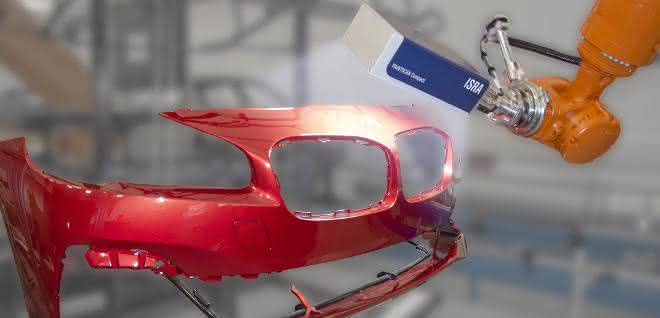
Many car manufacturers and their Tier 1 suppliers carry out defect checks on the painted surfaces of components as a manual visual inspection by trained employees. However, even with many years of experience and training, the critical eye as quality assurance remains very subjective and delivers fluctuating results in terms of reproducibility and quantifiability. The factors influencing the quality of the manual inspection of painted surfaces range from personal quality perception and discretionary scope to individual daily form. However, overlooked errors cause disruptions in the production process and are therefore a high cost and risk factor.
Highly efficient, automated inspection solutions for quality assurance can reduce costs and increase the quality of painting processes. A robot-guided inspection system enables an objective and consistent evaluation of the paint surface quality. The robot ensures that the sensor moves precisely over the contours of the surfaces to be inspected. This is an extremely important task that human eye-hand coordination cannot perform with such continuous precision and reliability on a permanent basis.
These intelligent systems for paint inspection can be integrated directly into the production lines, where they inspect the surfaces of everything from individual painted parts to complete car bodies. Defects in the painting process can be detected and rectified much earlier thanks to the automated inspection systems. Precise marking of the repair areas also supports manual reworking. Precise knowledge of the defect location also enables automated robot-assisted repair. Automated paint repair combines optical inspection, sanding and polishing, thus enabling an efficient process flow with a high savings potential.
The detection of surface defects is a technically demanding challenge, particularly in the case of multi-variant and complex-shaped car parts, which can only be solved with expertise in surface inspection and robotics. Based on its decades of experience, the inspection system provider Isra Vision has further developed its Car Paint Vision (CPV) inspection system, which is used as standard for inspecting the entire car body. With a new concept for the automated inspection of painted parts, exterior components, such as front and rear bumpers, can also be reliably inspected for defects.
The newly developed, fully automated system with Paintscan Compact sensors uses industrial robots to inspect the painted surface of even large components inline, keeping pace with the production speed. In the scalable and highly flexible system, one to four robots are equipped with Paintscan Compact sensors. The system, which works with a high-performance multi-mode LED line, achieves defect detection of ≥0.15 mm. Each defect is detected or inspected several times at 200 Hz via oversampling and classified multi-dimensionally. The defect detection rate for topographical and non-topographical defects is typically over 98.5 percent. Data processing takes place in the process cycle and defect information is available immediately. The analysis of the collected inspection data enables sustainable and continuous production optimization.
Reliable quality control for painted individual parts
The multi-mode LED line technology of the Paintscan Compact sensor uses state-of-the-art sensor technology and precision optics to enable full-surface quality control and reliable and accurate detection and classification of relevant topographical paint defects such as inclusions, craters and scratches. Precise inspection is also possible for tightly stacked parts such as bumpers, cover panels and spoilers. Paintscan Compact combines the strengths of robotics and surface inspection: both topographical defects and non-topographical defects can be detected. The detected defects can optionally be automatically marked for reworking in a downstream station. The support options for reworking, such as automatic spray-dot robot marking and a laser marking interface for reworking, are particularly practical.
The new solution for paint inspection combines a powerful classification pipeline that defines the type and relevance of detected defects. During the inspection, the classification pipeline is used to generate process-relevant quality data. For example, craters are distinguished from other types of defects, which could indicate process problems in similar locations on the painted part. It is also possible to set specific tolerances per zone (hood, roof, etc.). An example would be defects on primary surfaces that are in the direct field of vision and attention of the end customer or defects on secondary surfaces with high to medium priority as well as defects on parts that are mainly outside the field of vision of the end customer.
All data collected by the inspection system flows into a paint defect database so that the production process can be further improved. Statistical data can be displayed on corresponding dashboards using the individualized Enterprise PROduction Management Intelligence solution (EPROMI). Production-specific evaluations are also available as PDF reports.
Improved paint inspection for higher quality standards
Automated quality inspection for detecting surface defects on painted add-on parts ensures consistently high quality in production with reliable, precisely definable results. Defects in the painting process can be detected and rectified earlier with the Paintscan Compact sensors. Expensive manual reworking to remove defects is thus drastically reduced, while product quality is increased and consistently assured.
The quality expectations of the automotive industry, which is under cost pressure, and of demanding end customers are becoming ever higher. Only with highly efficient, automated inspection solutions can the highest quality be achieved at a reasonable cost. Isra's surface inspection system can be retrofitted at any time. Users benefit from the comprehensive inspection results, which can be used to systematically improve products and production processes.
Surface defects in the paint can only be subsequently rectified on the finished product at considerable expense. These high follow-up quality costs can have a major impact on the profitability of production. The use of automatic surface inspection for defect detection quickly pays for itself: it offers the advantage that surfaces are inspected economically and defects are found according to reproducible specifications. Employees can concentrate on eliminating defects and their sources.


You might also be interested in
Humanoid robotics from Germany
Igus launches service robots for everyday industrial use
Humanoid robotics: With the Iggy Rob Home, igus presents a service robot for industry and everyday life. What's behind it.
 read more...
New sales and service unit in Gurugram
Yamaha Motor expands robotics business in India
Yamaha Motor is opening a new Robotics Business Support Division in India to strengthen sales and service in the growing robotics market. The unit will support SMT systems and industrial robots, among other things, and will be complemented by a...
read more...Robotics and autonomous order picking
Locus Robotics acquires Nexera Robotics and expands autonomous warehouse logistics
Locus Robotics takes over Nexera Robotics and may have taken a decisive step towards truly universal warehouse automation. A new gripping technology should now make possible what was previously considered difficult to automate.
read more...Factory planning without compressed air...
How vacuum becomes mobile
Modular factories, mobile robotics and rising energy prices are fundamentally changing automation. One solution: into the future without compressed air. Electric vacuum systems reduce costs, save energy and support flexible manufacturing and...
read more...A robot for all occasions
Industrial robots take on many tasks. Even milling with accuracies in the sub-millimeter range is now possible.
read more...Why stator and rotor laminations are becoming a performance factor
Why the future of robotics depends not only on software, but also on high-precision stator and rotor laminations inside the motor.
read more...Infineon Startup Challenge 2026
Focus on humanoid robotics
Infineon brings together young deep-tech companies worldwide to drive innovation in humanoid robotics. The focus is on hardware and system solutions from sensor technology to motor control. Applications are still possible until May 27, 2026.
read more...Synergy in the special machine
Highly automated production line for scaffolding standpipes sets standards in efficiency and process reliability
How is one of the most modern scaffolding tube production lines in Europe created? At MJ-Gerüst, a fully networked high-tech line produces six finished standpipes every 60 seconds. With automation, robotics and precision technology from Schunk. How...
read more...Quality controls in production
Robots check car floor pans fully automatically
How can complex components in automotive production be inspected fully automatically and in real time with the help of machine vision and robotics? The case study shows how floor pans are measured and inspected fully automatically.
read more...