

Test systems
Systems for automated quality control
The advantages of automated quality control are obvious: accurate, reliable and reproducible test results. In addition, qualified laboratory personnel are freed up from routine tasks and are available for more complex tasks. A high sample throughput also leads to a reduction in testing costs. What does an automated testing system need to achieve in order to offer maximum flexibility in addition to these requirements?
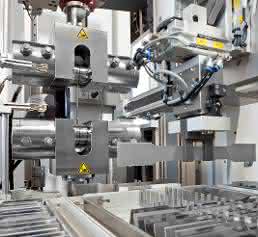
Metal and plastic production increasingly require automated testing of materials. The reasons for this include the high repeatability and reproducibility of the results due to the elimination of operator influence. Added to this is the rapid provision of test results in order to optimize the production process accordingly. The high sample throughput, which leads to a reduction in testing costs in the medium term thanks to the parallel operation of several testing machines by a robot system, is also a key aspect. Another requirement is flexibility - for example, to enable integration into customer-specific measuring devices, the variety of which has increased significantly. Zwick's RoboTest testing systems show how all of this can be achieved as efficiently as possible. Depending on the system, they are specially designed for the automated execution of tensile, flexure or impact tests.
Full integration into existing QM systems
With the test systems, the complete test sequence is logged by the software and stored in a database that can be linked to the operator's quality assurance system. What all RoboTest systems have in common is the flexibility to integrate additional measuring systems into the test system. These range from a barcode or 2D code reader for unique sample identification to measuring devices for determining sample thickness, width, length and weight as well as surface roughness, material hardness and layer thickness.
Other options include optical systems for determining the constriction at break, spectrum analyzers for material characterization and temperature chambers. Three series with graduated equipment features offer the right solution for all requirements. The high-end systems include the robotic testing systems RoboTest R and RoboTest P. While RoboTest P is used for fully automated tensile tests on metal specimens, RoboTest R is designed for tensile tests on metal specimens or tensile and flexure tests on plastic specimens. Both systems are capable of optionally performing additional tests such as hardness or roughness measurements or pendulum impact tests and were developed for testing machines from 5 to 2,500 kN.
Fully automatic handling of the test specimens
In the case of the RoboTest R, industrial robots from Kuka are used to handle the samples. Their task is to precisely insert and position the samples. This can be a small strip of sheet metal or a piece of metal up to 70 cm long and weighing up to 30 kg. The variable magazine offers space for up to 600 test specimens, depending on the specimen dimensions. The industrial robot is positioned centrally and is surrounded by the specimen magazine and the testing machines used. The robot of the RoboTest P, on the other hand, moves linearly back and forth between the various stations. Its magazine, designed for a maximum of 400 samples, holds test specimens weighing up to 10 kg. Specimens are placed in the respective testing machine in hydraulic specimen grips developed by Zwick.
The Zwick software autoEdition and testXpert III control, regulate and monitor all processes and take over the process visualization - i.e. the display of status information and the device status. Operation is very simple and convenient thanks to the use of barcodes for specimen identification: insert the specimens into the magazine and start.
The autoEdition automation software works according to the principle of decentralized intelligence: The autoEdition sequencer acts as a master and assigns individual task steps to a device. In addition to one or more testing machines, these can also be additional measuring devices such as scales or surface measuring devices. Each individual device is an active component and provides feedback to the central sequence. Once commissioned, it works through the task assigned to it independently and only reports back when it has been completed.
Thanks to Kuka's powerful and open control concept, Zwick can adapt the testing systems to the specific requirements of the end customer. In addition, numerous expansion options are available to adapt the robot to modified testing tasks or completely new tasks. Manual testing is also possible at any time by moving the robot to a parking position.
How do the dimensions change?
For example, a materials testing machine from the AllroundLine series can be used. These testing machines are equipped with different extensometers for measuring the change in length and width. The makroXtens contact extensometer is designed for tensile, compression, flexure and cyclic tests in manual and automated testing systems. In the HP version, it enables closed-loop strain rate control to ISO 6892-1 (2009) method A1 and ASTM E 8-09 (method B). Fine strain measurements are also possible. For metals, they are primarily used to determine the modulus of elasticity and the technical elastic limit.
Together with the non-contact measuring videoXtens, it is also possible to determine the change in width during tensile tests. This is required, for example, to determine the r-value (vertical anisotropy). Measurements are taken in one, two or four cross-sectional planes. The videoXtens works with a full-frame camera. The digitized image is then processed in real time.
With RoboTest P and RoboTest R, Zwick offers two highly flexible solutions for automated quality control. Adaptable to different test scenarios and easy to integrate into existing systems, they are able to perform fully automated materials tests. Optimized handling ensures accurate, repeatable and reproducible test results. In the medium term, they reduce testing costs due to the high sample throughput and at the same time relieve the burden on qualified personnel. am


You might also be interested in
AI automation specialist reorganizes...
Generation change at Insiders Technologies
After almost 30 years at the helm, Werner Weiss is handing over the management of Insiders Technologies. Andree Albrecht takes over the management after a transition phase.
 read more...
Intelligent brownfield networking
Many industrial companies are struggling with established plant structures and proprietary interfaces. Stefan Klaus' presentation will show in a practical way how brownfield environments can be efficiently networked with open technologies and made...
read more...Factory-X in practice
How can set-up processes in highly variant production be automated efficiently? Markus Benndorff from soffico shows how Factory-X, industrial data rooms and modular architectures create new possibilities for flexible production concepts.
read more...Quality controls in production
Robots check car floor pans fully automatically
How can complex components in automotive production be inspected fully automatically and in real time with the help of machine vision and robotics? The case study shows how floor pans are measured and inspected fully automatically.
read more...Measurement software with integrated calibration wizard
The WinControl measurement software from Ahlborn is designed for the acquisition and processing of measurement data with Almemo measuring devices and offers functions for complex calibration tasks. A graphical user interface and context-sensitive...
read more...New platform facilitates chip design
Siemens opens access to EDA software in Europe
Siemens is cooperating with the Chips JU within the framework of EuroCDP and is facilitating access to modern EDA software for chip design, development and innovation for European companies. The aim is to strengthen start-ups, SMEs and research...
read more...AI and virtual twins for the industry
Dassault Systèmes confirms annual forecast after solid start to 2026
The French software group Dassault Systèmes has made a solid start to 2026 and is continuing to focus on artificial intelligence, cloud applications and virtual twins as growth drivers in its industrial business.
read more...Use data consistently and uniformly
New connectors and an app solution for the IIoT framework from PLCnext Technology make it easier to collect data from controllers, sensors and field devices - especially in existing systems.
read more...How companies can prevent cyberattacks
Instead of using traditional malware, attackers use legitimate programs and system tools within their victims' IT environments. Malicious behavior can hardly be distinguished from normal user behavior. For companies, this means that security...
read more...