

Quality control
Weld seams in laser light
The sports cars in its R8 series are Audi's racing cars for the road. A laser projection system from Freiburg-based manufacturer Z-Laser supports the employees in the body production of these cars, which have a basic output of 610 hp, in the manual inspection of around 1,500 weld seams per body.

Manual production and quality control in the production of high-quality car bodies can be found at the Audi Böllinger Höfe factory of Audi Sport GmbH. The Audi R8 super sports car is built here almost by hand. The body shop is also a special manufacturing operation. The R8 manufactory is designed for small series and great variety: "Our highly qualified colleagues build the cars with the utmost care and craftsmanship. They meet the highest quality standards," says Felix Knoll, specialist project manager for body construction at Audi Sport.
In the first step, specialists weld together the front body, the middle floor and the rear body from aluminum castings and extruded profiles, then connect the three modules to form the substructure. Robots take over the cold connections. The subsequent quality control of the approximately 1,500 weld seams per R8 body is also carried out by employees. According to Knoll, it was essential that every single weld seam was inspected 100 percent with absolute certainty of detecting faulty joints: "A body with just a single unclean weld seam no longer meets our high quality standards and is therefore unsaleable."
In order to answer the question of how 100 percent of all weld seams on every car body can be inspected, a colleague of Knoll's across the Group was involved in evaluating and searching for technologies and examined various technologies for this purpose. The problem was: how do you inspect an aluminum weld seam on an aluminum background? "In our experience, optical processes such as image processing systems, which compare the whole thing with a given image, have not yet been effective for this task," says Knoll. "Other technologies such as computer tomography, MRI or augmented reality were also possible candidates, but in the end they also turned out to be unsuitable. In the end, we opted for a laser projection system from Z-Laser Optoelektronik in view of the many criteria that had to be met."
Implementation in a confined installation space
The criteria mentioned by Knoll included the requirement that the system had to enable the inspection of every weld seam on every single car body within the cycle time so as not to cause any delays in the production flow. It was also necessary that the implementation period matched the conditions in the production of the R8 models: "The implementation of the system had to be feasible in terms of time and space. The space in such a plant is naturally always limited. The main difficulty was that we had to integrate the system into existing systems, the installation space for such a laser cell was limited and we had to implement the system with the available space. We therefore installed suspensions, lifting platforms and peripherals such as power and data cables so that Z-Laser could commission its system without any problems."
In addition to these technical and spatial constraints, another prerequisite for implementation was that the system had to remain within a given budget.
"In view of the large number of weld seams and the required reliability of the quality inspection, we definitely wanted to provide our employees with an aid for inspecting all weld seams," emphasizes Knoll. During the technology search phase, he and his colleagues came across the Freiburg-based company Z-Laser, which has been specializing in the production of laser sources for special customer applications for many years. "At the beginning of 2016, Z-Laser visited us with a test device for demonstration purposes, and we were quickly convinced that the system presented could meet our requirements." Following detailed feasibility studies, the final system was selected and assembled, and in October 2016, Z-Laser received the order from Audi.
The Freiburg-based company then supported Knoll and his team with the integration of the laser system into the plant and with its programming. In April 2017, the system was then put into operation to test bodywork for the Audi R8 Coupe as the first model variant. A short time later, the entire series production range could be mapped using this system. The Audi engineer describes the inspection process as follows: "We map our 3D data set of the car body in the system, and the Z laser system projects this data set onto the real car body from different directions using a total of six LP-HFD2 laser projectors. The parts to be inspected are first placed on reference points using the conveyor system provided. The employee then selects the correct position and the current model and can then click through the individual steps of the inspection using the laser system's remote control. Depending on the position of the weld seam, a suitable laser projector then projects green laser lines onto the car body and shows the employee the target position with the start and end points of the weld seams. On this basis, he can compare the projection and the real weld seam and easily recognize whether the individual weld seam is present and whether the specified length is correct. However, the employee must assess the quality of the weld seam himself." A green laser source creates a maximum brightness impression on the viewer.
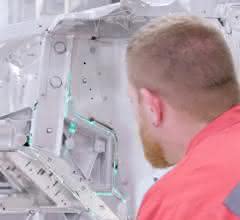
In the production process, three employees are responsible for visual inspection. One of them checks the weld seams using the projection system. The other two in the so-called quality control loop (QRK) check them visually at different stages of production, so that every scope is covered by the four-eyes principle. According to Knoll, the employees must be very experienced for these tasks and know all production scopes and their location in order to be able to identify and correct faulty processes if necessary.
Easy familiarization thanks to standardized processes
Knoll is very satisfied with the solution, which has now been running smoothly for several months: "We have become much more efficient with our inspection process and can now integrate more inspection scopes into the QRK employee's process that were previously checked elsewhere."
One of the things the Audi engineer finds very useful for this application is the fact that "we can use software to decide at which point in time and in which position a particular weld seam position is displayed by which laser. This gives us a defined, standardized test sequence. This means that every weld seam is always scanned at the same time." In this way, it is quick and easy to train new employees on the system so that they can carry out the inspection of a car body independently.
Implement changes quickly
According to Knoll, the system is very flexible when it comes to adapting inspection sequences, for example if a new model or model changes lead to a change in the weld seams: "The CAD data of the circumferences to be inspected serves as the basis. This data set is assigned a time in the test sequence and defines the position and laser from which the projection should take place. Software converts new data packages into projection data. If the scope is small, such as a modified weld seam, we are able to implement the corresponding change in the inspection sequence within a few minutes." In the case of a new model, defining the test sequence and determining the projection without fine-tuning takes around 2 to 3 weeks. "However, we can implement this without further external support," emphasizes the specialist project manager.
Knoll rates the collaboration with Z-Laser as very good and problem-oriented: "The project was optimized thanks to helpful suggestions from Z-Laser and is now an essential part of optimizing the manual inspection of weld seams in the production of our R8 models."


You might also be interested in
Plagiarius 2024 negative prize
On January 26, 2024, the Plagiarius campaign awarded its dreaded "Plagiarius" negative prize for the 48th time to manufacturers and retailers of particularly brazen counterfeits and fakes.
 read more...
Ivalua honors winners of the Generative AI...
AI-supported "add-ons" for buyers within 48 hours
Ivalua, provider of cloud-based spend management solutions, announced the winners and innovations of the first Generative AI Innovation Cup. The competition took place in December 2023. It was open to all Ivalua partners and employees - more than...
read more...Efaflex celebrates 50 years of high-speed...
The emphasis is on "fast"
Since day one, Efaflex has wanted to use new technologies as early as possible and drive progress in the industry. This year, the family business is celebrating its 50th anniversary under the motto "Fast Forward".
read more...Security of supply even during power outages
In the winter of 2022, Germany was worried about energy shortages. The drugstore retailer dm did not paint any horror scenarios, but nevertheless saw the possibility of controlled, temporary, regional power cuts (brownouts).
read more...Safety technology in mechanical engineering
Modules with new functions
Euchner's product highlights at EMO 2023 include the communication-capable solenoid interlocks.
read more...Transforming the paper industry towards climate neutrality
Together with partners from industry and research, Voith is developing a project for the optimization of energy and material flows in paper production. The aim of the research project is to develop a digital framework that enables effective process...
read more...Up to 95 percent less flue gas thanks to direct extraction
The requirements for occupational safety measures and safety technology are also constantly increasing in welding technology. The Technical Rules for Hazardous Substances (TRGS) stipulate that welding fumes and harmful substances must be extracted...
read more...Competitive advantages with large machines
Whether 3D-printed components for machines and systems, prototypes or aids for design: additive manufacturing is almost indispensable for modern companies in mechanical and plant engineering and automation if they want to play in the premier league.
read more...Transport technology from the modular system
Many transport tasks can be realized with the help of linear technology. Pre-configured solutions are available to simplify the interaction between the linear unit, motor, gearbox and controller. This minimizes the effort required for research and...
read more...