

Tape measure tester
Checked line by line
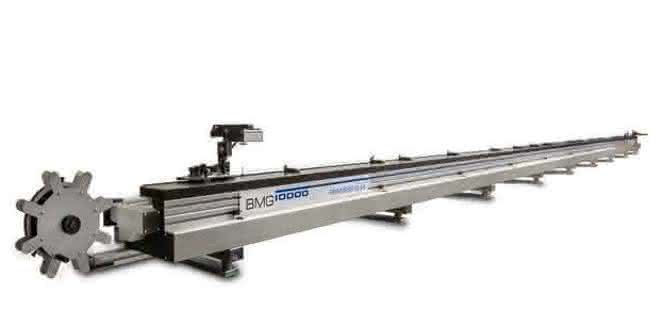
Automatic calibration. In addition to a 50-meter interference comparator, the Physikalisch-Technische Bundesanstalt (PTB) also uses a ten-meter fully automatic tape measure tester from Feinmess Suhl to test and assess the conformity of length measuring equipment.
Embodied linear measures with graduations such as measuring tapes, folding rulers ("folding rules"), working rulers (steel or glass rulers, cutting rules) are ubiquitous. In industry, trade and commerce, they are used to measure length or to determine area and volume and are therefore often the basis for invoicing services or economic goods. The length gauges used for this purpose must undergo a conformity assessment procedure in accordance with Directive 2004/22/EC (MID) as they are used in the legally regulated area.
The performance of these tests or assessments of the "conformity of length measuring instruments" on the basis of type samples, production samples and drafts is the task of Working Group 5.45 of the same name in the Production Metrology Department of the Physikalisch-Technische Bundesanstalt (PTB).
Testing techniques for different requirements
In addition to a 50-metre interference comparator in a fully air-conditioned environment, the working group 5.45 has also been using a tape measure tester (BMG) from Feinmess Suhl with a measuring length of ten meters and automatic image processing (BV) for the type examination certification of measuring tapes, rigid or semi-rigid graduated rules and folding rules as well as non-contact length measuring systems for some time now. On both devices, in the case of embodied linear gauges with graduations, the graduations of the respective test specimen are compared with those of a standard. "With the interference comparator, measuring tapes can be measured to an accuracy of a few micrometers. However, these measurements are very time-consuming and the device requires a lot of maintenance," explains working group leader Ingo Lohse.
This is why his team uses the BMG10000 BV tape measure tester instead when random, production-monitoring tests are carried out on commercially available measuring tapes and folding and working scales. The error limit or accuracy of the BMG is less than 50 micrometers (over a length of ten meters) and is therefore more than sufficient. In addition, the tests with the new measuring tape tester are uncomplicated thanks to the fully automatic test mode and the workload is significantly lower than for tests with the interference comparator.
Specially designed
Feinmess Suhl developed the BMG10000 BV at the beginning of 2017 as an evolution of the shorter BMG5000 BV. The PTB provided the impetus for this. This is because the calibration of tape measures has become increasingly important due to the latest amendment to IATF 16949 with regard to the assessment of measuring systems and the way in which calibration and verification of test equipment is recorded. Ingo Lohse and his team were already familiar with the smaller BMG5000 BV calibration station. However, they wanted more length. After all, the longer the tape measure tester, the less frequently it has to be moved and realigned when testing long measuring tapes.
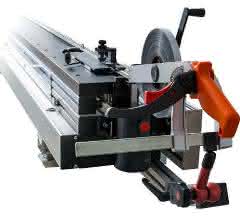
The BMG10000 BV allows fully automatic calibration and testing of folding rules and rolling rules in all lengths and shapes as well as circumference rules and steel or glass rules with scales that can be read by a camera. A high-resolution CCD camera automatically records the graduation of the test piece, which is compared with the target value and logged in the software. Manual reading errors are eliminated in this way. If a repositioning is necessary when testing longer measuring tapes, the software automatically finds the recording point again and continues testing from there. In addition, the measurement results are visualized and forwarded to the measurement and evaluation software via the integrated interface. Stored test algorithms simplify the test sequence and evaluation.
Feinmess Suhl modified the software for the BMG10000 in Braunschweig in accordance with the PTB's requirements profile. A line width measurement was implemented in order to be able to test according to international standards.
The decisive factor in the design of the BMG was a small distance between the test specimen and the measuring system. This minimizes the Abbe error and guarantees measurement accuracy. To ensure the accuracy of the overall system and traceability to national standards, PTB calibrates the BMG twice a year using its in-house interferometer. The value determined in this process must be within the scope of the measurement uncertainty balance of the device and subsequently taken into account in every test with the BMG.
Length as a logistical challenge
However, the realization of the ten-metre-long tape measure testing device presented Feinmess Suhl with various challenges, particularly logistical ones. For transport reasons, the BMG10000 consists of at least two basic parts, each approximately 5,200 millimeters long. As the PTB test laboratory for length measuring equipment is located in a basement room with restricted access, these two individual parts first had to be lowered down a vertical light well with the help of a crane and then transported around several corners to their final destination. "The installation of the system in the building and the subsequent installation of the measuring system, a temperature-stabilized measuring ruler made of Invar steel, in the assembled, two-part base body was also not without its challenges," explains Nils Blondin, Managing Director of Feinmess Suhl.
But the effort was worth it: thanks to the new BMG, the team was able to significantly reduce the inspection times for embodied linear dimensions with graduation marks. "There are currently no comparable inspection systems on the market. The physical idea is not new, but the implementation is very smart," confirms Ingo Lohse.
D.Rode/as


You might also be interested in
Protection against electrostatic discharge
StoFloor ESD KU 614 from StoCretec: dissipative flooring with the latest technology meets all ESD standards, is economical, extremely durable, mechanically and chemically resistant. The surface can be adjusted to be slip-resistant. The system is...
 read more...
Cables and wires from Helukabel
Food cultivation on a new level
Vertical farming - cultivation in multi-storey greenhouses - is considered one of the most exciting trends in food production. One of the pioneers in this field is the Romanian start-up Ultragreens. The company relies on solutions from Helukabel to...
read more...Further training for specialists to become security experts
With the "CESA - Certified Expert for Security in Automation" qualification, automation expert Pilz offers a two-day expert course designed to provide participants with compact security knowledge in line with the latest standards.
read more...Meaningful data on the service life of the seal
Seals prevent substances from penetrating or entering technical components. The intelligent seals from Freudenberg Sealing Technologies can significantly expand this core task in the future: the seal itself is also a sensor and becomes a "smart...
read more...Online stud configurator according to drawing
For standard bolts, with head, thread or hole
For standard bolts, with head, thread, bore or as a version with recess, mbo Osswald configurators map the standard specifications, are very easy to use, take a lot of work off the user's hands and save a lot of time.
read more...Safe palletizing with the Cobot
Verla-Pharm's medicinal products and food supplements have been available for decades. Ever-increasing throughputs result in ever-increasing logistics costs, whereby optimum utilization of the available production space is necessary.
read more...The tiger among processors
Since the move towards the Industrial Internet of Things (IIoT) and Industry 4.0 has picked up speed, processor boards and modules must be able to process exponentially growing amounts of data.
read more...VDWF publishes "Sustainability Compendium"
Nowadays, nobody can avoid "sustainability": In addition to a far-reaching presence in the media, it is also becoming increasingly important for companies in the tool and mold making industry to develop and implement appropriate concepts.
read more...More transparency and synergies with QM software
Weber, manufacturer of wood and metal sanding machines and extruders, has reorganized its quality management with ConSense IMS Professional. The software solution enables transparent documentation and more efficient processes.
read more...