

Load mapping for optical sensors
Smart placement control of workpiece carriers
The smart task functionality Load Mapping, which Sick provides for its smart optical sensors with IO-Link, makes it possible to record the occupancy of workpiece carriers during the feeding process into an assembly cell and output it directly to the robot controller as a digital sensor signal.
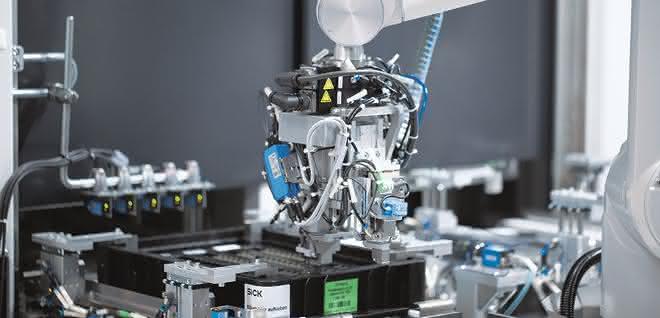
Where are parts located in the workpiece carrier that a robot can access? A question that is (still) solved in many places with complex camera systems. But there is a more efficient way: with the smart task functionality Load Mapping, which Sick has developed for all product families of smart optical sensors with IO-Link.
The implementation of placement control using smart sensors with load mapping functionality has decisive advantages. Compared to the use of complex image processing systems, it is often easier to integrate and more economical. Compared to the application solution with a sensor directly on the gripping element, the load mapping of workpiece carriers enables better OEE (overall equipment efficiency), for example in placement and assembly processes, because each slot no longer has to be scanned individually - which is time-consuming. This is demonstrated by the use of photoelectric proximity switches from the WTB4S-3 product family with integrated load mapping in a robot cell in photoelectric sensor assembly at Sick's 4.0 Now Factory in Freiburg-Hochdorf.
Flexible production requires reliable parts provision
The networked, smart factory with autonomous digital production and control processes is already a reality here. The ability to manufacture different products in individual batch sizes in twelve fully automated and networked production technology modules (PTM) requires flexibility and reliability in the provision of parts close to production.
In the PTM for equipping sensor housings with electronic cards, which are later used to operate the sensors, the components are stored in a tray memory. When a production order arrives via the network, the required tray is transported from the memory to the robot cell. Due to previous orders, for which the same tray may be stored and retrieved several times, it may have different fill levels, residual quantities and loading patterns.
In order for the robot to access the tray quickly and safely, it must receive information about the position in the tray where an e-card is available for removal. Today, this information is typically generated either by successive individual scanning of the slots in the tray using a sensor on the robot gripper - at the cost of a high proportion of non-value-adding process time, which reduces system efficiency. Or by using an image processing system, which is relatively expensive and complex to purchase, integrate and evaluate.
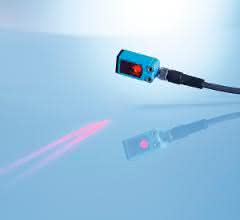
In contrast, Sick's load mapping approach ensures an optimization of the OEE and saves money, especially compared to an image processing system, as it only consists of "smart" standard sensors and an IO-Link master. Load mapping therefore enables efficient, cost-effective and production-related inventory management, especially in highly autonomous systems such as those in the 4.0 Now Factory.
Assignment of the workpiece carrier as a bit mask
The photoelectric sensors - in this application from the WTB4S-3 product family - with integrated load mapping are mounted above the infeed section of the trays in the robot's work area. Each sensor scans a row of slots as it moves in and detects the individual electronic cards one after the other. The resulting detection pattern is dynamically translated by the Smart Task in the sensor into a bit mask that reflects the assembly situation of this row of slots - "0" for an empty slot and "1" for an occupied, accessible slot.
The process takes place simultaneously in all installed load mapping sensors - the intelligent edge computing implementation thus provides a complete picture of the overall occupancy of the tray. In this way, the robot controller receives information from the light barriers as to where E-cards are present and converts this into gripping coordinates. No value-adding time is lost, as the placement check takes place simultaneously with the entry of the tray into the robot cell - and the exit back into the tray storage system at the end of the order.
The load mapping functionality is not only available for the WTB4S-3, but for all product families of smart sensors with IO-Link from Sick. This means that even larger trays and load carriers can be evaluated or sensors with greater working distances can be mounted - just as the specific application requires. If several load mapping sensors are used in one task, they can be combined via their IO-Link interface using Sensor Integration Machines (SIM) such as the SIM1004 (with four connections) or the SIM1012 (with twelve connections). This simplifies sensor integration and at the same time reduces the communication load - because the robot controller then does not communicate with each sensor individually, but instead queries the first equipped and accessible position in the tray in the SIM, for example.
Tray placement control is one of the first applications of the load mapping functionality. Others are currently undergoing feasibility tests, pilot projects and concrete implementation. Areas of application include the monitoring of drill and tool changes in machine tools, joining and assembly processes, filling and packaging applications and the localization of errors in various forms. as


You might also be interested in
Basler acquires 76% of Indian image processor
Basler, supplier of image processing components for computer vision solutions, has acquired 76% of the Indian sales partner Alpha TechSys Automation.
 read more...
Process monitoring and fault detection
Cameras ensure quality during laser melting
Powder bed-based laser melting (PBF-LB/M) opens up new possibilities in additive manufacturing. Modern camera systems provide crucial process data to further increase quality and efficiency.
read more...Vision Sensor is three times faster than its predecessor
The 'CS-62' vision sensor from di-soric is around three times faster than its predecessor, the 'CS-60'. In combination with the 'nVision-i 25.1' software, it enables image processing solutions that were previously reserved for smart cameras.
read more...Thermal imaging cameras for quality control
Automated thermal imaging cameras are often suitable for quality control applications where temperature plays a role. However, while there are various solutions on the market for slow processes, it is challenging to select a camera that reliably...
read more...Easy entry into industrial VGA thermography
Reliable temperature measurement is a prerequisite for the success of many industrial processes. Berlin-based manufacturer Optris presents the Xi 640 infrared camera, a new member of its Compact Line, which enables non-contact temperature...
read more...Powder bed-based laser melting optimized
Aconity3D has set itself the goal of optimizing the stability of the manufacturing method of powder bed-based laser melting and thereby promoting its use in a wide range of industries. By using high-speed industrial cameras from SVS-Vistek, the...
read more...INDUSTRIAL Production Products of the year...
2nd place, category handling, assembly and production logistics: SICK
safeVisionary2 is the first 3D time-of-flight camera with Performance Level c safety certification. It enables safe three-dimensional environmental detection and won 2nd place in the competition for Product of the Year 2024 in the handling, assembly...
read more...Nomination Products of the Year 2024
SICK: Camera systems safeVisionary2
safeVisionary2 is the first 3D time-of-flight camera with Performance Level c safety certification. It enables safe three-dimensional environmental detection and has been nominated in the 2024 Product of the Year competition in the handling,...
read more...AI vision brings additional opportunities
The seamless integration of AI into the consumer sector has helped to improve our quality of life and make interactions with technology more efficient. In industry, AI vision with machine learning opens up new possibilities that are not covered by...
read more...