

Setting and measuring device
Set turning tools to an accuracy of 1/100th of a degree
Hardly any technical element has to be manufactured more precisely than medical components. This applies in particular to bone screws and implants that are to be inserted into the human body. Not only is special care required here, but batch size 1 is also not uncommon in this context - as are extremely small dimensions in the diameter range of well under 1 millimeter.

The requirements for manufacturing these components, which are often produced on sliding headstock lathes, are correspondingly high. Optimally adjusted tools, especially for the center height, are the basis for perfect production results. The Hyperion presetting and measuring machine from Zoller, an expert in setting, measuring, checking and managing cutting tools, can be used to set all tools for the Traub TNL machine series from the Index Group.
Turning tools from the roll
Changing tools on the linear slide of sliding headstock automatic lathes is always a particularly tedious task: limited space and poor accessibility are often standard. Not much installation space is required for the production of small parts. The operator is the one who suffers. However, there are now various changing systems that allow the tools to be set and measured outside the automatic lathe, making work easier.
The engineers at the automatic lathe manufacturer Index have pulled off a special coup with the Traub TNL series: The linear slide on these sliding headstock automatic lathes is designed as a turret with a CNC rotary axis. Thanks to the special arrangement of the tools, there is space for up to 24 cutting tools over an effective length of up to 1,444 millimetres. The turret has a radius of just 180 mm (Traub TNL20) or 250 mm (Traub TNL32). It has eight or ten stations for holding tools, whereby up to three tools can be installed in one tool holder. The particular advantage of this tool holder is the fast tool change from chip to chip. This is because the CNC rotary axis can move to any angular position with high precision and in a short time and thus set the tool position exactly - provided this is known.
From millimeters to degrees
A fixed position on the metric scale is usually defined for each tool on a linear slide. This position is approached with the linear slide and the corresponding tool can be fed.
If the linear axis is designed as a CNC rotary axis, as with the Traub TNL series, the metric dimension must be converted into an angle. The eight tool stations on the turret are each offset by 45° to one another. To select a tool, an angle is specified for the rotary axis. For the sixth tool holder, for example, the rotary axis moves to the value 225°. This corresponds to the position 765 millimetres on the linear slide, for example.
Set the tip height precisely
Whether the center height of the turning tool is actually at the 225,000° of the CNC rotary axis - the rotary axis can move to the angular position with this accuracy - can only be determined by a test cut - or a direct measurement of the turning tool on an external presetting and measuring device. For this purpose, the tool holder is inserted into a holder specially designed for Traub TNL machines in the horizontal setting and measuring machine Hyperion from Zoller. The holder on the turret table of the Hyperion is based exactly on the turret holder of the Traub sliding headstock automatic lathes. This allows the center height of the turning tool to be measured to an accuracy of one hundredth of a degree. This data is then transmitted directly to the machine's control system. Errors during data transfer are eliminated, the tools are positioned precisely using the CNC rotary axis and the machining results are perfect.
Three tools in one go
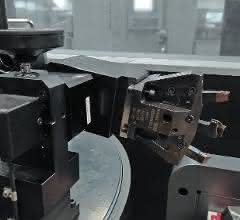
Measuring the center height of the triple tools is particularly complex. The middle position on the tool holders is specified as 0°, while the other two positions are specified as ± 13°, for example. However, as the components used, such as tool holders, clamping holders and cutting inserts, are also subject to tolerances, this results in deviations in real everyday production, which require exact measurement of the actual tip height of a tool. A tolerance of 1° at a distance of 200 millimetres between the origin of the rotation axis and the cutting insert edge corresponds to more than 0.3 mm on the circumference - far too much for delicate precision parts. A more accurate measurement of the tip height is therefore necessary.
The corresponding measured angle is then transferred to the control unit and the CNC rotary axis can move to the correct value.
The tool was previously measured correctly in the radial tool holder in its coordinates Z, X and angle value for the center height. The machine can automatically approach precisely these values and immediately produce dimensionally accurate parts - further infeed in the Y direction is not necessary. This means even faster from chip to chip, as only one CNC axis needs to be adjusted automatically and then everything fits.
Good reasons for precise measurements
Only precisely adjusted turning tools can produce exact components. And the smaller a component is, the greater the relative impact of deviations. The consequences of incorrectly set tools are far-reaching: If a slug remains when facing with tools set "under-center", the tool is used without a sufficient clearance angle when set "over-center". The result is a drastically reduced tool life, as the insert on the cutting edge bursts after only a short period of use. This in turn results in machine downtimes and increased tool costs, apart from the reduced production quality achieved by the poorly adjusted tool.
Materials that are difficult to machine, such as titanium or Inconel alloys, are often used in medical technology. These materials and cutting materials require precise coordination of the overall system in order to manufacture economically and keep set-up times to a minimum.


You might also be interested in
RS expands partnership with Phoenix Contact
RS Components has significantly expanded its range of products from Phoenix Contact. The distributor now supplies more than 45,000 products from the manufacturer of products, solutions and digitalization expertise for the electrification, networking...
 read more...
Component design via online tool
mbo Osswald aims to set new standards in the world of fastening technology with its new sleeve configurator. This tool was developed to design individual components for different industries precisely and in line with requirements.
read more...Competitive advantages with large machines
Whether 3D-printed components for machines and systems, prototypes or aids for design: additive manufacturing is almost indispensable for modern companies in mechanical and plant engineering and automation if they want to play in the premier league.
read more...Networking event at Schunk: Expert Days on...
Expert exchange at the highest level
On October 25 and 26, 2023, SCHUNK is once again organizing the Expert Days: an annual international and cross-industry event on the topic of "Robotic Material Removal". 70 specialists from Europe and North America will meet in Brackenheim-Hausen to...
read more...Transport technology from the modular system
Many transport tasks can be realized with the help of linear technology. Pre-configured solutions are available to simplify the interaction between the linear unit, motor, gearbox and controller. This minimizes the effort required for research and...
read more...Purchasing optimization for rolling bearing...
Best choice thanks to pre-classification
With the ABEG method, Findling Wälzlager has created a transparent and calculable decision-making basis for avoiding oversizing and undersizing of rolling bearings. This purchasing optimization helps customers to always select the technically and...
read more...Predictive maintenance on the smart drive
Baumüller offers a drive-based software solution to diagnose the machine status. The Smart Condition Monitoring tool runs on the PLC integrated in the drive controllers and uses the drive to record signals. Sebastian Maul, application engineer at...
read more...Siemens: continued profitable growth and...
Result April to June 2023: strong momentum
Siemens continued its profitable growth trajectory in the third quarter of fiscal year 2023 (ending June 30, 2023). All industrial businesses achieved strong revenue growth. The company also recorded strong order momentum for major projects and in...
read more...How production can benefit from AI
Together with AI technology, IIoT networking makes it possible to better control machine parameters and optimize quality with predictive quality. Downtimes and set-up times can also be further minimized. Cloud platforms also make these technologies...
read more...