

Quality assurance for fuel cell vehicles
6 Leak testing tasks in the production of components for FCEVs
Fuel cell vehicles (FCEV) carry their drive energy with them in the form of hydrogen.
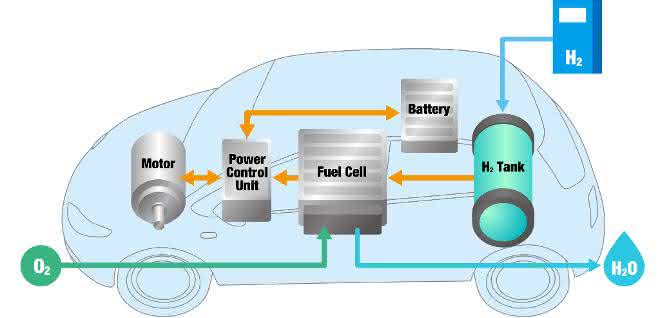
In the fuel cell, the controlled reaction of hydrogen with atmospheric oxygen produces water vapor - and the electricity that powers the vehicle's electric motors. However, hydrogen is highly flammable in a wide concentration range from 4 to 73 percent hydrogen in air. For this reason alone, the gas-tightness of the hydrogen-carrying components plays a very important role in the production of FCEVs.
Inficon, a specialist in leak testing and leak detection, has extensively investigated the various testing tasks on fuel cell vehicles. One finding: limit values and test methods are determined by the possible failure modes of the components. The following six FCEV components require a particularly reliable leak test.
1. the centerpiece: the bipolar plate
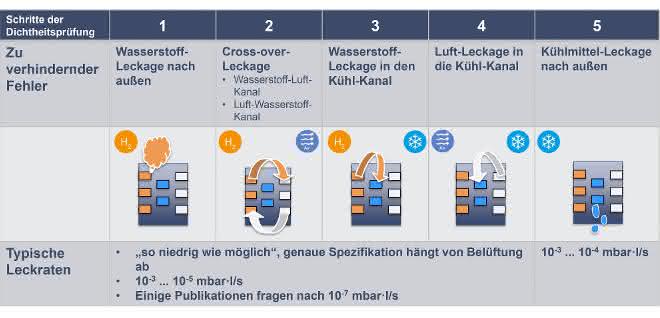
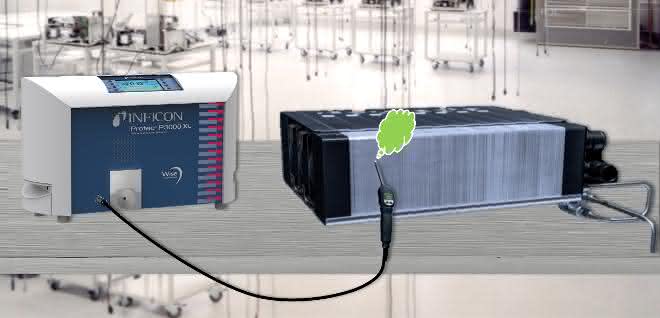
The fuel cell stack is like the heart of a fuel cell vehicle. And the heart of the fuel cell stack is its bipolar plates. The electrically conductive bipolar plates connect the anode of one cell to the cathode of the other. Several bipolar plates are stacked between the end plates of the stack, each separated by membrane electrode units. Each bipolar plate contains two cavities for the process gases hydrogen and atmospheric oxygen and usually also an internal cooling loop. Of course, no hydrogen should escape from the bipolar plates to the outside. There must also be no uncontrolled hydrogen-oxygen reactions due to so-called crossover leaks between the anode and cathode. The bipolar plates should therefore be tested using the sensitive vacuum method: in a vacuum chamber with helium as the test gas. The limit leakage rates are in the range of 10-4 to 10-5 mbar∙l/s. However, since we are talking about hydrogen, limit leakage rates of 10-7 mbar∙l/s, which are hundreds of times lower, are also being discussed.
2. reliable cooling circuits
Bipolar plates have a high-temperature cooling circuit. To avoid short circuits, the cooling medium must only have a low conductivity: As a rule, deionized water with an antifreeze additive is used. The liquid tightness of the cooling channel requires a test against leakage rates in the range of 10-3 to 10-4 mbar∙l/s - because the water itself seals leaks of this size. The vacuum method is also recommended here in the production line. This is because it combines high reliability with short cycle times.
3. assembled fuel cell stacks
Once the bipolar plates have been assembled into complete fuel cell stacks, it is time for end-of-line tests. Helium is also used as the test gas here, as all tests with hydrogen carry the risk of the fuel cell producing electricity unintentionally. In addition, gross leaks in the hydrogen circuit could quickly lead to ignitable hydrogen concentrations of more than 4 percent in air. The limit leakage rate that is still acceptable for the completed fuel cell stack also depends to a large extent on the specific installation situation in the vehicle. The leak rate at which an ignitable hydrogen concentration can occur ultimately has as much to do with the volume surrounding the fuel cell stack as with the air exchange there. In practice, assembled fuel cell stacks are usually tested against helium limit leak rates in the range of 10-3 to 10-5 mbar∙l/s.
4. hydrogen recirculation and media distribution plate
Hydrogen and atmospheric oxygen are fed to the membrane electrode units of the bipolar plates superstoichiometrically. In other words, residues of the two gases always remain during the reaction. This is where the hydrogen recirculation of the fuel cell comes into play. The process gas residues first pass through a water separator, then the hydrogen content is recirculated in order to be available again. In addition to the leak tests on the hydrogen recirculation, tests are also required on the media distribution plate of a fuel cell. It conducts hydrogen, air and coolant. Various valves and pumps must also be tested. For all these hydrogen-carrying components, tests against leakage rates in the order of 10-4 to 10-6 mbar∙l/s are recommended.
5. hydrogen tank bodies with high operating pressures
Type IV tanks made of composite materials are usually installed in FCEVs. Such tanks for passenger cars are designed to withstand operating pressures of up to 700 bar. Very large hydrogen tanks for buses must remain tight at operating pressures of up to 350 bar. International standards define the maximum permissible permeation rates. According to ISO 15869 B.16, this results in a helium limit leakage rate of 2.3 ∙ 10-2 mbar∙l/s for a passenger car hydrogen tank with a capacity of 30 l and a pressure of 700 bar. In practice, however, hydrogen tanks are often not only tested according to the standards, but against even smaller leak rates in the range of 10-3 mbar∙l/s - because any leak rate above the permeation of the material is evidence of a real leak. In addition to the vacuum method, the accumulation method with forming gas - a commercially available and non-flammable mixture of 5 percent hydrogen and 95 percent nitrogen - is also used to pre-test the tank bodies. This involves measuring how much hydrogen tracer gas escapes in a defined period of time and accumulates in a simple test chamber.
6. the testing of complete tanks with all fittings
Even after assembling the tank body with all the fittings - filling and outlet valves as well as pressure sensors - one more test is necessary: the so-called sniffer leak test. The finished tank is filled with either helium or forming gas and then sealed. A sniffer tip can now travel along the surface of the tank - especially at the connection points to the fittings as the neuralgic points. In automated, dynamic sniffer leak detection, a robot arm guides the sniffer tip. This avoids the error sources of human inspectors and ensures maximum throughput. However, the sniffer leak detectors must have a particularly high gas flow, as this is the only way the robot arm can move the sniffer tip over the test part quickly enough and with the necessary safety distance. The limit leakage rates for leak tests on finished hydrogen tanks are in the range of 5∙10-2 mbar∙l/s.
"E-mobility: Leak testing for vehicles with alternative drives"
A comprehensive e-book from Inficon covers the various testing tasks involved in the industrial production of components for Battery Electric Vehicles (BEV), Plug-in Hybrid Electric Vehicles (PHEV) and Fuel Cell Electric Vehicles (FCEV). It is available for free download here.


You might also be interested in
Protection against electrostatic discharge
StoFloor ESD KU 614 from StoCretec: dissipative flooring with the latest technology meets all ESD standards, is economical, extremely durable, mechanically and chemically resistant. The surface can be adjusted to be slip-resistant. The system is...
 read more...
Cables and wires from Helukabel
Food cultivation on a new level
Vertical farming - cultivation in multi-storey greenhouses - is considered one of the most exciting trends in food production. One of the pioneers in this field is the Romanian start-up Ultragreens. The company relies on solutions from Helukabel to...
read more...Further training for specialists to become security experts
With the "CESA - Certified Expert for Security in Automation" qualification, automation expert Pilz offers a two-day expert course designed to provide participants with compact security knowledge in line with the latest standards.
read more...Meaningful data on the service life of the seal
Seals prevent substances from penetrating or entering technical components. The intelligent seals from Freudenberg Sealing Technologies can significantly expand this core task in the future: the seal itself is also a sensor and becomes a "smart...
read more...Online stud configurator according to drawing
For standard bolts, with head, thread or hole
For standard bolts, with head, thread, bore or as a version with recess, mbo Osswald configurators map the standard specifications, are very easy to use, take a lot of work off the user's hands and save a lot of time.
read more...Safe palletizing with the Cobot
Verla-Pharm's medicinal products and food supplements have been available for decades. Ever-increasing throughputs result in ever-increasing logistics costs, whereby optimum utilization of the available production space is necessary.
read more...The tiger among processors
Since the move towards the Industrial Internet of Things (IIoT) and Industry 4.0 has picked up speed, processor boards and modules must be able to process exponentially growing amounts of data.
read more...VDWF publishes "Sustainability Compendium"
Nowadays, nobody can avoid "sustainability": In addition to a far-reaching presence in the media, it is also becoming increasingly important for companies in the tool and mold making industry to develop and implement appropriate concepts.
read more...More transparency and synergies with QM software
Weber, manufacturer of wood and metal sanding machines and extruders, has reorganized its quality management with ConSense IMS Professional. The software solution enables transparent documentation and more efficient processes.
read more...