

Surface inspection
Perfect measurement of glass displays
Isra Vision is presenting new versions of the deflectometry system for measuring reflective surfaces at Control. The measurement technology for glass displays and shiny components provides data for product and process optimization, even for curved components.
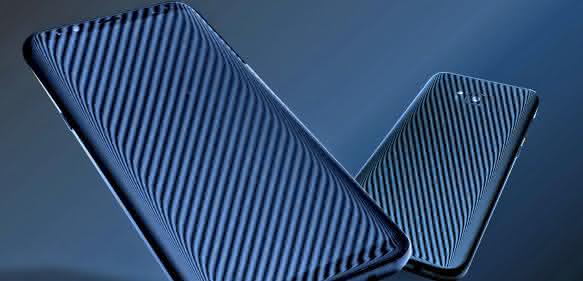
Worldwide sales of tablets, smartphones and smartwatches amount to billions of devices every year. To ensure a flawless aesthetic impression and the correct functioning of touch surfaces, each individual display must be checked for defects. Now, new variants of a deflectometry system for measuring reflective surfaces offer precise inspection of curved display and cover glass. Housing components, curved car interior elements and painted components are also included in the scope of application.
The new system variants of the Specgage3D measure reflective and transparent surfaces using the incident light (curved type) or transmitted light (transmission type) method. Up to twelve cameras observe the reflected and distorted fringe images on the object, which are projected onto the test surface by an LCD display. The object geometry is reconstructed solely from the recorded image sequence using photogrammetric methods.
Curved displays in particular can be inspected right up to the edges. In addition to defects on the substrate surface, the transmitted light method for transparent objects also detects inclusions and defects in the glass as well as defects that cause distortions simply by varying the refractive power. Collected inspection data serves as a basis for adjusting process parameters during glass treatment such as temperature, bending speed, cooling time and similar factors to an optimum. As a result, users achieve high product quality and sustainably reduce production waste.
Rejected defective products save costs and material compared to the final inspection: they do not consume any additional components and do not require any further production capacity. Comprehensive quality control also prevents customer complaints as well as cost-intensive damage to the production system. as
Hall 4, Stand 4106


You might also be interested in
Basler acquires 76% of Indian image processor
Basler, supplier of image processing components for computer vision solutions, has acquired 76% of the Indian sales partner Alpha TechSys Automation.
 read more...
Process monitoring and fault detection
Cameras ensure quality during laser melting
Powder bed-based laser melting (PBF-LB/M) opens up new possibilities in additive manufacturing. Modern camera systems provide crucial process data to further increase quality and efficiency.
read more...Vision Sensor is three times faster than its predecessor
The 'CS-62' vision sensor from di-soric is around three times faster than its predecessor, the 'CS-60'. In combination with the 'nVision-i 25.1' software, it enables image processing solutions that were previously reserved for smart cameras.
read more...Thermal imaging cameras for quality control
Automated thermal imaging cameras are often suitable for quality control applications where temperature plays a role. However, while there are various solutions on the market for slow processes, it is challenging to select a camera that reliably...
read more...Easy entry into industrial VGA thermography
Reliable temperature measurement is a prerequisite for the success of many industrial processes. Berlin-based manufacturer Optris presents the Xi 640 infrared camera, a new member of its Compact Line, which enables non-contact temperature...
read more...Powder bed-based laser melting optimized
Aconity3D has set itself the goal of optimizing the stability of the manufacturing method of powder bed-based laser melting and thereby promoting its use in a wide range of industries. By using high-speed industrial cameras from SVS-Vistek, the...
read more...INDUSTRIAL Production Products of the year...
2nd place, category handling, assembly and production logistics: SICK
safeVisionary2 is the first 3D time-of-flight camera with Performance Level c safety certification. It enables safe three-dimensional environmental detection and won 2nd place in the competition for Product of the Year 2024 in the handling, assembly...
read more...Nomination Products of the Year 2024
SICK: Camera systems safeVisionary2
safeVisionary2 is the first 3D time-of-flight camera with Performance Level c safety certification. It enables safe three-dimensional environmental detection and has been nominated in the 2024 Product of the Year competition in the handling,...
read more...AI vision brings additional opportunities
The seamless integration of AI into the consumer sector has helped to improve our quality of life and make interactions with technology more efficient. In industry, AI vision with machine learning opens up new possibilities that are not covered by...
read more...