

Measurement technology
Precise flow measurement for large pipes
Precise ultrasonic sensors allow the flow rate to be measured accurately even in very large or difficult to access pipes.
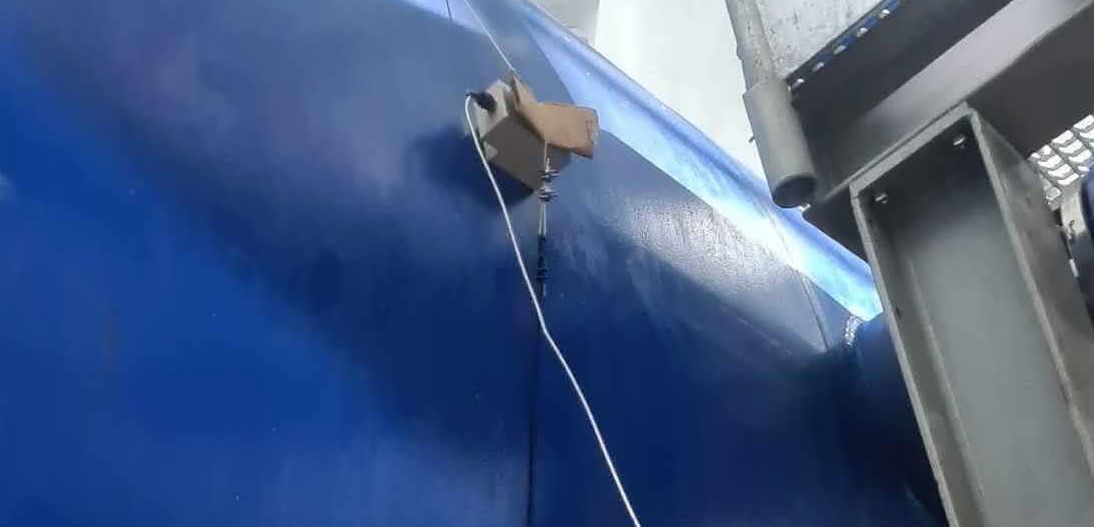
Systec Controls' sales partner in the Philippines, Rizal, was given the task of carrying out a pressure pipeline test in XXL-diameter conical pipes at a flow rate of 24 to 27m3/s. The pipeline was more than 10 years old and had to be tested with existing layers of paint. The pipeline, which was more than 10 years old, had to be tested with existing layers of paint. The aim of the measurement was to collect valuable data such as flow rate and total volume of flowing water. The latest software features used in the DeltawaveC-F ultrasonic flow meter were crucial for the precise measurement. The signal optimization and improved signal evaluation of the new hardware generation in particular ensured the success of the measurement.
To reliably rule out incorrect measurements, Deltawave transmits coded signals similar to a Morse code. The digital signal processor then searches for the transmitted code in the received signal. If it finds a deviating signal, the signal is discarded. This virtually eliminates false measurements caused by noise. This is made possible by the powerful ultrasonic transducers, which cleanly convert such coded transmitted signals into ultrasonic signals.
Thanks to the Auto-Optimizer, DeltawaveC also has problematic measuring points well under control. Pipe and fluid are a complex sound system. The acoustic characteristics determine how well the coupling of the ultrasonic signals works and how much the signals are distorted. Signal strength and distortion influence the accuracy and reliability of the measurement. High signal levels provide reserves in the event of interference, for example in the form of gas bubbles, growing incrustations, EMC or fouling in the pipe. Thanks to the signal optimization, the desired accuracy was achieved despite the relatively short inlet section at the Philippine measuring point.
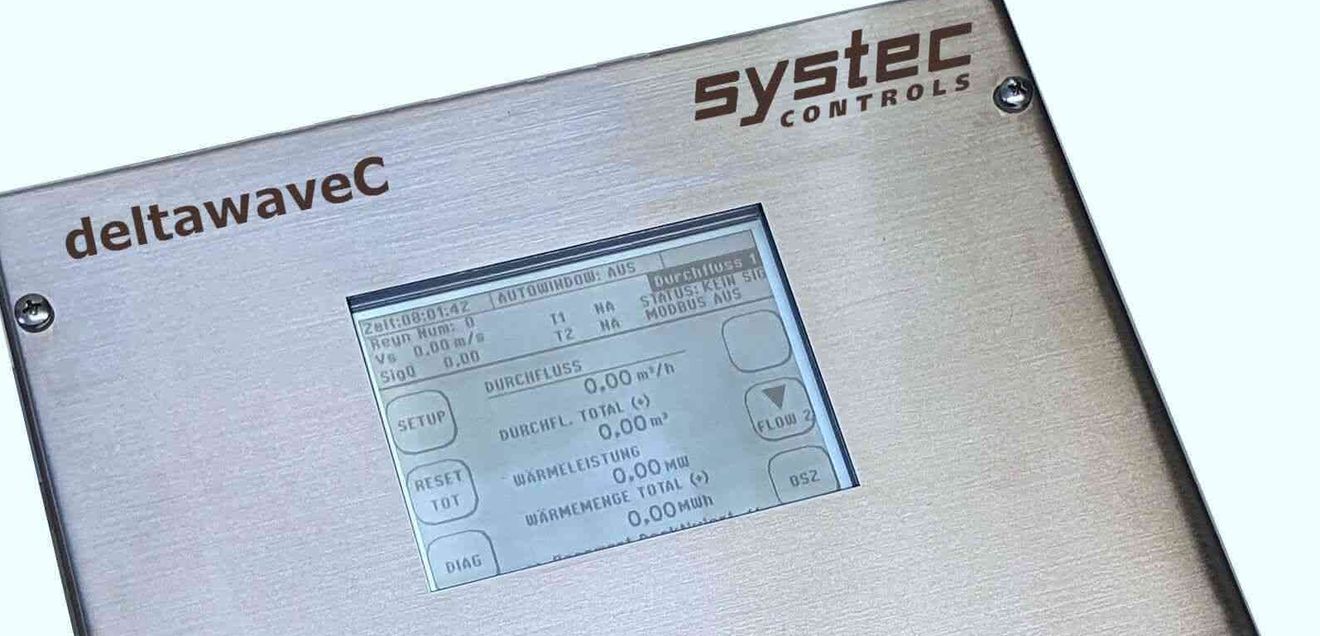
Precise measurement thanks to automatic signal generation and evaluation
The distortion of the received signal and the achievable signal level depend on the quality of the coupling, but also on whether the transmission frequency harmonizes well with the frequency spectrum of the pipeline. The variation of the signal frequency and the selection of the transmission signals with different excitation and attenuation components was previously reserved for experts using an oscilloscope. With cross-correlation, the ultrasonic scans of the upstream and downstream signals are superimposed and shifted until optimum "coverage" of the signals is achieved. The improved signal processing helps to maximize the quality of the measurement data and thus achieve precise measurement results.
The automatic signal optimization facilitates "impossible" clamp-on measurements, i.e. measurements with ultrasonic transducers resting on the outside of the pipe wall. At the touch of a button, DeltawaveC varies the transmission frequencies and signal coding and analyzes the results in terms of amplitude, signal-to-noise ratio, signal distortion and significance of the cross-correlation results. This evaluation provides the optimum settings at this measuring point. The automatic signal optimization significantly improves the signal quality, especially with unfavourable line-sensor combinations: the measurement has smaller zero point errors, higher accuracy, lower measured value noise and more reserves against influences such as gas bubbles, solids or EMC interference. Even at simple measuring points, signal optimization reduces zero point errors and allows more dynamic measurements.
Ideal for hard-to-reach measuring points
Used far away from civilization, the DeltawaveC-P ultrasonic flow meter, in combination with a solar panel and the WakeUp function, is the ideal solution for cyclical measurement processes on liquids and an energy self-sufficient endurance runner. Using the wake-up function - a kind of energy-saving program - a measuring cycle can be extended to several days without an additional power supply.
In energy-saving mode, for example, the flow meter developed by Systec Controls has a battery life of 700 hours with a one-minute wake-up time per day. If measurements are taken for one minute per hour, this still equates to 450 running hours. If measurements are taken for 1 minute every 2 minutes, the wake-up function ensures 37 hours of battery operating time. Using the wake-up function, the user can tell the DeltawaveC-P, for example, "Wait 12 hours, measure 12 hours, wait 12 hours, measure 12 hours." For example, the WakeUp Logger's battery lasts for 21 days with a total of 360 minutes of measurement per day. Unlimited measuring is possible in combination with a solar panel.


You might also be interested in
From sensor to intelligent system
Sensors, measurement technology and artificial intelligence are merging to form intelligent systems. From June 9 to 11, 2026, Sensor+Test in Nuremberg will showcase the most important trends in a changing industry.
 read more...
Measurement software with integrated calibration wizard
The WinControl measurement software from Ahlborn is designed for the acquisition and processing of measurement data with Almemo measuring devices and offers functions for complex calibration tasks. A graphical user interface and context-sensitive...
read more...How measured values are turned into decisions
Systems constantly generate measured values - but many of them disappear into systems that nobody actively uses. The problem is not the amount of data, but how it is collected. Only when information is available without detours and converges in a...
read more...Students at Darmstadt University of Applied Sciences test driverless racing system
The student racing team at Darmstadt University of Applied Sciences is developing an autonomous driving system for the electric racing car "F26" with expertise in image processing and computer science.
read more...Quality inspection with fast measurement workflows
Hexagon's Stationary Division presents Maestro, a next-generation coordinate measuring machine (CMM) that transforms quality inspection with fast, networked measurement workflows. The solution has been developed from the ground up with the...
read more...Performance up, costs down
A transparent overview of the devices actually installed is the prerequisite for targeted maintenance, forward-looking risk management and reliable investment planning. The dynamic analysis of the installed base creates this basis by creating...
read more...Maintenance with a view to efficiency
At Maintenance, RS offers an overview of its range of products and services. From consumption meters and frequency inverters to power supplies and measuring and testing devices, the company provides support in the selection of products and solutions.
read more...Installation tester and current clamp
At Maintenance, Conrad will be providing an overview of its services as a solution provider in the field of technical procurement and showcasing a number of measurement technology innovations.
read more...Digitization of the entire value chain
At SPS 2025, ifm will be demonstrating how the digitalization of the entire value chain can be implemented in practice. In an interview, Michael Marhofer, CEO of the ifm group of companies, explains which technologies are in focus, which industry...
read more...