

Sensors and test automation
Safely tested all round
At Control, the Kistler Group will be showcasing its expanded portfolio of industrial testing systems. In addition to the automatic testing and sorting machines from Vester, the focus will be on the application areas of force and torque sensors and screwdriving technology. The world's first digital charge amplifier will also be on show.
With increasing demands in terms of performance and conformity to standards in industrial production, quality assurance plays an important role. With two stands at the trade fair, the Kistler Group will be demonstrating how production processes can be optimized to achieve competitive advantages.
Test automation for stamped, bent and turned parts
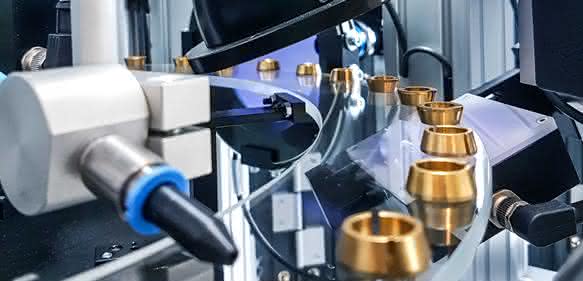
Vester Elektronik, which recently became part of Kistler, will be presenting three automatic testing and sorting machines for stamping and forming technology as well as for testing individual series parts on a separate stand. With the help of powerful image processing systems, dimensional and surface inspections, optionally also gauge and hardness tests, are carried out fully automatically. The digital camera technology used ensures 100 percent inspection of mass-produced parts with high throughput. The Smart Ray 3D laser triangulation sensor in the inspection process of the glass plate machine will also be presented. This makes it possible to measure previously unrepresentable height profiles and shape and position tolerances - such as flatness - on the test object.
"Thanks to Vester, industrial image processing is now also part of the Kistler Group's comprehensive expertise. We are taking this opportunity to set up a Vision Center in Karlsruhe to further develop the relevant technologies," says Frank Kirgis, Head of the Industrial Process Control (IPC) Division at Kistler.
Universal screw testing on site
Kistler's mobile testing systems create the conditions for efficient and standard-compliant quality assurance of bolted joints, tools and systems. The Inspectpro portable measuring and evaluation device enables convenient testing of the torque and angle of rotation of bolted joints. Assembly processes can be analyzed graphically to ensure optimum quality during screw assembly. In order to carry out tests even faster and more effectively, specific software modules are developed according to customer requirements, which make handling easier for the user and testing processes more transparent.
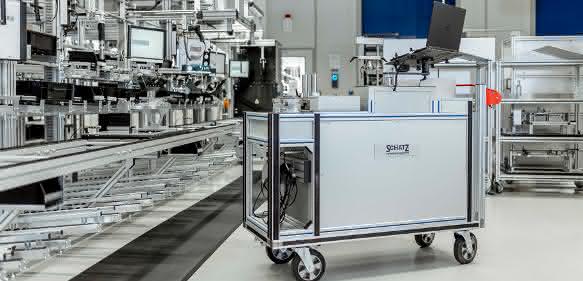
The Combitest mobile testing system combines the ability to calibrate manual torque wrenches with the testing of automated screwdriving systems. This means that all tools on an assembly line can be tested directly on site and their process capability ensured.
Integrated process monitoring
Thanks to their robust design, piezoelectric sensors from Kistler keep a precise eye on quasi-static and highly dynamic force processes, even under difficult production conditions. Compared to other technologies, they offer the advantages of proportionality, short measuring paths and a long service life.
In addition, very small forces can also be measured: Kistler is presenting a portfolio of sensors at Control, including sensor types that can be used in confined spaces thanks to miniaturization.
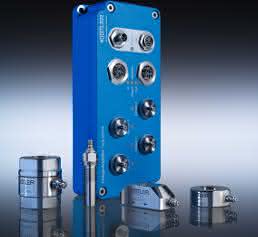
Last but not least, there will also be an innovation in Stuttgart: the world's first digital charge amplifier provides a direct Ethernet connection (via Profinet, Ethercat or Ethernet-IP) of any piezoelectric sensors to the control system and thus offers more data consistency and transparency in the sense of Industry 4.0 - excluding analog interference variables. It also has a variety of measuring functions on four individually controllable channels. With up to 10,000 bus cycles per second and 50,000 measured values per channel and second, it is ideally suited for precise and time-critical control. as
Hall 6, Stand 413
Hall 7, Stand 313


You might also be interested in
AI automation specialist reorganizes...
Generation change at Insiders Technologies
After almost 30 years at the helm, Werner Weiss is handing over the management of Insiders Technologies. Andree Albrecht takes over the management after a transition phase.
 read more...
Intelligent brownfield networking
Many industrial companies are struggling with established plant structures and proprietary interfaces. Stefan Klaus' presentation will show in a practical way how brownfield environments can be efficiently networked with open technologies and made...
read more...Factory-X in practice
How can set-up processes in highly variant production be automated efficiently? Markus Benndorff from soffico shows how Factory-X, industrial data rooms and modular architectures create new possibilities for flexible production concepts.
read more...Quality controls in production
Robots check car floor pans fully automatically
How can complex components in automotive production be inspected fully automatically and in real time with the help of machine vision and robotics? The case study shows how floor pans are measured and inspected fully automatically.
read more...Measurement software with integrated calibration wizard
The WinControl measurement software from Ahlborn is designed for the acquisition and processing of measurement data with Almemo measuring devices and offers functions for complex calibration tasks. A graphical user interface and context-sensitive...
read more...New platform facilitates chip design
Siemens opens access to EDA software in Europe
Siemens is cooperating with the Chips JU within the framework of EuroCDP and is facilitating access to modern EDA software for chip design, development and innovation for European companies. The aim is to strengthen start-ups, SMEs and research...
read more...AI and virtual twins for the industry
Dassault Systèmes confirms annual forecast after solid start to 2026
The French software group Dassault Systèmes has made a solid start to 2026 and is continuing to focus on artificial intelligence, cloud applications and virtual twins as growth drivers in its industrial business.
read more...Use data consistently and uniformly
New connectors and an app solution for the IIoT framework from PLCnext Technology make it easier to collect data from controllers, sensors and field devices - especially in existing systems.
read more...How companies can prevent cyberattacks
Instead of using traditional malware, attackers use legitimate programs and system tools within their victims' IT environments. Malicious behavior can hardly be distinguished from normal user behavior. For companies, this means that security...
read more...