

Real-time quality control
IT meets food technology
Compliance with high standards in food production ensures comprehensive consumer protection, the economical use of raw materials and the avoidance of higher production costs and complaints. Overall, these are high requirements for the quality assurance process, which is currently "often only carried out on a random and retrospective basis", says Professor Oliver Niggemann, Director of the Institute for Industrial Information Technology (inIT).
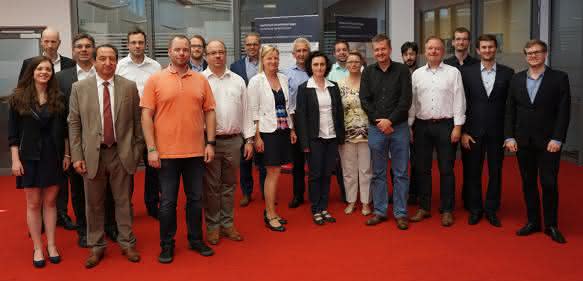
Researchers at inIT and the Institute for Food Technology NRW (ILT.NRW), both institutes at OWL University of Applied Sciences in Lemgo, are therefore working with partners from the (food) industry to develop a methodology that enables continuous, predictive monitoring of the entire food production process. This is where the IP1 research project comes in: A model of the products, a so-called "virtual image", is to be generated from sensor data and raw material information during production.
The virtual images can be used in quality control to monitor standards and specification values.
"The virtual image can be used to access real-time information such as product properties and food quality, largely without time-consuming laboratory tests or additional costly sensor technology," explains project manager Niggemann. To this end, the inIT researchers are harnessing the benefits of cyber-physical systems: Model formalisms are being developed that both allow the prediction of all relevant product properties and support model learning during operation.
The virtual images learned can be used in quality control, for example, to monitor standards and specification values. The target values determined along the process chain are compared directly and immediately with the actual values derived from the virtual images. "This approach makes it possible to identify faulty batches and safety risks while production is still underway and remove them from circulation in order to minimize safety risks and protect consumers," says Professor Jan Schneider, Deputy Director of the ILT.NRW, explaining one of the aims of the research project. Furthermore, due to the real-time forecasts of process or raw material fluctuations, the aim is to improve "space, time and raw material yield", which can give food producers a competitive advantage. as


You might also be interested in
Plagiarius 2024 negative prize
On January 26, 2024, the Plagiarius campaign awarded its dreaded "Plagiarius" negative prize for the 48th time to manufacturers and retailers of particularly brazen counterfeits and fakes.
 read more...
Ivalua honors winners of the Generative AI...
AI-supported "add-ons" for buyers within 48 hours
Ivalua, provider of cloud-based spend management solutions, announced the winners and innovations of the first Generative AI Innovation Cup. The competition took place in December 2023. It was open to all Ivalua partners and employees - more than...
read more...Efaflex celebrates 50 years of high-speed...
The emphasis is on "fast"
Since day one, Efaflex has wanted to use new technologies as early as possible and drive progress in the industry. This year, the family business is celebrating its 50th anniversary under the motto "Fast Forward".
read more...Security of supply even during power outages
In the winter of 2022, Germany was worried about energy shortages. The drugstore retailer dm did not paint any horror scenarios, but nevertheless saw the possibility of controlled, temporary, regional power cuts (brownouts).
read more...Safety technology in mechanical engineering
Modules with new functions
Euchner's product highlights at EMO 2023 include the communication-capable solenoid interlocks.
read more...Transforming the paper industry towards climate neutrality
Together with partners from industry and research, Voith is developing a project for the optimization of energy and material flows in paper production. The aim of the research project is to develop a digital framework that enables effective process...
read more...Up to 95 percent less flue gas thanks to direct extraction
The requirements for occupational safety measures and safety technology are also constantly increasing in welding technology. The Technical Rules for Hazardous Substances (TRGS) stipulate that welding fumes and harmful substances must be extracted...
read more...Competitive advantages with large machines
Whether 3D-printed components for machines and systems, prototypes or aids for design: additive manufacturing is almost indispensable for modern companies in mechanical and plant engineering and automation if they want to play in the premier league.
read more...Transport technology from the modular system
Many transport tasks can be realized with the help of linear technology. Pre-configured solutions are available to simplify the interaction between the linear unit, motor, gearbox and controller. This minimizes the effort required for research and...
read more...