

High-precision measurement
Fast measurement with high precision
When it comes to high-precision measuring in three-shift operation, slow processes and complex conventional measuring technology strain patience, effectiveness and efficiency. With a new measuring device, the long-established Swabian company Stihl has significantly accelerated the quality inspection of crankshafts and connecting rods at its main plant in Waiblingen. The Leitz PMM-C 3D coordinate measuring machine and a highly parameterized software are used, which allows for self-inspection even for complex measurements.
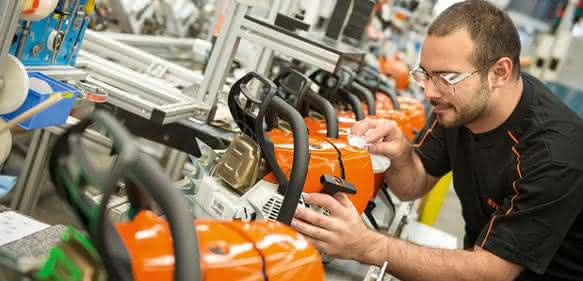
Chainsaws from Stihl are in demand worldwide. The Stihl Group develops, manufactures and sells numerous power tools for forestry, agriculture, landscaping, the construction industry and the discerning private user. The range extends from blowers to cut-off grinders, from augers to cleaning equipment across more than ten product groups. Founded in 1926, the Swabian family business employs around 15,000 people worldwide and significantly exceeded the three billion euro turnover mark in 2015.
In Plant 1 at the company headquarters in Waiblingen, the company has upgraded its metrological equipment in the Crank Drive Center. The previous equipment has been replaced by a 3D coordinate measuring machine of the ultra-high accuracy class. The heart of the engine-powered Stihl machines is produced in the Crank Drive Center: the crankshafts and connecting rods. Their perfect running is the basis for optimum performance, low vibration and the longevity of every engine. "What we manufacture here are central precision parts with the tightest tolerances in the micrometer range," explains Stefan Baumert, Crank Drive Quality Planning Officer in Waiblingen.
"Basically, we carry out both series production and acceptance tests," continues the graduate engineer. This primarily involves shape and position measurements, i.e. testing roundness, parallelism and cylinder shape - to name the most important features. This requires a lot of dexterity and patience. This was precisely the challenge, especially when it came to testing during series production. As they are too complex for a worker self-inspection in production, the measurements during series production - in addition to the acceptance tests - also had to be carried out by QA specialists in the precision measuring room. "We had various measuring devices at our disposal for this, such as form measuring devices," Baumert recalls. "However, multiple systems also meant multiple efforts - just for the constant re-clamping of the test part for each individual measuring procedure."
Things became difficult when the precision measuring room was barely able to cope with the 24/6 operation with its personnel capacity. "To eliminate this bottleneck, we increasingly had to call in employees from production to carry out the tests in the precision measuring room," says Stefan Baumert, describing the situation. This required extensive training, qualifications and subsequent support for the production employees.
In addition, there was the influence of the operator: although the devices were very accurate, they lost a lot of measuring precision on the user side - for example, when manually aligning the crankshafts when recording line markings. "If you then also have to meet the highest demands in terms of documentation and reproducibility of the measurement results, you quickly reach the limits of what is feasible," says the quality planner. The need for action was therefore very clear. "The aim was to make the entire process faster, more effective and more economical, to have less operator influence in the measuring process and to obtain reproducible results."
Accuracy and repeatability
After intensive market research and a critical selection process, Stihl opted for the solution from Hexagon Manufacturing Intelligence and the associated coordinate measuring technology from Leitz. "The specialists from Hexagon were the ones who were able to explain to me most convincingly how our requirements could be implemented - also in terms of the software's range of functions," says Baumert.
"We were able to demonstrate that we can meet the accuracy requirements in the micrometer range with the selected Leitz PMM-C ultra-high-precision coordinate measuring machine by carrying out measurement tests together with the customer on their components in Wetzlar," explains Gerhard Ehling, Regional Sales Support Manager at Hexagon and coordinator of the Stihl project. "Equally important was the proof of a corresponding capability analysis for repeatability."
The Leitz PMM-C is a 3D coordinate measuring machine in portal design with a fixed portal. It combines maximum accuracy with extraordinary speed and thus guarantees high measuring throughput. The device can handle any complex measuring task quickly and economically and can even be used as a gear measuring center. The cast iron construction and granite base bed guarantee long-term stability, high rigidity of the measuring axes and consistent accuracy throughout the entire measuring volume.
The high measuring speed is made possible by the servo drive with recirculating ball screws, which accelerates very quickly even over short distances, while the positioning remains extremely reliable. Decoupled X and Y axes ensure fast correction options and rapid recommissioning. Equipped with a Leitz probe head with integrated high-speed scanning, the PMM-C is characterized by its ability to capture even large quantities of points and is therefore also suitable for fast form measurement. Variable high-speed scanning ensures optimum measuring speed depending on tolerances and geometry. The system reduces its speed in the case of strong curvatures or tight tolerances.
Save time during acceptance and series testing
"The time we save during acceptance testing with the PMM-C is significant," says a satisfied Baumert. "Whereas with the previous equipment we needed a good 30 minutes for a complete measurement run of a crankshaft - partly due to the frequent reclamping - we now do it in just under seven minutes." The user-specific user interface based on Hexagon's Quindos measuring software plays a major role in the time saved. Stefan Baumert confirms: "Thanks to the clear user guidance and extensive parameterization of the measuring programs, our employees in the factory self-inspection department also have no problems using the system." "What's more, operator influence is virtually eliminated and the software delivers the optimum measurement results almost automatically in conjunction with the machine," adds Hexagon Support Manager Ehling.
Since mid-2016, Stihl has also been using the coordinate measuring machine to calibrate test equipment, such as gauges. Stihl has created a device specifically for this purpose, on which up to 40 gauges can be clamped and evaluated in one measuring sequence. The measuring program for this was again created by Hexagon. am
Control, Hall 5, Stands 5200/5202/5300/5400


You might also be interested in
Further simplify assembly processes
In addition to the proven racks with a length of one meter, Wittenstein alpha now offers optional two-meter racks for linear systems. They are particularly suitable for use in short axes, for example, in order to simplify assembly even further.
 read more...
Hiwin manufactures its own shaft gearboxes
Have you ever waited several months for an urgently needed corrugated gearbox? Hiwin has too. That's why the Offenburg-based drive specialist has decided to produce its own space and weight-saving reduction talent.
read more...Human-robot interaction at the trade fair
Sumitomo Drive Technologies is presenting its drive solutions for automation and robotics at Automatica 2023 together with the Lafert Group. The company will be showcasing two different applications of the Tuaka drive system for robot applications...
read more...Partial automation with robots
At Automatica, Promess will be showcasing its modular individual workstations and how these can be partially automated with robot support. The servo press manufacturer will also be providing information about the latest features of its Revolution X...
read more...A new benchmark for collaborative robots
At this year's Automatica, Denso Robotics will be showcasing its innovations in the field of robotics. The collaborative Cobotta Pro product family will be the focus of the presentations. Visitors to the trade fair can see all variants in various...
read more...Clamping system for a new milling machine
Investments in machinery often lead to further purchases - as is the case at Joma-Maschinenbau, whose modern production facility has recently been supplemented by a 5-axis milling machine.
read more...Schunk wants to simplify processes in automated production
The declared aim of automation specialist Schunk is to make its customers' processes comprehensible, simple and efficient. Data transparency plays an important role in this. It enables reliable processes and provides the basis for resource-saving...
read more...Festo and Hahn Automation develop battery tester for greater safety
The success and reputation of electric vehicle manufacturers depend on the safe and flawless functioning of batteries. Hahn Automation has therefore developed a battery tester that performs a fully automated 100% test of mobile energy storage...
read more...SPN Schwaben Präzision presents gearbox solutions for automation and industrial robotics
Short cycle times, robust technology, wear-free surfaces and compact designs have always been relevant for automation and robotics solutions. This year's Automatica trend topics include "Sustainable production" and "Digitalization and AI". SPN aims...
read more...