

Sensor+Test 2021
First Sensor presents solutions and new developments
First Sensor is using the digital Sensor+Test to present current products and new developments such as the MTE Efficiency pressure transmitter platform and the LHD Ultra series in a new way.
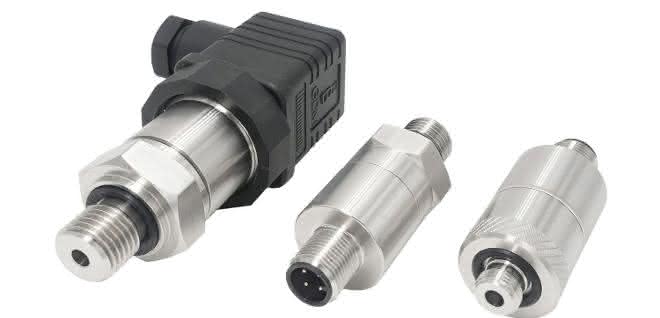
The new MTE Efficiency pressure transmitter platform offers exceptional cost-effectiveness for precision applications. The modular platform allows individual adaptations in the shortest possible time and stands for high accuracy and stability. It comprises the MTE7000, MTE8000 and MTE9000 transmitter series.
The MTE7000 series is based on piezoresistive pressure sensors and is particularly suitable for measuring dry, non-corrosive gases from as low as 10 mbar. The MTE8000 series, which is based on piezoresistive ceramic pressure sensor elements, consists of pressure transmitters with stainless steel housings and has a particularly high media compatibility for corrosive liquids and gases. The same applies to the MTE9000 series, in whose stainless steel housing fully welded stainless steel pressure sensor elements without internal elastomer seals are used.
Thanks to new production processes and a more compact design, users benefit from particularly low costs for all three series.
LHD Ultra - two elements in one housing
The new LHD Ultra series comprises high-precision 2-in-1 differential pressure sensors that combine two sensor elements with different pressure ranges in a single housing. Based on thermal microflow measurement in combination with First Sensor's own key technology - the integration of the microflow channel and the thermal MEMS sensor element on an SI chip - they measure a pressure range from 0 to 5,000 Pa. They offer maximum precision even in the lowest pressure range around the zero point. The models have a 16-bit analog-to-digital converter for the upper and lower ranges. A special averaging process results in a 24-bit resolution for the entire working range.
The overall accuracy is 1.5 percent (typical) of the measured value over the entire range from one to 100 percent of full scale. The models are equipped with a linearized digital I2C or SPI output as well as an integrated on-chip temperature sensor and a barometric sensor. The sensors also impress with their compact dimensions and wide range of applications.


You might also be interested in
Housing and inserts for plenty of power
Lapp presented the expansion of its Epic Power series at SPS 2023: four new M23 circular connector inserts and three new M23 housings. The special feature: all housings can be combined with any of the four inserts.
 read more...
News and product updates from Smartgas
Portable gas analyzers for outdoor use
Smartgas is starting the second half of the year with a series of updates to existing products and a number of new products. Portable analyzers expand the range of applications, while new accessories such as protective housings and heating modules...
read more...Everything accurate in switch cabinet construction
To ensure smooth work processes, tools for processing enclosures and housings must function flawlessly and reliably. Häwa rounds off its punching range with the Multi-Press 500.
read more...Shafts and conversion parts
The Rodriguez range includes ball bushings including matching housings, shaft brackets, crossbars and supports.
read more...Cooling and temperature control units
Hygienic packaging sells safely
In few industries are the requirements for hygiene in the production process as strict as in the food sector - the health of consumers has top priority. This results in enormous challenges for all machines and components involved, especially in...
read more...Simple tool change in seconds
With the CMS, Schunk is launching a user-friendly, manual change system for quick component replacement. In addition to its simple and convenient operation, the CMS also stands out with its extensive range of optional modules and complementary end...
read more...Motion controller for small drives
Medium power range covered
Faulhaber has another housing-less and compact motion controller in its range, which is particularly suitable for integration in device construction and medical technology applications.
read more...Welding solutions in the name of resource efficiency
At the Welding & Cutting trade fair in Essen (September 11-15), Fronius will be focusing on the major drivers in welding technology. Quality requirements are increasing in all industries, but the required welding specialists are scarce. In...
read more...Safe solutions for cable installations
From thick power cables to thin sensor lines, cables and lines must be routed safely through systems and machines. A challenge that should not be underestimated, explains Jörg Sokat, Head of Product Management at Pflitsch.
read more...