

Compartment fine positioning
Always in front of the right compartment
Camera-based positioning sensor. High-bay warehouses are constantly in motion due to different loading conditions, temperature-related expansion or manufacturing tolerances. It is a challenge for the sensor technology to ensure trouble-free compartment fine positioning of the storage and retrieval machine in this environment. This is where Leuze presents the IPS 200i.
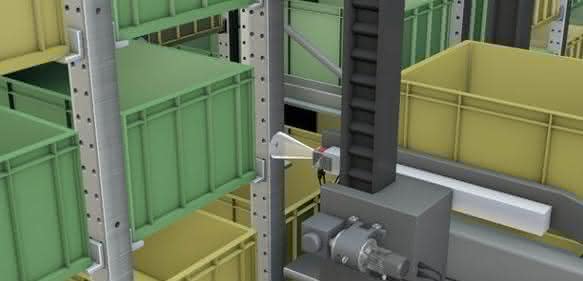
In the course of Industry 4.0 and IIoT, users also increasingly expect diagnostic options and predictive maintenance of sensor technology. This requires the exchange of diagnostic and parameterization data with the sensor. Camera-based positioning systems with an evaluation algorithm tailored to the specific application combine these performance features and often achieve the goal faster and more elegantly than previous solutions that used several conventional binary sensors. Solutions in which the camera and evaluation unit are integrated into a compact system are particularly popular with users. They enable simple commissioning and operation without specialist knowledge. With the IPS 200i, Leuze electronic is launching the smallest camera-based sensor for compartment fine positioning of storage and retrieval machines on the market, which helps to reduce downtimes of storage and retrieval machines by providing an additional quality indicator and thus meets the demand for condition monitoring.
System downtime is avoided
With the IPS 200i, Leuze offers an alternative to the previous upright and transom positioning with several diffuse reflection light scanners. Time-consuming mounting, alignment and readjustment during operation is no longer necessary, saving the customer time. The IPS 200i uses a quality indicator to report changes to the sensor or shelf compartment; this indicator helps to detect special features such as soiling or an overhanging film at any position. The system area at risk can be localized in good time, thus preventing system downtime due to incorrect positioning. The key figure also helps to identify special features that precede a system failure in order to filter out individual system components at risk in good time. This information can be used to plan maintenance times in advance, minimize downtimes and increase efficiency. Thanks to the integrated web server, all relevant data can be called up worldwide via global access without having to access the control system.
The IPS 200i enables quick and easy commissioning and operation. The web-based, multilingual configuration tool with a user-guided wizard reduces commissioning time to a minimum. The IPS 200i can also be configured via XML commands or intuitively commissioned and operated using just two buttons without a PC connection. Innovative feedback LEDs provide direct feedback. Similar to an acoustic distance sensor in a car, the position of the marker relative to the sensor is indicated by the four LEDs on the side. Each side LED corresponds to a single quadrant. If the marker is located in one of the quadrants, the corresponding LED flashes. If the marker is in the center (coordinate origin), all four LEDs light up simultaneously; the sensor is then optimally positioned. In alignment mode, the distance of the marker to the original coordinate is also visually displayed by the flashing frequency.
High reading performance
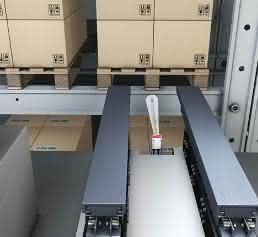
The sensor, which is optimized for high depth of field, has a fixed focus position and is used for the optical fine positioning of a storage and retrieval machine (SRM) in the X or Y direction after rough positioning has been completed. It is able to transmit the correction coordinates to a stacker crane for the exact approach of a shelf. In concrete terms, it looks like this: The smart sensor detects circular holes or reflectors in a single-deep bolt or upright of a pallet warehouse and determines the positional deviation of pallets or containers in the X and Y directions relative to the target position. The positioning sensor generates one or more images as a gray value. In this image, the sensor first searches for a defined, round marking (hole/reflector). The X/Y deviation is output in millimetres relative to the target position or as quadrants using the available switching outputs.
The 66 x 43 x 44 millimeter small IPS 200i in industrial design with protection class IP 65 is suitable for use in the normal temperature range as well as with optional integrated heating for the deep-freeze range down to minus 30 degrees Celsius. In the standard version, Leuze offers the device with a plastic housing cover, which can optionally be replaced by a glass cover. Thanks to three-sided mounting, the sensor can be flexibly attached to the storage and retrieval unit. The powerful, ambient light-independent infrared LED (light-emitting diode) illumination ensures highly flexible application options within conveyor and storage technology. This results in a short exposure time for moving objects; no additional external lighting is required. The high object speed in combination with a high depth of field also supports the flexibility of the positioning sensor. Intelligent image processing algorithms ensure reliable positioning and high throughput. The FTP image transfer of the IPS 200i enables complete documentation of the (fault) images. pb


You might also be interested in
Housing and inserts for plenty of power
Lapp presented the expansion of its Epic Power series at SPS 2023: four new M23 circular connector inserts and three new M23 housings. The special feature: all housings can be combined with any of the four inserts.
 read more...
News and product updates from Smartgas
Portable gas analyzers for outdoor use
Smartgas is starting the second half of the year with a series of updates to existing products and a number of new products. Portable analyzers expand the range of applications, while new accessories such as protective housings and heating modules...
read more...Everything accurate in switch cabinet construction
To ensure smooth work processes, tools for processing enclosures and housings must function flawlessly and reliably. Häwa rounds off its punching range with the Multi-Press 500.
read more...Shafts and conversion parts
The Rodriguez range includes ball bushings including matching housings, shaft brackets, crossbars and supports.
read more...Cooling and temperature control units
Hygienic packaging sells safely
In few industries are the requirements for hygiene in the production process as strict as in the food sector - the health of consumers has top priority. This results in enormous challenges for all machines and components involved, especially in...
read more...Simple tool change in seconds
With the CMS, Schunk is launching a user-friendly, manual change system for quick component replacement. In addition to its simple and convenient operation, the CMS also stands out with its extensive range of optional modules and complementary end...
read more...Motion controller for small drives
Medium power range covered
Faulhaber has another housing-less and compact motion controller in its range, which is particularly suitable for integration in device construction and medical technology applications.
read more...Welding solutions in the name of resource efficiency
At the Welding & Cutting trade fair in Essen (September 11-15), Fronius will be focusing on the major drivers in welding technology. Quality requirements are increasing in all industries, but the required welding specialists are scarce. In...
read more...Safe solutions for cable installations
From thick power cables to thin sensor lines, cables and lines must be routed safely through systems and machines. A challenge that should not be underestimated, explains Jörg Sokat, Head of Product Management at Pflitsch.
read more...