

3D scanner
Measures small components and complex shapes
The Atos 5 product family has a new member. Specially developed for small components and complex free-form surfaces, GOM is presenting a new optical 3D measuring machine. The sensor is suitable for inspecting turbine blades in the aerospace and power generation industries, for example.
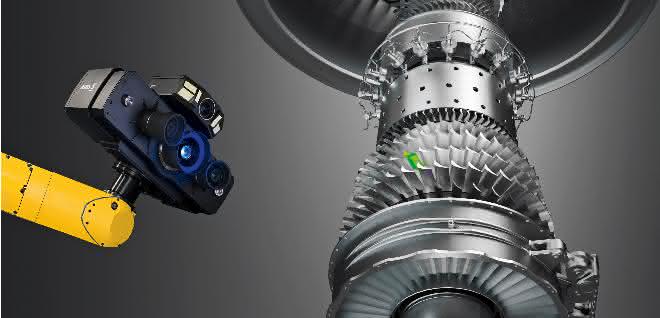
The new Atos 5 for Airfoil complements the Atos 5 family in the measuring range for small components. While the Atos 5, as an all-rounder, successfully performs a wide range of measuring tasks in measuring fields from 170 to 1,000 mm in length, the Atos 5X is particularly suitable for large surfaces and components thanks to its strong, focused light. It demonstrates this in the automotive industry, for example, where even entire car bodies are quickly digitized.
The rotating turbine blades in turbines, like the rigid structures that guide the air, are exposed to enormous forces and are therefore susceptible to wear. The performance of the aircraft engine or the electricity yield achieved is only stable if they function optimally in terms of flow technology. To achieve this, small manufacturing tolerances must be monitored and adhered to during production, maintenance and repair.
With the introduction of a 3D measuring machine specifically for small components with a size of 100 x 70 mm2 to 400 x 300 mm2, GOM is closing the previous gap in the lower measuring field. According to the company, the Atos 5 for Airfoil is also particularly suitable for inspecting turbine components produced for the aerospace industry, such as blades, blisks and air-guiding structures. Their complex-shaped edges and surfaces previously posed a challenge for 3D digitization. The Atos 5 for Airfoil also shows its strength in the maintenance and repair of turbine guide vanes. The cost of a new blade that has to be replaced due to defects is over 10,000 euros. If the defects in the component can be repaired using digital reverse engineering, for example in metal 3D printing, considerable savings can be made.
With the launch of Atos 5 for Airfoil, GOM is also offering the associated software update. The 2019 versions of Atos Professional and GOM Inspect Professional feature new modules that make it even easier to analyze challenging edge geometries, among other things.
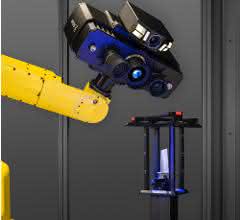
Common to all scanners in the product family are the high digitization speed and the high precision of the measured data. A scan in one measuring position takes just 0.2 seconds and 120 images per second can be triggered. The sensor transmits the data via fiber optics. A turbine blade is completely digitized in 3 minutes, an entire blisk in about an hour. The point cloud obtained can be immediately compared with the CAD model or data from previous measurements in the GOM software by means of surface comparison. This quickly provides an easy-to-understand overview of the dimensional accuracy of the component that has just been produced, maintained or repaired. Thanks to their robust design with protected optics, encapsulated electronics and a self-monitoring sensor, the measuring systems are also suitable for harsh production environments.
Premiere at the Atos Tech Day
The new 3D scanner was presented to the public for the first time at the "Atos Tech Day for Gas Turbines" on September 26 at the company headquarters in Braunschweig. The technology day focused on the use of optical measurement technology in the aerospace industry. In presentations and knowledge tracks, numerous speakers reported in detail on the potential offered by optical measurement technology in quality assurance for industrial gas turbines (IGT) and aerospace engines. Live demonstrations showed how quickly and precisely the Atos scanners work, even in automated applications. Around 100 participants from all over Europe gathered information at the event in Braunschweig, with two further technology days taking place in the USA and China.
The Atos triple scan principle
The sensors in the product family work according to the triple scan principle. They project precise stripe patterns onto the object surface, which are captured by two cameras using the stereo camera principle. As the beam paths of both cameras and the projector are known in advance thanks to the calibration, 3D coordinate points can be calculated from the three different beam intersections. The result is a network of complete measurement data without holes or faulty points, even with reflective surfaces and complex-shaped objects with complicated undercuts. The sensors work with narrow-band blue light so that interfering ambient light can be filtered out during image acquisition.


You might also be interested in
Basler acquires 76% of Indian image processor
Basler, supplier of image processing components for computer vision solutions, has acquired 76% of the Indian sales partner Alpha TechSys Automation.
 read more...
Process monitoring and fault detection
Cameras ensure quality during laser melting
Powder bed-based laser melting (PBF-LB/M) opens up new possibilities in additive manufacturing. Modern camera systems provide crucial process data to further increase quality and efficiency.
read more...Vision Sensor is three times faster than its predecessor
The 'CS-62' vision sensor from di-soric is around three times faster than its predecessor, the 'CS-60'. In combination with the 'nVision-i 25.1' software, it enables image processing solutions that were previously reserved for smart cameras.
read more...Thermal imaging cameras for quality control
Automated thermal imaging cameras are often suitable for quality control applications where temperature plays a role. However, while there are various solutions on the market for slow processes, it is challenging to select a camera that reliably...
read more...Easy entry into industrial VGA thermography
Reliable temperature measurement is a prerequisite for the success of many industrial processes. Berlin-based manufacturer Optris presents the Xi 640 infrared camera, a new member of its Compact Line, which enables non-contact temperature...
read more...Powder bed-based laser melting optimized
Aconity3D has set itself the goal of optimizing the stability of the manufacturing method of powder bed-based laser melting and thereby promoting its use in a wide range of industries. By using high-speed industrial cameras from SVS-Vistek, the...
read more...INDUSTRIAL Production Products of the year...
2nd place, category handling, assembly and production logistics: SICK
safeVisionary2 is the first 3D time-of-flight camera with Performance Level c safety certification. It enables safe three-dimensional environmental detection and won 2nd place in the competition for Product of the Year 2024 in the handling, assembly...
read more...Nomination Products of the Year 2024
SICK: Camera systems safeVisionary2
safeVisionary2 is the first 3D time-of-flight camera with Performance Level c safety certification. It enables safe three-dimensional environmental detection and has been nominated in the 2024 Product of the Year competition in the handling,...
read more...AI vision brings additional opportunities
The seamless integration of AI into the consumer sector has helped to improve our quality of life and make interactions with technology more efficient. In industry, AI vision with machine learning opens up new possibilities that are not covered by...
read more...