

Sensors
Detectives for particularly flat objects
The Ray10 and Ray26 reflex array sensors from Sick can detect leading edges just a few millimeters high and therefore reliably detect flat and position-tolerant objects.
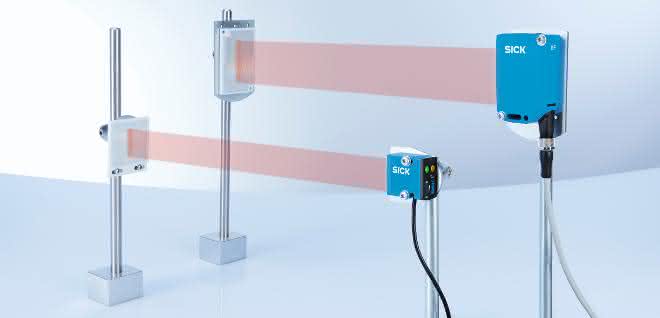
Ray10 and Ray26 are the names of the new product families of reflex array sensors from Sick, which the company presented at Logimat. The sensors work with a 2D light band that makes it possible to reliably detect flat and position-tolerant objects on stationary conveyor systems. This saves up to 50 percent of the installation and costs associated with light grid solutions or multiple light barriers.
The compact Ray10 and the performance-oriented Ray26 are specified for different installation and detection conditions and can detect objects with edge heights between two millimetres and ten millimetres from different working distances. As a result, they offer a high degree of mounting flexibility for different detection and installation situations. In CEP hubs and distribution centers, the sensors have proven to be reliable, integration-friendly and economical solutions for detecting polybags and shipping bags - which are increasingly being used by shippers to minimize freight costs - as well as magazines and other flat mail items and objects, according to the manufacturer.
The 2D functional principle of the Ray10 and Ray26 is also suitable for determining the height of pallets in intralogistics, for detecting objects with perforated surface structures and for detecting interfering objects in front of weighing or labeling systems.
Space-saving strip light barrier
The Reflex Array sensor Ray10 is designed for use in confined machine environments with limited mounting space and therefore enables space-saving sensor solutions. Installation is made easier by the PinPoint LED with its sharply contoured light spot and the integrated alignment aid.
With a detection height of 25 millimetres, the Ray10 can handle minimum object heights from five millimetres - and with a response time of 0.5 milliseconds. As a result, the sensor delivers reliable detection results even at high conveyor speeds and ensures a high system throughput, for example on CEP conveyor lines, says Sick.
Flat object leading edges or large detection height
The Ray26 works with a detection height of 55 millimetres and - depending on the sensor variant - can detect minimum edge heights of between two millimetres and ten millimetres. The smart sensor version has an IO-Link communication interface that an automation system can use to load the appropriate setting directly into the device. This allows a machine to be adapted very quickly and flexibly to the objects to be detected - which optimizes the availability and productivity of processes and systems.
In addition, the Belt Blanking function suppresses interference signals, such as those caused by the surface of belt conveyors, to ensure detection and signal reliability - even at high object speeds. Sensor integration is also made easier with the Ray26 thanks to the bright PinPoint LED and optically supported alignment.
Application potential beyond logistics
The Reflex Array sensors avoid the often space-critical and adjustment-intensive installation of light barriers positioned one above the other or the increased expense of a light grid solution. In addition to possible applications in logistics, there are therefore also examples of applications in other sectors where objects need to be detected based on their front edge. These can be found, for example, in packaging technology when processing cardboard blanks, in the steel industry when detecting profile material, in the automotive industry when detecting radiator condensers on conveyor systems, in PCB protrusion control in electronics production or in the wood industry when automatically detecting boards, panels and panels.


You might also be interested in
Robotics and autonomous order picking
Locus Robotics acquires Nexera Robotics and expands autonomous warehouse logistics
Locus Robotics takes over Nexera Robotics and may have taken a decisive step towards truly universal warehouse automation. A new gripping technology should now make possible what was previously considered difficult to automate.
 read more...
How bridging steps, stairs and catwalks are changing processes in production and logistics
At Logimat 2026, Munk Günzburger Steigtechnik will be showcasing modular bridging steps, stairs, platform and walkway systems for production, warehousing and logistics. With online configurators, distances can be efficiently shortened, processes...
read more...Highly automated warehouse for...
SSI Schaefer implements highly automated warehouse for CERP in France
SSI Schaefer and CERP are building a highly automated logistics center for pharmaceutical logistics in Wissous with shuttle storage, A-Frame, robotics and WAMAS software.
read more...Start of construction for new production hall
Mayr Antriebstechnik invests in its home base and internationally
Mayr Antriebstechnik strengthens location and international logistics: Construction of a new hall in Mauerstetten - parallel expansion of the plant in Poland as a logistics hub.
read more...Conveyor systems that adapt
Modern conveyor systems must reliably transport different product sizes, shapes and materials. The new modular product system from Kipp offers flexible, modular solutions for this: Adjustable side guides ensure precise alignment and gentle...
read more...Focus on sustainability and AI at the trade fair
With more than 120,000 square meters of exhibition space, LogiMAT 2025 will once again occupy all ten halls of the Stuttgart exhibition grounds. From March 11 to 13, global players, medium-sized companies and start-ups will provide an overview of...
read more...Workstation system for shipping and logistics
With Sintro Packing, Karl is launching a workstation system that is designed to meet the specific requirements of shipping and logistics. It is characterized by modular adaptability and ergonomic efficiency.
read more...Deutsche Messe announces Robotics Award
On the occasion of Hannover Messe 2025, Deutsche Messe is once again presenting the Robotics Award after a break of several years. Prizes will be awarded for robot-supported automation and logistics solutions. Companies and institutions from Germany...
read more...Micro motors as the driving force behind intralogistics
Suitable transport structures in intralogistics are a prerequisite in all industries in order to withstand competitive pressure in the future. The basis for this is comprehensive automation, which would be inconceivable without an armada of powerful...
read more...