
Quality inspection
AI with an eye for sweetness
In its first deep learning project, Bi-Ber has implemented visual product inspection for a manufacturer of chocolate and wafer products. The final inspection ensures that there are no foreign objects on the products and that they meet aesthetic standards.
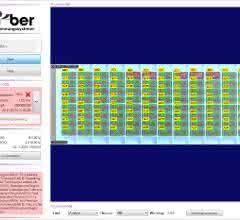
Until now, this task could only be fulfilled by visual inspection because conventional rule-based automatic image processing (machine vision) cannot reliably distinguish defects on irregularly structured surfaces from normal variances. AI-based automatic quality inspection is now set to increase detection reliability.
The inspection system reports an OK or NOK signal for each chocolate product in a mold - this requires an evaluation speed of up to 54 segments per second. Bi-Ber used Cognex VisionPro ViDi software to develop the AI, which includes an efficient segmentation and defect detection tool and requires only a few images to train an artificial neural network.
Bi-Ber only taught in 49 images of good products and 58 of rejects for the test run. Optimizing the recognition accuracy and speed for the system cycle was particularly labour-intensive. Once Bi-Ber had mastered this task, new molds and products can now be taught in within just four minutes. Bi-Ber has trained the fully integrated software and hardware system with sample molds. It is currently being tested in a six-month trial run, expanded to include new molds and fine-tuned. The hardware is based on Bi-Ber's previous successful machine vision projects in the confectionery industry: GigE cameras, flat design, shielding from the product area, stainless steel housing, touchscreen outside the product area. as


You might also be interested in
Basler acquires 76% of Indian image processor
Basler, supplier of image processing components for computer vision solutions, has acquired 76% of the Indian sales partner Alpha TechSys Automation.
 read more...
Process monitoring and fault detection
Cameras ensure quality during laser melting
Powder bed-based laser melting (PBF-LB/M) opens up new possibilities in additive manufacturing. Modern camera systems provide crucial process data to further increase quality and efficiency.
read more...Vision Sensor is three times faster than its predecessor
The 'CS-62' vision sensor from di-soric is around three times faster than its predecessor, the 'CS-60'. In combination with the 'nVision-i 25.1' software, it enables image processing solutions that were previously reserved for smart cameras.
read more...Thermal imaging cameras for quality control
Automated thermal imaging cameras are often suitable for quality control applications where temperature plays a role. However, while there are various solutions on the market for slow processes, it is challenging to select a camera that reliably...
read more...Easy entry into industrial VGA thermography
Reliable temperature measurement is a prerequisite for the success of many industrial processes. Berlin-based manufacturer Optris presents the Xi 640 infrared camera, a new member of its Compact Line, which enables non-contact temperature...
read more...Powder bed-based laser melting optimized
Aconity3D has set itself the goal of optimizing the stability of the manufacturing method of powder bed-based laser melting and thereby promoting its use in a wide range of industries. By using high-speed industrial cameras from SVS-Vistek, the...
read more...INDUSTRIAL Production Products of the year...
2nd place, category handling, assembly and production logistics: SICK
safeVisionary2 is the first 3D time-of-flight camera with Performance Level c safety certification. It enables safe three-dimensional environmental detection and won 2nd place in the competition for Product of the Year 2024 in the handling, assembly...
read more...Nomination Products of the Year 2024
SICK: Camera systems safeVisionary2
safeVisionary2 is the first 3D time-of-flight camera with Performance Level c safety certification. It enables safe three-dimensional environmental detection and has been nominated in the 2024 Product of the Year competition in the handling,...
read more...AI vision brings additional opportunities
The seamless integration of AI into the consumer sector has helped to improve our quality of life and make interactions with technology more efficient. In industry, AI vision with machine learning opens up new possibilities that are not covered by...
read more...