Rolling bearings
The term rolling bearing
Rolling bearings are among the most frequently used machine elements today. They usually consist of an inner and an outer ring, which are movably connected by rolling elements. In technology, they are used as locating or non-locating bearings for fixing shafts or axles. Depending on the design, they absorb radial and axial forces and allow the shaft or mounted components to rotate.
Types of rolling bearings
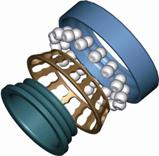
A basic distinction is made in the design between radial bearings and axial bearings. Within this broad classification, there are now six basic types of rolling bearings: Ball bearings, in which balls serve as rolling elements, are the best-known type of rolling bearing. Ball bearings are the most commonly used rolling bearings. The widest selection is available here. In other types of rolling bearing, the rolling elements are designed as cylinders, needles, barrels or cones and run in a cage. Some rolling bearing types and special designs do not have a cage. In the past, brass was usually used as the cage material, but today the cage is often made of plastic. However, brass cages still exist. Many rolling bearing types use cages made of low-alloy, non-hardened steel.
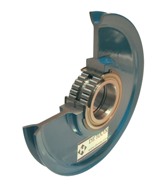
Radial bearings include, for example, deep groove ball bearings, angular contact ball bearings (single row, double row), four point contact bearings, shoulder ball bearings, self-aligning ball bearings, cylindrical roller bearings, tapered roller bearings, spherical roller bearings and spherical roller bearings. Needle roller bearings and toroidal roller bearings also belong to this group. Axial bearings (sometimes also referred to as thrust bearings) include axial deep groove ball bearings, axial cylindrical roller bearings and axial spherical roller bearings.
The dimensions of rolling bearings - i.e. their bore, outside diameter, width, etc. - are largely subject to standardization. In addition, bearings are also available in finished, movable bearing blocks. Some types are supplied with sealing washers and permanent lubrication or cover washers. Rolling bearings are selected using table books and online catalogs. Their identifiers are made up of letters and numbers that follow the logic of DIN 623.
Materials for rolling bearings
The vast majority of rolling bearings today are made of chrome steel. For special applications, however, there are also bearings made of stainless steel, technical ceramics, hybrid materials and material combinations (e.g. plastic with rolling elements made of glass or ceramic). There are also rolling bearings in which the outer and inner ring have current-insulating coatings.
Mounting of rolling bearings
Rolling bearings are usually mounted on shafts or axles. In designs without separate inner and outer rings, the running surfaces can be pressed directly onto the shaft or axle or into the bearing housing. The rolling bearing is then integrated into these components. This variant is mainly chosen for reasons of space. For this reason, needle rollers in particular are predestined for this task. The bearings are usually secured against slipping by a retaining ring, retaining nut or spacer sleeve. To protect against contamination, bearings are installed in a bearing housing or covered with a shaft seal. When installing the bearings, the press-in force must never be applied via the rolling element set. With special tools such as a drive-in sleeve, the bearing is only driven in via the outer ring, for example. Needle roller bearings must be pressed in with a mandrel. When removing the bearings, the appropriate tool must be used (puller).
Service life of rolling bearings
The service life of a rolling bearing depends on many factors. Some influencing variables can be measured or calculated (bearing load, surface quality); others cannot be determined numerically (contamination, lubrication condition). The service life and running performance of rolling bearings range from a few hundred hours to many thousands of hours, depending on the bearing type and area of application. Depending on the load, some bearings can withstand up to three billion revolutions.
Rolling bearings and SCOPE
The industry magazine SCOPE and its specialist internet portal SCOPE-ONLINE regularly report in various facets on rolling bearings and their use in mechanical and plant engineering, special machine construction, process engineering, automotive and vehicle construction, aerospace and many other areas.
Further key topics from the field of machine elements
 Standard partsStandard parts and standard components are machine elements, connecting elements (C-parts) and operating parts that are used as vendor parts in design and development, mechanical and plant engineering, automotive and vehicle construction, assembly and automation technology and electrical engineering and whose design is subject to a standard (DIN, ISO, etc.).