
Advertisement - Highlight of the week
Digital warehouse management arrives at the railroad
Deutsche Bahn operates eight maintenance depots for locomotives and ICE trains throughout Germany. In order to increase transparency and productivity, the long-distance maintenance depot in Munich has switched its warehouse organization from analogue to digital management. This pilot project will soon be followed by the other maintenance depots. As part of the software changeover, all warehouse areas in Munich were relabeled - without interrupting operations. ONK produced the more than 17,000 storage location labels and around 170 aisle signs required for this and installed them on site.
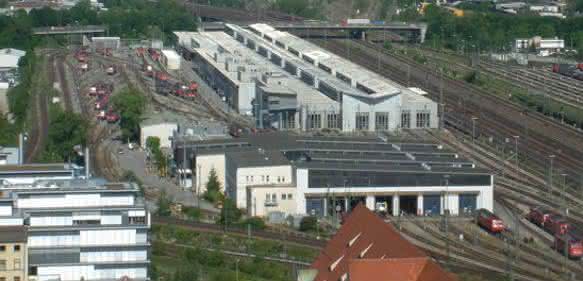
The hall at the ICE plant in Munich is 455 meters long and 50 meters wide and has six continuous hall tracks, each of which can accommodate a complete ICE train (Fig. 1). It is primarily ICE 3 and ICE T trains that are inspected, cleaned, maintained and repaired here. A team of 390 craftsmen work simultaneously on four levels. On the upper level, the roof level, work is carried out on pantographs, air conditioning and antennas, among other things. On the platform level below, work is carried out on exterior walls, doors and windows, maintenance of vehicle electronics and lighting, and the dining car is refilled. The third level at rail level is the main work level. This is where wheels, bogies and braking equipment, as well as transformers and oil circuits for driving heads, are checked and repaired if necessary. Finally, in the track pit, the team focuses on the underfloor area, replacing brake linings and checking the floor plates. "Perfectly coordinated work preparation, material planning and logistics are required to ensure that the downtime is only as short as necessary," explains Stefan Lorenz, Head of Materials Management.
Train sends error messages to the ICE plant in advance
In order to have the required spare parts on site as soon as the train arrives, ICE drivers traveling in southern Germany send the stored fault and error messages to Munich in advance at the touch of a button. All available spare parts as well as their drawings and circuit diagrams are stored in the IT system on call. Around 12,000 different spare parts and materials are stored in Munich in pallet and shelving racks with up to seven levels. Until the end of 2016, inventory management was still analog: Warehouse staff had entered incoming and outgoing goods manually and thus controlled the stock levels. The ICE plant then switched to digital warehouse and inventory management - in three construction phases so as not to interrupt ongoing operations, as 30 ICEs are serviced here every day. "We expect the reorganization of our warehouses to result in shorter maintenance times, as access times to spare parts and materials will be shorter thanks to clearer organization and clearly legible labeling, and barcodes will minimize error rates," explains Lorenz. "The barcodes also create the basis for the subsequent use of handhelds."
Barcode labels for around 17,000 storage locations
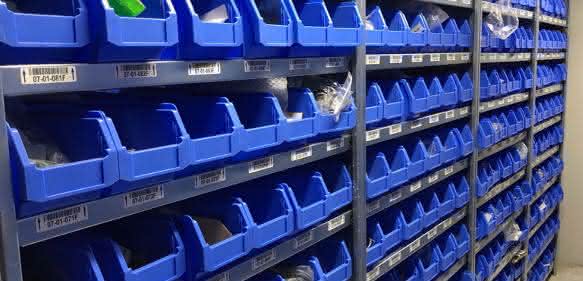
For the complete re-labeling of the warehouse, the newly implemented software was first used to generate a numbering plan with up to ten-digit coordinates for each individual storage location - consisting of shelf, column, level and space. Based on these specifications, ONK, the Cologne-based specialist for visual warehouse organization, produced more than 17,000 self-adhesive storage location labels, 170 aisle signs and 56 floor markings with barcoded and partially plain text representation of the respective storage location coordinates (Fig. 2 + 3).
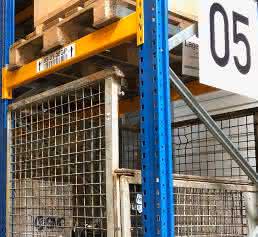
The basic structure in the shelving and pallet racking warehouses is defined by aisle signs made of rigid PVC foam measuring between 15 x 15 and 50 x 50 cm, which identify the individual rows of shelves by number. The ONK team has marked the up to seven rack levels with different background colors, e.g. yellow for level 03, light green for 05 and light blue for 07. Each of the more than 17,000 rack locations is also provided with a self-adhesive, two-line printed plastic label, which shows the location as a barcode and in plain text and contains directional arrows for upper and lower height positions. In high-traffic areas, the shelf labels are also covered with a protective laminate. For hard-to-reach shelf levels, colored multiple labels show several levels on a single label in an easily accessible location. The multiple labels contain three adjacent barcodes on a different colored background for different storage levels, which are rotated to enable error-free scanning. Finally, ONK has marked pallet storage locations with self-adhesive floor markings made of rigid PVC film, on which the storage location coordinate is shown as a barcode and in plain text.
Smooth processes during the changeover
In September 2017, after around 9 months, the software was implemented and the infrastructure completed - exactly as planned. ONK also contributed to this. "We are very satisfied with the services provided by ONK. Consultation, on-site inspection, quotation preparation, delivery and installation all took place within the specified time frame," says Lorenz. "During the first two construction phases, we still had to coordinate a few things during the installation of the logistics labels due to our circumstances, but the third phase was completed independently." In October, the material was relocated and in 2018 only minor conversion work was required. The ICE plant in Munich is the first long-distance transport plant to have its warehouse and inventory management reorganized. The other seven maintenance plants are also gradually converting, with Cologne following next. "Our colleagues have already looked at our new warehouse hardware and software as well as the labeling in detail. As we were acting as a pilot project, our main focus was on smooth processes during the changeover," says Lorenz.


You might also be interested in
Micro motors as the driving force behind intralogistics
Suitable transport structures in intralogistics are a prerequisite in all industries in order to withstand competitive pressure in the future. The basis for this is comprehensive automation, which would be inconceivable without an armada of powerful...
 read more...
E-scooter with customizable damping
The startup Scuddy has significantly improved the flexibility, performance, customizability and ergonomics of its second-generation foldable e-scooter of the same name - thanks in part to damping technology from ACE.
read more...Electric multidirectional counterbalanced...
360-degree steering on three wheels
Hubtex has given its FluX electric multidirectional counterbalanced truck an update: The new generation for the three-ton capacity class.
read more...New FLUX: 360-degree steering on 3 wheels
HUBTEX presents the new generation of the FLUX 30 electric multidirectional counterbalanced truck (load capacity 3 t). The innovative 2-in-1 stacker is both a front and sideloader. With its patented 360-degree HX steering, it transports both long...
read more...Norelem supports VDI Racing Camp
Mastering the challenges of e-mobility
Promoting young talent has been a priority at Norelem for many years: the company supports young talents with components and the necessary know-how and provides schools with illustrative material.
read more...igus:bike honored with German Design Award 2023
A wide, angular frame made of plastic, black wheels with Y-spokes: The futuristic look of the bicycle designed by Dutch bicycle developer mtrl with motion plastics from Igus can look forward to the prestigious German Design Award 2023.
read more...Floating garbage trap cleans up the Rhine
Every day, a ton of garbage flows down the Rhine. To catch some of it, the Cologne-based Krake association has now inaugurated a floating garbage trap. One of the sponsors of the so-called Rhine octopus is the plastics specialist Igus.
read more...Torwegge presents FlexO rollers
Visitors to the FMB - Supplier Fair for Mechanical Engineering can once again look forward to a new product at the Torwegge stand this year: the FlexO rollers.
read more...Igus partner Mura's project is making progress
Recovering crude oil from plastic: This is the goal that the British company Mura Technology is pursuing with the HydroPRS process. Igus has been supporting the project as an investor since 2020. The first HydroPRS plant for the chemical recycling...
read more...