
Display
Competitive advantages with large machines
3D printing offers enormous opportunities for mechanical engineering and automation. Whether 3D-printed components for machines and systems, prototypes or design aids: additive manufacturing is almost indispensable for modern companies in mechanical and plant engineering and automation if they want to play in the premier league. Innovative engineers and designers use 3D-printed components to improve their products and secure a real competitive advantage for their company, for example through faster development. At the same time, the intelligent use of additive manufacturing in the company can save costs and improve the sustainability balance.
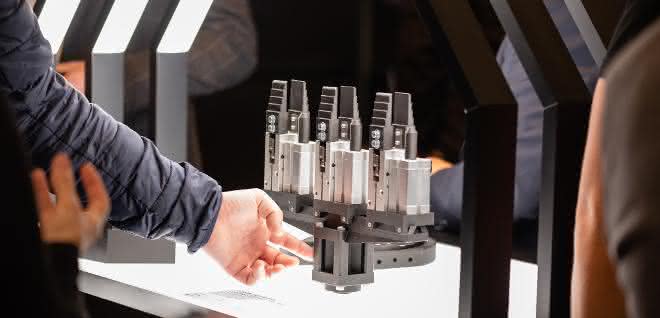
The decisive factor for the successful use of AM in mechanical and plant engineering and automation is not only the clear commitment of management, but also the greatest possible know-how of the people responsible.
Seminars, contacts and applications at Formnext
But where and how can you acquire this expertise in additive manufacturing? A visit to Formnext, which takes place this year from November 7 to 10 in Frankfurt am Main, offers a very good general overview. The Discover3Dprinting seminars on each day of the trade fair offer excellent insights into the world of industrial 3D printing. The extensive stage program, which is freely accessible to all trade fair visitors, offers numerous other insights. In addition, hundreds of exhibitors will be providing information on solutions along the entire additive manufacturing process chain: from design and the selection of suitable manufacturing technology to post-processing.
From prototype to fixture
3D printing has been used in mechanical engineering for many years, and the range of applications has continued to grow. Starting with the production of prototypes, numerous companies now also use 3D printing to quickly and cost-effectively produce equipment such as brackets or templates. In particular, the use of fiber-reinforced plastic, which can now also be processed with desktop 3D printers, has accelerated this development enormously, as it allows components with very high strength to be produced comparatively inexpensively.
Small quantities and complex geometries
Final components are the ultimate in additive applications. 3D printing can play to several of its strengths, particularly in mechanical and plant engineering and automation: Individual parts or very small quantities can be produced quickly and cost-effectively, as no tools are required, for example. 3D printing also enables special geometries that cannot be realized with other manufacturing methods. In addition, components that were previously made up of numerous individual parts can now be printed in one piece.
In addition to these advantages, 3D printing offers companies in the automation sector an additional opportunity: additive manufacturing is increasingly being used for larger quantities in industrial environments in various sectors, which often requires an automated production process including post-processing. Companies from the automation sector have already discovered these business opportunities for themselves in a rapidly growing market and are successfully offering solutions in this area.


You might also be interested in
Plagiarius 2024 negative prize
On January 26, 2024, the Plagiarius campaign awarded its dreaded "Plagiarius" negative prize for the 48th time to manufacturers and retailers of particularly brazen counterfeits and fakes.
 read more...
Ivalua honors winners of the Generative AI...
AI-supported "add-ons" for buyers within 48 hours
Ivalua, provider of cloud-based spend management solutions, announced the winners and innovations of the first Generative AI Innovation Cup. The competition took place in December 2023. It was open to all Ivalua partners and employees - more than...
read more...Efaflex celebrates 50 years of high-speed...
The emphasis is on "fast"
Since day one, Efaflex has wanted to use new technologies as early as possible and drive progress in the industry. This year, the family business is celebrating its 50th anniversary under the motto "Fast Forward".
read more...Security of supply even during power outages
In the winter of 2022, Germany was worried about energy shortages. The drugstore retailer dm did not paint any horror scenarios, but nevertheless saw the possibility of controlled, temporary, regional power cuts (brownouts).
read more...Safety technology in mechanical engineering
Modules with new functions
Euchner's product highlights at EMO 2023 include the communication-capable solenoid interlocks.
read more...Transforming the paper industry towards climate neutrality
Together with partners from industry and research, Voith is developing a project for the optimization of energy and material flows in paper production. The aim of the research project is to develop a digital framework that enables effective process...
read more...Up to 95 percent less flue gas thanks to direct extraction
The requirements for occupational safety measures and safety technology are also constantly increasing in welding technology. The Technical Rules for Hazardous Substances (TRGS) stipulate that welding fumes and harmful substances must be extracted...
read more...Transport technology from the modular system
Many transport tasks can be realized with the help of linear technology. Pre-configured solutions are available to simplify the interaction between the linear unit, motor, gearbox and controller. This minimizes the effort required for research and...
read more...Robot assistant in the doctor's surgery
KR 6 Agilus makes an impression on patients
Making a virtue out of necessity: This is the philosophy of Italian dentist and entrepreneur Giorgio Castagno. A Kuka robot cleans dental instruments in his practice - saving time and money and reducing the workload of the entire practice team.
read more...