

Workplaces
More safety for smooth warehouse processes
Ergonomics and an improved workstation layout, the introduction of a safety culture, specific work instructions and the introduction of regular safety checks ensure a safe environment in a warehouse.
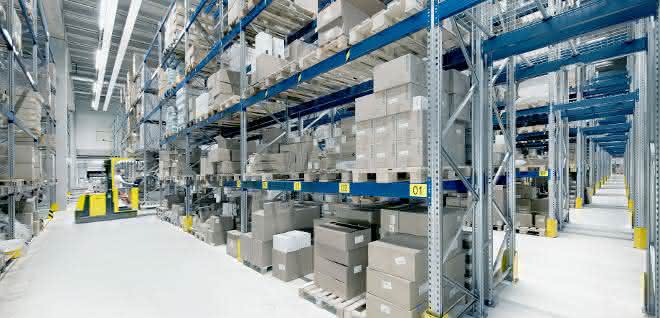
What sounds so simple, however, is often neglected in its implementation and accidents can unfortunately be the result. Make your warehouse safer.
A warehouse generally gives the impression of being a completely safe place. In contrast to a construction site, it largely looks anything but unsafe. However, accidents often happen in warehouses too, for example because picking activities are carried out under time pressure, objects are placed on moving surfaces or unsecured loads fall down. Lifting and moving heavy objects with repetitive movements (lifting, reaching out, pulling and pushing) can also lead to muscle fatigue and injuries.
The US Bureau of Labor Statistics has determined that workers in logistics and warehousing suffer musculoskeletal injuries almost twice as often as workers in the private sector. The most common injuries are to the back, shoulders, hands and knees.
So how can we make the warehouse even safer? Safety can be improved by the following measures, for example:
- Improved workplace design, increased focus on ergonomics
- Introduction of a safety culture
- Concrete and documented work instructions
- Introduction of regular safety checks
Improved design and more ergonomics
A warehouse will not be able to offer the same level of safety as an office, but the dangers can be minimized by a well thought-out design of the workstations and machines. In other words: "A safe warehouse is not a matter of luck, but the result of careful planning so that you no longer need luck to avoid accidents", as one of our customers from Asia put it in a nutshell.
This is exactly what planning is all about and even simple aids can help to avoid the worst. To prevent people or machines from slipping off loading ramps, floor plates with a non-slip surface are fitted and edged in yellow so that operators can easily see where the non-slip surface ends. Floor surfaces must always be level and free of ruts to avoid the risk of tripping or falling.
Equally important, although often underestimated, is to provide sufficient space for forklift trucks in all aisles to facilitate easy replenishment and removal of goods. Without sufficient space, the risk of forklift trucks colliding with racking increases significantly, and with it the risk of all the associated consequences. Pallet racking is not designed to withstand repeated ramming by forklift trucks, even if the speed is low.
In addition, it is advisable to install various shelf guards to protect the shelves from collisions. Like shelving, these are available in very different designs. The choice of protective devices therefore needs to be carefully considered, as repairing or replacing shelves at a later date can be very costly.
Introduction of a security structure
Given the dynamic nature of warehouse operations, it is difficult to lay down rules for all situations and thus to identify all accident causes. The only possible solution is therefore to develop a safety structure in the warehouse and to make employees aware that they are responsible for their own safety.
You will probably know that objects placed on walkways or paths can become tripping hazards and obstacles. That materials must be stacked or placed in a safe manner and that floors must be dry so that no one slips or falls on them. Nor will they try to break the rules, even under great time pressure. For example, order pickers will not have the idea of climbing up a shelf to reach a package that they absolutely need and that is no longer available on the lower pallets.
Essential knowledge is explained in safety training so that all employees are instructed in the safety guidelines for warehouses and are up to date with the latest knowledge.
Work instructions
The development of standardized work instructions is the be-all and end-all of a well-functioning company. All employees are instructed in the same procedures and uniform procedures are ensured, which is essential for a smooth process. These are required, for example, in incoming goods, for storage, stocktaking, picking, shipping and handling returns.
Use ergonomic work tables in quality control, for packing or hydraulic scissor lifts to raise loads to the desired height to avoid unnecessary lifting movements. Introduce a maximum permitted weight for boxes, containers or packages so that employees do not have to lift loads that are too heavy.
Introduction of regular security checks
Regular inspections are essential for increased safety. Many accidents involving forklift trucks, collisions, dropped or incorrectly positioned loads are not reported for a variety of reasons. The consequence of this is that no preventative measures are taken and accidents cannot be prevented in time.
In a shelving system, any damage to the frame has a negative impact on the structural stability and reduces the load-bearing capacity of the shelving. If the racking collapses, not only are the goods damaged and operations interrupted, but the company's reputation can also suffer. All components must therefore be checked very carefully - uprights, crossbars, treads and shelf connectors. It is equally important to check for changes in shape, loading and overloading. When purchasing racking systems, make sure that you choose reputable suppliers who comply with all international design standards and that regular inspections are carried out.
You should also ensure that the load capacity and safe working conditions are indicated on all shelving. Most accidents in warehouses are avoidable if appropriate preventative measures are taken and the necessary safety precautions are taken. On the SSI Schaefer website you can download general information material on "Warehouse Safety" as well as a checklist on warehouse safety.


You might also be interested in
From risk to resilience
NIS2 significantly increases the requirements for industrial security concepts. In addition to cyber resilience, physical access protection is becoming increasingly important.
 read more...
Security Operations Center module
When cyber attacks reach production
Adlon is further developing its Security Operations Center and adding another module to the existing Managed SOC for Microsoft 365 environments (based on Managed XDR): Managed SOC Advanced.
read more...Lifecycle management and safe IO-Link communication
At SPS, Pilz will be presenting solutions that combine safety and security in production. The focus is on the digital Myzel Lifecycle Platform, a SaaS offering for the management of machinery and personnel over the entire lifecycle.
read more...The basics of warehouse safety
Safety in the warehouse primarily relates to the employees. However, goods must also be transported safely and transport equipment must not be damaged.
read more...Environmental containers and fire protection
Companies can choose from a wide range of environmental containers for storing chemicals and other hazardous substances.
read more...Secure focus on access
To ensure comprehensive safety, holistic safety concepts for safety and industrial security on machines are required. Authorizations and access must be clearly regulated.
read more...Added value through safety and productivity
Machine malfunctions can have serious consequences and put people's health at risk. Functional safety therefore plays a central role in industry. With control and inverter technology including integrated safety functions from ABB, plant operators...
read more...Protect Ethernet interfaces
Pilz is expanding its portfolio of operating and signaling devices with the control element PIT oe ETH. It is equipped with an Ethernet port that can be activated and protects freely accessible Ethernet interfaces in industry against unauthorized...
read more...Protective tool in everyday life
Cybershield is a company founded in 2021 with a focus on operational technologies and has set itself the goal of significantly advancing IT security in the OT sector and supporting customers.
read more...