

Cleanliness during sanding
Extraction of hazardous substance dusts
Cleanliness in the workplace is not only for technical reasons, health aspects and regulations are increasingly restricting processing options - Pferd offers solutions for keeping the workplace clean and protecting the user.
"Cleanliness at the workplace is often essential for technical reasons," says Ralf Heimann, Product Manager for grinding tools at Pferd, explaining the basic requirements in metalworking. Problems such as contact corrosion, mechanical damage and soiling caused by dust or oil/mist come into play here. "If you want to work and produce at a high level of technical perfection and quality while optimizing costs, you need to keep the workplace clean," adds the Pferd product manager.
If the processing involves complex materials, not only technical-functional requirements apply, but also rules aimed at protecting the worker. "There are also the 'Technical Rules for Hazardous Substances (TRGS)'. They describe the state of the art, occupational medicine and occupational hygiene as well as other occupational science findings for activities involving hazardous substances."
Such hazardous substances are found, for example, in non-ferrous metal production, in pig iron and steel production and in electroplating in the production of coatings with chromates. "We find the processing of chromium VI compounds in particular in numerous applications for our customers in the aerospace industry and in power plant and turbine construction." Here, spray coatings with chromate-containing primers have been applied to aircraft, large components and engine components.
Chromium(VI) compounds are considered carcinogenic and are classified as skin and in some cases respiratory sensitizers, "two exposures to which the worker may also be exposed during grinding work." If the employer cannot rule out a risk to employees when working with carcinogenic substances, he must reduce the risk to a minimum. Technical measures have priority over organizational and personal protective measures or occupational health monitoring.
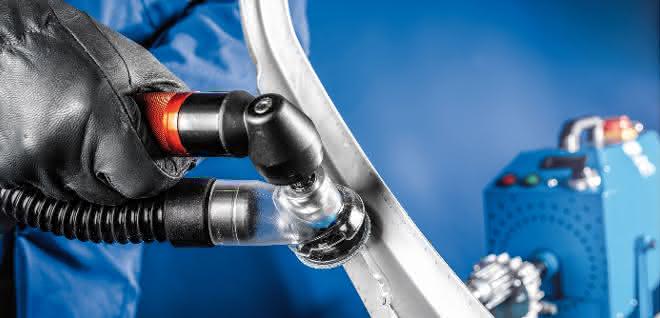
"We are aware of the requirements resulting from this regulation and are providing these customers with a simple but highly effective tool," reports Heimann. "With the new Dust Remover, the potentially hazardous dust is absorbed directly where it is produced: Directly during sanding."
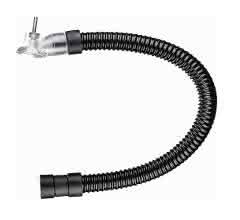
As processing often takes place directly on or in the aircraft or the individual parts and components are too large for processing in an extraction cabin, such mobile solutions are preferred. "The Dust Remover is an extraction unit for Combidisc tools with a diameter of 50 or 75 mm. It can be used universally with all dust extraction systems with CD and CDR support plates."
On the drive side, flexible shaft drives, straight grinders, angle grinders or cordless angle grinders can be used. "The only requirement is that the 6 mm shank can be accommodated," adds Ralf Heimann. For effective extraction, the volume flow of the extraction system should also be at least 300 m³/h.
"The CD Dust Remover is a simple but effective solution for complying with the rules for handling hazardous substances," says the Pferd Product Manager. This product therefore meets the high requirements for work ergonomics as part of Pferd Value, Pferd's value-added program, which considers and evaluates application solutions in terms of their ergonomic and economic effectiveness.


You might also be interested in
RS expands partnership with Phoenix Contact
RS Components has significantly expanded its range of products from Phoenix Contact. The distributor now supplies more than 45,000 products from the manufacturer of products, solutions and digitalization expertise for the electrification, networking...
 read more...
Component design via online tool
mbo Osswald aims to set new standards in the world of fastening technology with its new sleeve configurator. This tool was developed to design individual components for different industries precisely and in line with requirements.
read more...Competitive advantages with large machines
Whether 3D-printed components for machines and systems, prototypes or aids for design: additive manufacturing is almost indispensable for modern companies in mechanical and plant engineering and automation if they want to play in the premier league.
read more...Networking event at Schunk: Expert Days on...
Expert exchange at the highest level
On October 25 and 26, 2023, SCHUNK is once again organizing the Expert Days: an annual international and cross-industry event on the topic of "Robotic Material Removal". 70 specialists from Europe and North America will meet in Brackenheim-Hausen to...
read more...Transport technology from the modular system
Many transport tasks can be realized with the help of linear technology. Pre-configured solutions are available to simplify the interaction between the linear unit, motor, gearbox and controller. This minimizes the effort required for research and...
read more...Purchasing optimization for rolling bearing...
Best choice thanks to pre-classification
With the ABEG method, Findling Wälzlager has created a transparent and calculable decision-making basis for avoiding oversizing and undersizing of rolling bearings. This purchasing optimization helps customers to always select the technically and...
read more...Predictive maintenance on the smart drive
Baumüller offers a drive-based software solution to diagnose the machine status. The Smart Condition Monitoring tool runs on the PLC integrated in the drive controllers and uses the drive to record signals. Sebastian Maul, application engineer at...
read more...Siemens: continued profitable growth and...
Result April to June 2023: strong momentum
Siemens continued its profitable growth trajectory in the third quarter of fiscal year 2023 (ending June 30, 2023). All industrial businesses achieved strong revenue growth. The company also recorded strong order momentum for major projects and in...
read more...How production can benefit from AI
Together with AI technology, IIoT networking makes it possible to better control machine parameters and optimize quality with predictive quality. Downtimes and set-up times can also be further minimized. Cloud platforms also make these technologies...
read more...