

Efficiency control of systems
Inspection and diagnosis of solar modules from the air
Regular inspections are also an essential part of operational efficiency when managing solar installations. Thermal imaging camera manufacturer Flir Systems shows how solar installations can be efficiently inspected from the air using thermal imaging drones.
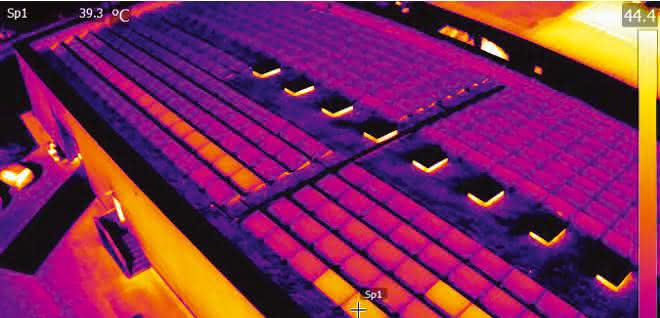
The management of solar installations is estimated to cost the industry 1 billion US dollars a year in labor costs. Regular inspections are an essential part of operational efficiency. However, they can be dangerous and time-consuming. Performing a complete inspection of a solar installation with portable electrical test instruments alone is so labor-intensive that it can take several weeks. At a large utility site, checking each individual string can be an endless task. Even checking smaller commercial and rooftop installations can take several days.
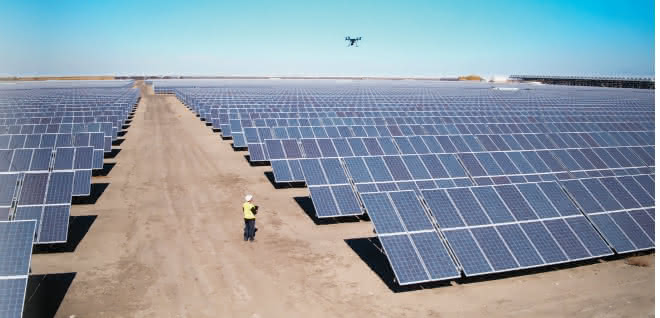
With any solar installation, it is crucial to detect and eliminate problems through regular inspections in order to avoid major failures, make warranty claims against suppliers and operate within the contractually agreed performance and yield margins. Solar panels that are not achieving peak performance due to problems with inverters, generator connections, string defects, module problems, misaligned solar trackers or even shading are made visible within seconds by infrared (IR) imaging. Solar panels that are not working efficiently usually have a different heat signature than panels that are working properly. A drone solution with integrated Flir thermal imaging technology, such as the Flir M210 XT2 640-13 mm, makes it easy for users to quickly inspect a wide target area and pinpoint problems on solar panels from the air. Once the problem area has been identified using IR imaging, they can use a digital multimeter or current clamp such as the Extech MA445 to check for electrical faults and rectify them.
The results
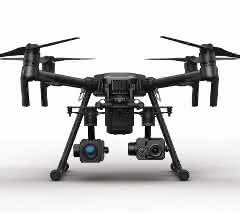
By incorporating thermal imaging inspections into their regular maintenance schedule, users can reduce their inspection times from weeks to hours with a drone-based solution and from hours to minutes with a portable thermal imaging solution. This allows them to work more safely as they come into contact with fewer system elements during their inspections and increase their overall efficiency.


You might also be interested in
Plagiarius 2024 negative prize
On January 26, 2024, the Plagiarius campaign awarded its dreaded "Plagiarius" negative prize for the 48th time to manufacturers and retailers of particularly brazen counterfeits and fakes.
 read more...
Ivalua honors winners of the Generative AI...
AI-supported "add-ons" for buyers within 48 hours
Ivalua, provider of cloud-based spend management solutions, announced the winners and innovations of the first Generative AI Innovation Cup. The competition took place in December 2023. It was open to all Ivalua partners and employees - more than...
read more...Efaflex celebrates 50 years of high-speed...
The emphasis is on "fast"
Since day one, Efaflex has wanted to use new technologies as early as possible and drive progress in the industry. This year, the family business is celebrating its 50th anniversary under the motto "Fast Forward".
read more...Security of supply even during power outages
In the winter of 2022, Germany was worried about energy shortages. The drugstore retailer dm did not paint any horror scenarios, but nevertheless saw the possibility of controlled, temporary, regional power cuts (brownouts).
read more...Safety technology in mechanical engineering
Modules with new functions
Euchner's product highlights at EMO 2023 include the communication-capable solenoid interlocks.
read more...Transforming the paper industry towards climate neutrality
Together with partners from industry and research, Voith is developing a project for the optimization of energy and material flows in paper production. The aim of the research project is to develop a digital framework that enables effective process...
read more...Up to 95 percent less flue gas thanks to direct extraction
The requirements for occupational safety measures and safety technology are also constantly increasing in welding technology. The Technical Rules for Hazardous Substances (TRGS) stipulate that welding fumes and harmful substances must be extracted...
read more...Competitive advantages with large machines
Whether 3D-printed components for machines and systems, prototypes or aids for design: additive manufacturing is almost indispensable for modern companies in mechanical and plant engineering and automation if they want to play in the premier league.
read more...Transport technology from the modular system
Many transport tasks can be realized with the help of linear technology. Pre-configured solutions are available to simplify the interaction between the linear unit, motor, gearbox and controller. This minimizes the effort required for research and...
read more...