
World Robotics 2021
Robot sales on the rise again
The number of industrial robots in factories worldwide has risen by 10 percent to a new record of around 3 million units - as reported by the International Federation of Robotics in the new "World Robotics 2021" yearbook.
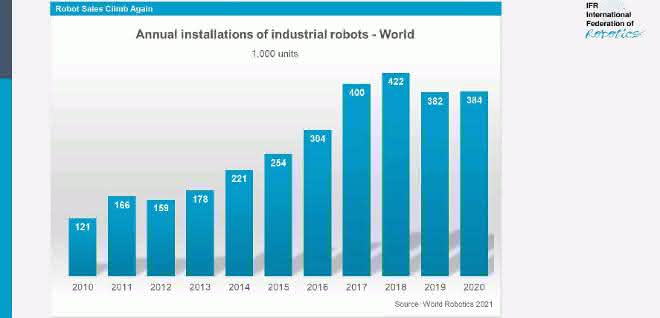
Despite the global pandemic, sales of new robots rose slightly by 0.5% in 2020: A total of 384,000 units were delivered worldwide. The positive market development in China drove the overall positive trend and offset the decline in other markets. 2020 was the third most successful year in the history of the robotics industry after 2018 and 2017.
"The economies of North America, Asia and Europe did not go through the economic low point of Covid-19 in the same period," says Milton Guerry, President of the International Federation of Robotics. "In the Chinese manufacturing industry, incoming orders and production rates began to pick up again in the second quarter of 2020. The North American economy subsequently recovered in the second half of 2020 and Europe followed a little later."
"The robotics market will recover strongly worldwide: We expect growth of around 13 percent to 435,000 units in 2021 - which would exceed the record level of 2018," reports Milton Guerry. "An increase of 17% to almost 43,000 units is forecast for North America. Installations in Europe are expected to increase by 8 percent to almost 73,000 units. In Asia, the 300,000-unit mark is likely to be surpassed, exceeding the previous year's result by 15 percent. Double-digit growth rates are expected for almost all Southeast Asian markets by 2021."
Asia, Europe and America at a glance
Asia remains the world's largest market for industrial robots. 71% of all newly installed units were sold in Asia in 2020 (2019: 67%). Sales in China, the largest user country in the region, increased by 20% with 168,400 robots delivered. This is the highest figure ever recorded for a single country. The operational inventory reached 943,223 units (+21 percent). The 1 million mark is expected to be broken in 2021. This high growth rate documents the rapidly advancing robotization in China.
Japan remains the second-largest market for industrial robots after China, despite the Japanese economy being hit hard by the Covid-19 pandemic: With 38,653 units installed, sales fell by 23% in 2020. This was the second year of decline after a peak of 55,240 units in 2018. In contrast to China, demand from the electronics and automotive industries was weak in Japan. Japan's operating inventory amounted to 374,000 units in 2020 (+5%).
Japan's outlook for the 2021 financial year is positive with an expected GDP growth rate of 3.7%. The Japanese robotics market is expected to grow by 7% in 2021 and by a further 5% in 2022. Regardless of the domestic market, the most important export destinations will secure demand for Japanese robotics. Even though the majority of production currently takes place directly in China, 36% of Japanese exports of robotics and automation technology were destined for China. A further 22 percent of exports went to the United States.
The Republic of Korea is the fourth largest robot market after Japan, China and the USA. In 2020, installations fell by 7% to 30,506 units. The operational inventory rose by 6 percent to 342,983 units.
The country's export-oriented economy has coped remarkably well with the pandemic so far. GDP only fell by 1% in 2020. Strong GDP growth of +4% and +3% is expected for 2021 and 2022. The electronics and semiconductor industries in particular are investing heavily. A subsidy program launched in May 2021 will further boost investment in machinery and equipment. Demand for robots from both the electronics industry and automotive suppliers is expected to increase significantly by 11% in 2021 and by an average of 8% per year in the following years.
Europe
In Europe, installations of industrial robots fell by 8% to 67,700 units in 2020. This was the second consecutive year of decline in the robotics market, following a peak of 75,560 units in 2018. Demand from the automotive industry fell by a further 20%, while installations in general industry rose by 14%.
Germany is one of the five largest robot markets worldwide (China, Japan, USA, Korea, Germany) and recorded a 33% share of total installations in Europe. It was followed by Italy with 13% and France with 8%.
The number of robots installed in Germany remained at around 22,300 units in 2020. This is the third-highest installation figure of all time - a remarkable result considering that 2020 was characterized by the pandemic. Driven by strong international business, the German robotics industry is recovering. The domestic market is expected to grow slowly, mainly supported by demand for low-cost robots in general industry and outside manufacturing.
In the UK, installations of industrial robots rose by 8% to 2,205 units in 2020. The automotive industry increased by 16% to 875 units - this corresponds to 40% of sales in the UK. The food and beverage industry almost doubled its installations from 155 units in 2019 to 304 units in 2020 (+96%) The food and beverage industry had a high proportion of foreign workers, often from Eastern Europe, and is facing a massive labor shortage. The ongoing Covid-19 travel restrictions are one reason and Brexit is another. According to forecasts, demand will grow strongly at double-digit rates in 2021 and 2022. A massive tax incentive will boost the modernization of the British manufacturing industry.
The 2,205 newly installed units in the UK in 2020 are around ten times fewer than deliveries in Germany (22,302 units), around four times fewer than in Italy (8,525 units) and less than half the number of industrial robots in France (5,368 units).
North America
The USA is the largest user of industrial robots on the American continent, accounting for 79% of total installations. It is followed by Mexico with 9 percent and Canada with 7 percent.
In 2020, new installations in the United States fell by 8%. After eight years of growth, this was the second year in a row with a decline. While the automotive industry demanded significantly fewer robots in 2020 (10,494 units, -19 percent), installations in the electrical/electronics industry increased by 7 percent to 3,710 units. The operational inventory in the United States has grown by 6 percent CAGR since 2015.
The overall forecasts for the North American market are very positive. A strong recovery is already underway and a return to pre-crisis levels can be expected in 2021. Robot installations are expected to increase by +17% in 2021. A post-crisis boom will provide additional growth in the low double-digit range in 2022 and beyond.
Outlook
The "post-crisis boom" is likely to subside slightly worldwide in 2022. From 2021 to 2024, average annual growth rates in the mid-single-digit range are expected. A race to catch up will take place in 2022 or 2023 - slight declines may occur as a statistical effect. Should special effects occur, they will not break the general growth trend. The historic mark of 500,000 robot units installed worldwide per year is expected to be reached in 2024.


You might also be interested in
Humanoid robotics from Germany
Igus launches service robots for everyday industrial use
Humanoid robotics: With the Iggy Rob Home, igus presents a service robot for industry and everyday life. What's behind it.
 read more...
New sales and service unit in Gurugram
Yamaha Motor expands robotics business in India
Yamaha Motor is opening a new Robotics Business Support Division in India to strengthen sales and service in the growing robotics market. The unit will support SMT systems and industrial robots, among other things, and will be complemented by a...
read more...Robotics and autonomous order picking
Locus Robotics acquires Nexera Robotics and expands autonomous warehouse logistics
Locus Robotics takes over Nexera Robotics and may have taken a decisive step towards truly universal warehouse automation. A new gripping technology should now make possible what was previously considered difficult to automate.
read more...Factory planning without compressed air...
How vacuum becomes mobile
Modular factories, mobile robotics and rising energy prices are fundamentally changing automation. One solution: into the future without compressed air. Electric vacuum systems reduce costs, save energy and support flexible manufacturing and...
read more...A robot for all occasions
Industrial robots take on many tasks. Even milling with accuracies in the sub-millimeter range is now possible.
read more...Why stator and rotor laminations are becoming a performance factor
Why the future of robotics depends not only on software, but also on high-precision stator and rotor laminations inside the motor.
read more...Infineon Startup Challenge 2026
Focus on humanoid robotics
Infineon brings together young deep-tech companies worldwide to drive innovation in humanoid robotics. The focus is on hardware and system solutions from sensor technology to motor control. Applications are still possible until May 27, 2026.
read more...Synergy in the special machine
Highly automated production line for scaffolding standpipes sets standards in efficiency and process reliability
How is one of the most modern scaffolding tube production lines in Europe created? At MJ-Gerüst, a fully networked high-tech line produces six finished standpipes every 60 seconds. With automation, robotics and precision technology from Schunk. How...
read more...Quality controls in production
Robots check car floor pans fully automatically
How can complex components in automotive production be inspected fully automatically and in real time with the help of machine vision and robotics? The case study shows how floor pans are measured and inspected fully automatically.
read more...