
Coronavirus / Covid-19
Disinfection robots on the rise
Robots are playing an important role worldwide in the fight against the coronavirus pandemic: they disinfect surfaces and deliver medical materials. The IFR is also reporting an increase in demand for medical and service robots.
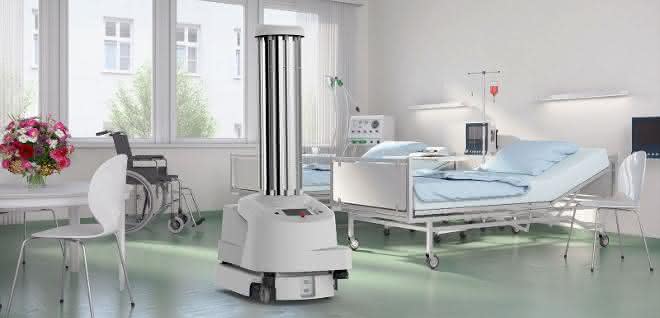
Robots are playing a key role in the global fight against the SARS CoV-2 coronavirus, especially in surface disinfection, for example in hospitals. According to a statement from the International Federation of Robotics, demand for the UVD disinfection robot from Danish manufacturer Blue Ocean Robotics has risen sharply since the outbreak of the virus. Chinese hospitals alone have ordered more than 2,000 of these robots. They were used in Wuhan. However, the robots are currently being used in more than 40 countries.
Increase in demand for disinfection robots
The UVD disinfection robots use ultraviolet light (UV-C) to kill pathogens. The robot has been honored with the IERA Award, an innovation prize awarded jointly by the IEEE and the International Federation of Robotics (IFR). "With our robots, we are helping to solve one of the biggest problems of our time: curbing the spread of viruses and bacteria and thus saving lives," says Claus Risager, CEO of Blue Ocean Robotics. "Demand for the UVD has skyrocketed with the outbreak of Covid-19 infections. Our existing customers are buying significantly more devices than before the crisis, but many new customers are also ordering UVD robots to combat coronaviruses and other harmful microorganisms."
Blue Ocean Robotics has recorded annual sales growth of more than 400 percent in the last two years. The Danish robot moves autonomously through operating theaters and patient rooms and irradiates all critical surfaces with the optimal amount of UV-C light to kill viruses and bacteria. The more intensively the robot irradiates a surface, the more harmful microorganisms are destroyed. 99.99 percent of all viruses and bacteria in a typical patient room are killed within 10 minutes.
Can also be used in offices and schools
However, the robots' areas of application are not limited to hospitals, but also extend to airports, schools and offices: "The UVD robot supports the cleaning staff in their work," explains Risager. For safety reasons, the devices work independently in the rooms and automatically switch off the UVC light as soon as someone enters the room. "The potential of robots to support us during the current severe coronavirus pandemic is enormous," says Dr. Susanne Bieller, Secretary General of the IFR. "They support us in healthcare, but also in the development, testing and production of medicines, vaccines and other medical devices and aids. Disinfection tasks - such as those carried out by the UVD robot - or the safe distribution of hospital materials in quarantine zones without human contact - which the mobile robot Phollower from Photoneo performs, are just two of many examples."
The Phollower robot was developed under the working title Pathfinder. As a new-generation autonomous mobile robot, it is suitable for transporting and moving materials in warehouses, hospitals, hotels and factories. For example, it helps hospital staff to distribute medicines, linen and other materials to the respective workstations. It can carry a maximum of 100 kg and pull a maximum of 350 kg. It saves time and no adjustments to the premises are necessary; the robot can move anywhere, even over elevators, without difficulty.
Medical robots are already a well-established service robot market in their own right with considerable growth potential. Sales of medical robots rose by 50% to 5,100 units in 2018. This is according to the World Robotics report presented by the IFR.


You might also be interested in
"We are clearly different from the competition"
The IT company 21unity offers a range of hardware and software services, as well as traditional services. Andreas Mühlbauer spoke to Managing Director Anja I. Gondolf about the company's appearance at the Hannover Messe, its services and future...
 read more...
Think digital, act local
When it comes to industrial damping technology, on-site advice is often very valuable for engineers and designers.
read more...Plagiarius 2024 negative prize
On January 26, 2024, the Plagiarius campaign awarded its dreaded "Plagiarius" negative prize for the 48th time to manufacturers and retailers of particularly brazen counterfeits and fakes.
read more...Spindel Full Service records second-best...
Maintenance as an economic success factor
Spindel Full Service, the spindle repair specialist from Baden-Württemberg, can look back on its second-best financial year in its history - with 15% growth compared to the previous year. And the further forecast also looks good.
read more...Thyssenkrupp and Novelis cooperate
Platform for the circular economy
With a platform for the circular economy in the automotive industry, the two companies Thyssenkrupp Materials Services and Novelis want to set new standards for the recycling of used materials. The open platform will enable access to larger...
read more...How production can benefit from AI
Together with AI technology, IIoT networking makes it possible to better control machine parameters and optimize quality with predictive quality. Downtimes and set-up times can also be further minimized. Cloud platforms also make these technologies...
read more...Marco Ghirardello takes the lead
Fanuc has appointed Marco Ghirardello (48) as the new President and CEO of Fanuc Europe. Ghirardello succeeds Shinichi Tanzawa, who has led the company since 2016 and will take on a new role at Fanuc's headquarters in Japan.
read more...Efficient robot monitoring
Microchips are installed almost everywhere - whether in smartphones, washing machines or cars. With increasing digitalization, the demand for semiconductors has been growing rapidly in all areas of the economy for years.
read more...Everything on one platform
Functional and powerful tools are essential for professional work on the construction site, in the workshop or when carrying out repairs.
read more...