

Vision systems for robots
Making service robots more intelligent
In the future, robots will be used as helpers in companies and households. To do this, however, they must be able to perceive and interpret their surroundings. Researchers at the University of Bayreuth have found a solution to this problem.
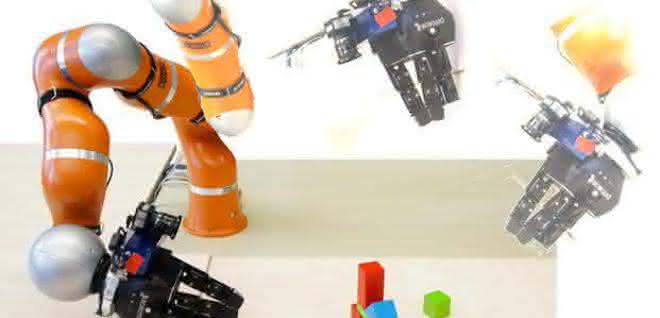
In order to be of use to humans, service robots must have a certain level of intelligence. They must be able to identify objects clearly and relate different spatial views to each other. This is exactly what researchers at the University of Bayreuth have developed a system for in the "SeLaVi" project.
Robots learn to see
"SeLaVi" stands for "Semantic and Local Computer Vision based on Color/Depth Cameras in Robotics". The project is led by Prof. Dr. Dominik Henrich at the Chair of Robotics and Embedded Systems. The aim is to enable robots to recognize what is happening in their environment on the basis of a few characteristic images. Cameras, which are attached to the arms of the robots like eyes, play a central role in this. The cameras generate images of the objects in their working environment, which are translated into geometric models. These models are characterized by the fact that they only depict a few representative surface areas of the objects. They are therefore called boundary representations (BReps) and require less memory and computing capacity than the point clouds or triangular meshes that have been commonly used for object recognition up to now. The new models are merged with additional color information contained in the camera images and stored in a database. By comparing new camera images with the database, the robots can recognize objects in their environment without errors. They are not disturbed by movements of neighboring objects.
This ability of the robots forms the basis for further learning steps, which concern the meaningful relationships between the static or moving objects in their working environment. Robots should learn to understand these "semantic relations" so that they can then use their arms to intervene in the respective scenarios in an appropriate manner. All of these capabilities, as they are currently being developed and optimized in Bayreuth, can be used in many areas - from autonomous service robots to cooperation between humans and robots.
According to documents from the University of Bayreuth / ag


You might also be interested in
Basler acquires 76% of Indian image processor
Basler, supplier of image processing components for computer vision solutions, has acquired 76% of the Indian sales partner Alpha TechSys Automation.
 read more...
Process monitoring and fault detection
Cameras ensure quality during laser melting
Powder bed-based laser melting (PBF-LB/M) opens up new possibilities in additive manufacturing. Modern camera systems provide crucial process data to further increase quality and efficiency.
read more...Vision Sensor is three times faster than its predecessor
The 'CS-62' vision sensor from di-soric is around three times faster than its predecessor, the 'CS-60'. In combination with the 'nVision-i 25.1' software, it enables image processing solutions that were previously reserved for smart cameras.
read more...Thermal imaging cameras for quality control
Automated thermal imaging cameras are often suitable for quality control applications where temperature plays a role. However, while there are various solutions on the market for slow processes, it is challenging to select a camera that reliably...
read more...Easy entry into industrial VGA thermography
Reliable temperature measurement is a prerequisite for the success of many industrial processes. Berlin-based manufacturer Optris presents the Xi 640 infrared camera, a new member of its Compact Line, which enables non-contact temperature...
read more...Powder bed-based laser melting optimized
Aconity3D has set itself the goal of optimizing the stability of the manufacturing method of powder bed-based laser melting and thereby promoting its use in a wide range of industries. By using high-speed industrial cameras from SVS-Vistek, the...
read more...INDUSTRIAL Production Products of the year...
2nd place, category handling, assembly and production logistics: SICK
safeVisionary2 is the first 3D time-of-flight camera with Performance Level c safety certification. It enables safe three-dimensional environmental detection and won 2nd place in the competition for Product of the Year 2024 in the handling, assembly...
read more...Nomination Products of the Year 2024
SICK: Camera systems safeVisionary2
safeVisionary2 is the first 3D time-of-flight camera with Performance Level c safety certification. It enables safe three-dimensional environmental detection and has been nominated in the 2024 Product of the Year competition in the handling,...
read more...AI vision brings additional opportunities
The seamless integration of AI into the consumer sector has helped to improve our quality of life and make interactions with technology more efficient. In industry, AI vision with machine learning opens up new possibilities that are not covered by...
read more...